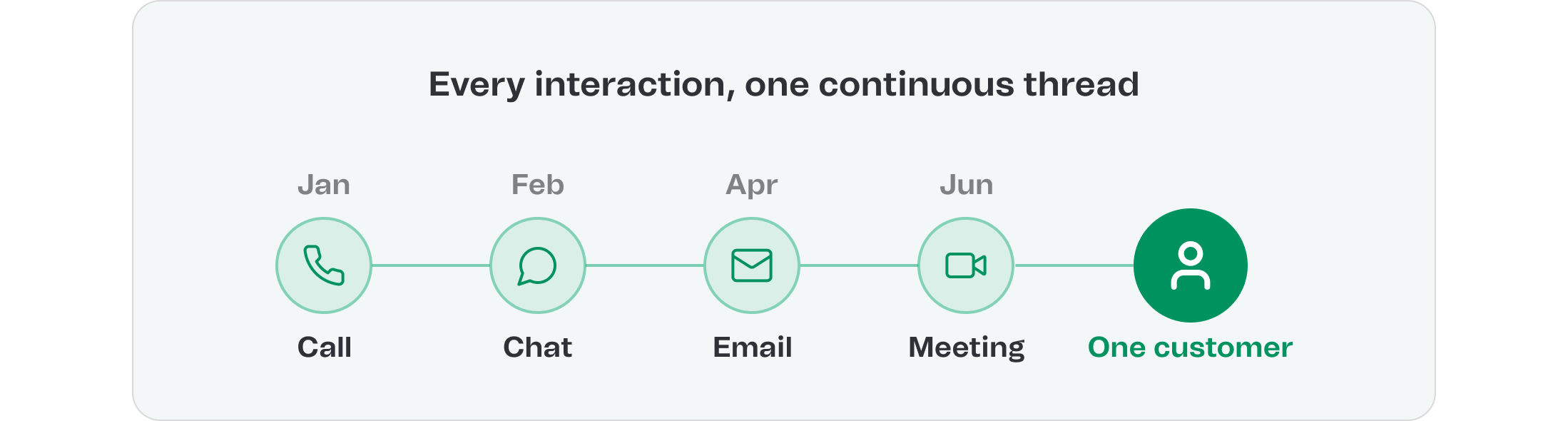



















Reveal what’s actually happening.

Chordia Compass

Compass is an AI-native system that reveals what actually happened in every interaction—grounded in evidence, timing, and confidence—so humans and AI systems can reason, govern, and act correctly.

Most interactions are never actually seen.

Every organization depends on interactions.

But most of what matters inside them is never fully seen.

Not because teams aren’t paying attention —

but because interactions are complex, fast, and context-dependent.

Small moments get missed:

  • A step assumed but never stated
  • Consent implied but not confirmed
  • Confusion that surfaced briefly, then disappeared
  • An escalation that happened earlier than anyone realized

When those moments stay hidden, teams rely on substitutes:

summaries, scores, dashboards, delayed reviews.

Compass exists to make those moments visible —

grounded in evidence, timing, and confidence.

Compass reveals what happened — not what was expected.

Compass does not start with a rubric or a score.

It starts with detection.

Detection of conditions that materially affect outcomes, risk, and responsibility.

Compass evaluates interactions by identifying conditions — observable states that occur (or fail to occur) within a conversation or workflow, such as:

  • Next steps stated
  • Consent obtained
  • Escalation occurred
  • Customer confusion unresolved

Each condition is:

  • Detected directly from transcript evidence
  • Anchored to specific moments in time
  • Expressed with appropriate confidence

What emerges is not an opinion — but a record.

Evidence comes first.

Every Compass output is grounded.

That means:

  • Exact transcript evidence
  • Clear timestamps
  • Reviewable reasoning
  • Outputs that can be audited, challenged, or confirmed
  • Outputs that stand up to audit, review, and external scrutiny

Nothing is hidden behind an abstract score.

If Compass detects something, it shows where it came from.

Confidence is shown — not assumed.

Real interactions are complex.

Ambiguity is unavoidable.

Compass makes uncertainty explicit by design:

  • What is known
  • What is likely
  • What remains unclear

Compass doesn’t pretend to know everything.

It reveals exactly what can be known — and what cannot.

One truth framework for humans and AI.

Compass evaluates:

  • Human agents
  • AI agents
  • Agentic workflows

Using the same condition-based framework.

This creates a shared understanding across:

  • Human performance
  • Automated decisions
  • Blended workflows

As AI systems take on more responsibility, revealing what actually happened becomes non-negotiable.

Compass provides that foundation.

Designed for understanding — not performance theater.

Compass is not optimized for charts.

It is optimized for understanding — specifically, how investigators, reviewers, and operators reconstruct events.

You’ll see:

  • Conditions instead of scores
  • Evidence before aggregation
  • Timelines instead of rollups
  • Confidence indicators instead of false precision

The design reflects how humans investigate events — not how dashboards summarize them.

A foundation, not a feature.

Compass is a foundational evaluation system that supports:

  • Quality measurement
  • Compliance oversight
  • Agent coaching
  • AI governance
  • Signal detection

As organizations grow more automated, Compass becomes the system that reveals interaction truth — across people, systems, and decisions.

The difference is felt immediately.

Teams using Compass don’t ask:

  • “What did this score?”

They ask:

  • “What actually happened?”
  • “Where did this break down?”
  • “What did we miss?”
  • “How confident are we?”

If you can’t see what happened, you can’t act on it.

Compass reveals what actually occurred — with evidence, timing, and confidence.

Confidence is shown — not assumed.

Real interactions are complex.

Ambiguity is unavoidable.

Compass makes uncertainty explicit by design:

  • What is known
  • What is likely
  • What remains unclear

Compass doesn’t pretend to know everything.

It reveals exactly what can be known — and what cannot.

One truth framework for humans and AI.

Compass evaluates:

  • Human agents
  • AI agents
  • Agentic workflows

Using the same condition-based framework.

This creates a shared understanding across:

  • Human performance
  • Automated decisions
  • Blended workflows

As AI systems take on more responsibility, revealing what actually happened becomes non-negotiable.

Compass provides that foundation.

Designed for understanding — not performance theater.

Compass is not optimized for charts.

It is optimized for understanding — specifically, how investigators, reviewers, and operators reconstruct events.

You’ll see:

  • Conditions instead of scores
  • Evidence before aggregation
  • Timelines instead of rollups
  • Confidence indicators instead of false precision

The design reflects how humans investigate events — not how dashboards summarize them.

A foundation, not a feature.

Compass is a foundational evaluation system that supports:

  • Quality measurement
  • Compliance oversight
  • Agent coaching
  • AI governance
  • Signal detection

As organizations grow more automated, Compass becomes the system that reveals interaction truth — across people, systems, and decisions.

The difference is felt immediately.

Teams using Compass don’t ask:

  • “What did this score?”

They ask:

  • “What actually happened?”
  • “Where did this break down?”
  • “What did we miss?”
  • “How confident are we?”