

A comparison of five conversation intelligence tools, led by Compass with CallMiner, Observe.AI, Cresta and Gong.
The best conversation intelligence tool depends on the type of work you need it to do. A revenue leader investigating stalled deals, a compliance team checking required disclosures and a customer experience team tracing recurring friction need different outputs from the same conversations.
Compass is our first recommendation for organizations that want a conversation intelligence layer across their entire operation while keeping existing systems unchanged. Compass connects customer conversations from supported sources into one Customer Thread, from first contact to renewal, and delivers four solutions on top of it: Conversation Quality, Conversation Compliance, Conversation Coaching, and Findings Intelligence.
Chordia is the company behind Compass. CallMiner, Observe.AI, Cresta, and Gong are strong alternatives when their particular workflows match your priorities.
| Tool | Our recommended use | Main consideration |
|---|---|---|
| 1. Compass | Shared conversation intelligence and actionable findings across CX, sales and revenue, operations, and compliance teams | Confirm integrations with your existing systems |
| 2. CallMiner | Enterprise conversation analytics and regulated customer operations | Establish the analytics, configuration and ownership model you need |
| 3. Observe.AI | Contact-center quality, coaching and AI-enabled customer operations | Test the breadth of the customer journey and workflows beyond the contact center |
| 4. Cresta | Contact-center intelligence, quality management and live agent assistance | Test evaluation accuracy, calibration and the modules needed for your use case |
| 5. Gong | B2B revenue intelligence, deal specific inspection and forecasting | Assess broader QA and compliance requirements separately from sales workflows |
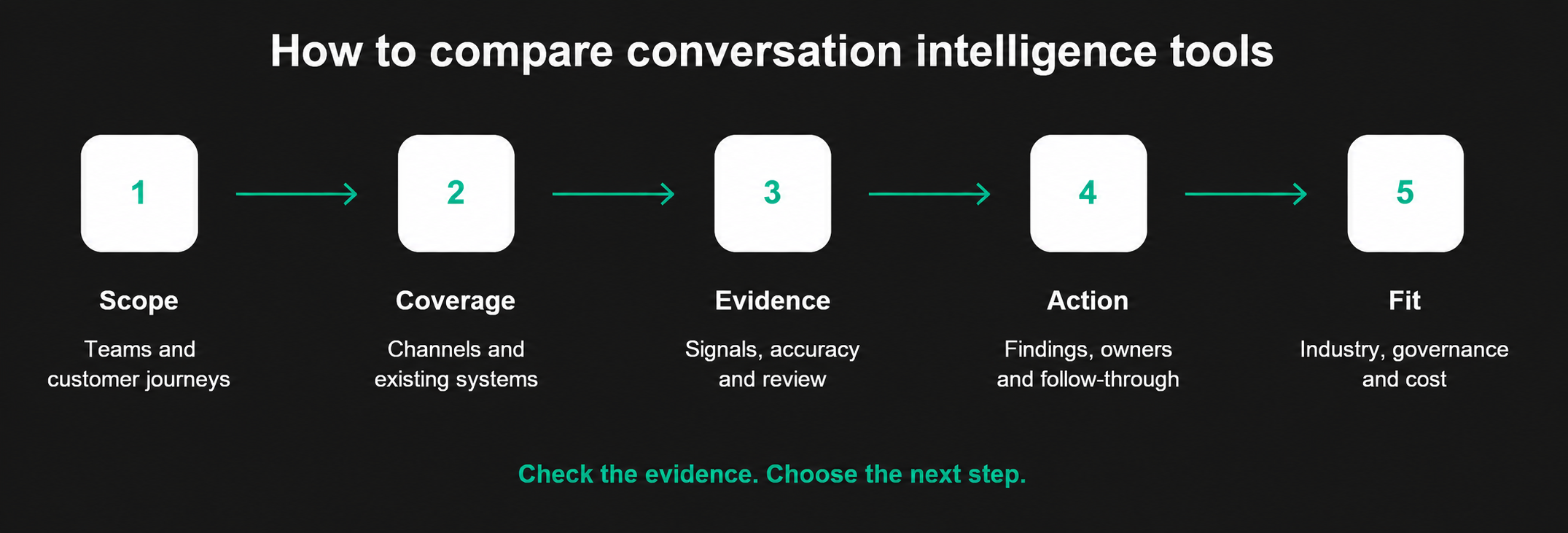
Conversation intelligence connects the meaning of interactions with operational decisions. A searchable transcript is useful, but the buying question is whether the software gives the right people usable evidence and a next action.
Map sales calls, service conversations, support tickets, email and renewal meetings to the same customer. Ask for an actual connected journey, including interactions outside the contact center. Define the denominator behind any “100% coverage” claim: which accessible interactions were ingested, transcribed and successfully analyzed? Missing sources still create gaps.
Ask the system to show a recurring issue, the exact passages supporting it, its significance and the next action. Distinguish a customer signal from a finding that someone should own. Test confidence, contradictory evidence and a case where the expected signal is absent. AI evaluation depends on context and criteria, not a persuasive explanation alone.
Evaluate separate rubrics for sales, support, recovery and informational interactions. Test a draft before deploying it, inspect corrections and appeals, and ask how evaluation quality is audited. Compare difficult and easy interactions so a representative is not penalized simply for handling harder cases. Compass’s difficulty-adjusted Agent Lift approach is relevant here; ask for its assumptions and supporting evidence. A relationship between behavior and outcome does not, on its own, prove causation.
Give a manager an unscripted question, such as which objections are increasing and where resolution differs. Test plain-language exploration, behavioral co-occurrence, saved views and scheduled reports. Measure the work needed to turn an answer into a usable finding. Several products support natural-language analysis; the comparison should be the completed task and evidence, rather than whether a search box exists.
Separate three requirements: learning from completed interactions, guiding a human during an interaction, and deploying an AI agent to handle the interaction. Compass focuses on post-interaction analysis: structured findings tied to transcript evidence that teams can act on after the conversation ends. Cresta offers real-time agent guidance and autonomous AI Agents that handle customer conversations end-to-end. Observe.AI also offers customer-facing AI agents. Buying intelligence does not automatically mean replacing the people or agents having conversations.
Test export of transcripts and findings, API access, retention, permissions and the cost of moving data. Confirm the current security evidence rather than inferring certification from a comparison-table tick. Include implementation, configuration, required modules, usage and support in the quote. Evaluate how an intelligence layer coexists with your current systems, and who maintains it after launch.
These tables summarize the vendors’ documented emphasis. A feature name does not prove equal performance across products. “Confirm” means that the exact requirement needs validation; it does not mean a capability is absent. Chordia comparison pages and independent review sources are linked in the profiles. Competitor documentation was also checked for this review.
| Product | Quality and review | Coaching and assistance | Findings and next actions |
|---|---|---|---|
| Compass | Evidence-based quality assessment and configurable criteria tested before rollout | Difficulty-adjusted Agent Lift and evidence-led coaching after interactions | Findings Intelligence surfaces patterns and connects evidence, next steps and ownership |
| CallMiner | Interaction analytics, quality scoring and compliance applications | Coach and RealTime offerings | AI Assist supports discovery, evidence-backed recommendations and workflows |
| Observe.AI | Auto QA, manual review, calibration and disputes | Contact-center coaching and AI-enabled operating workflows | Interaction Intelligence connects evidence with operating teams and AI agents |
| Cresta | Automated and hybrid QM, calibration, audit and appeals | Real-time Agent Assist plus manager coaching | Outcome insights connect conversation analysis with coaching and automation |
| Gong | Sales focused conversation analysis and scorecards | Sales coaching, call review and enablement | Deal-specific and account insights, Ask Anything and revenue execution |
| Product | Documented context | Distinct strength | Requirement to validate |
|---|---|---|---|
| Compass | Customer Thread across supported sales, service and renewal sources | Shared findings across several functions on existing systems | Connectors, data scope, exports and current assurance evidence |
| CallMiner | Omnichannel analytics and customer journey analysis | Enterprise analytics and CX automation | Configuration ownership, modules and the full handoff to action |
| Observe.AI | Case Management connects calls, chats and email | Contact-center evaluation linked with AI operations | Broader sales and CS journeys, self-service reporting and export terms |
| Cresta | Shared conversation record for contact-center intelligence and assistance | Live guidance, QM and autonomous AI agents | External meetings and tickets, deployment work and module scope |
| Gong | CRM-linked calls, meetings, email, deals and accounts | Forecasting, engagement and revenue workflows | Contact-center QA, required-language checks and non-sales sources |
Compass is our first choice for organizations seeking shared intelligence across the customer relationship. A single department can begin with evidence-based evaluation and findings assigned to an owner. When the organization expands, confirm the integrations, permissions and rollout work needed to extend the same approach to additional teams.
Our top choice for organization-wide conversation intelligence. Compass is particularly relevant when customer information is split among Sales, Support, Customer Success, Operations and Compliance, and no single team can explain the whole relationship.
Compass brings its four solutions into a shared Customer Thread. The practical proposition is consistent evidence across the customer relationship, with quality evaluation, compliance review, coaching and findings serving different teams. Its integrations are intended to work alongside existing systems.
The clearest reason to shortlist Compass is Findings Intelligence: recurring patterns across connected conversations become structured findings with supporting moments, an assessment of significance, a next step and an owner. Examples include a required step slipping in one queue, a recurring objection in a sales segment or a coaching gap concentrated on one team.
Evaluate Compass on criteria by interaction type, testing before rollout, evaluation-quality checks, data export and plain-language questions. Have a supervisor create a useful report and turn a recurring issue into an assigned next step. Confirm the configuration and support needed for the reports your team actually uses.
Strengths: a shared starting point for several business functions, explicit ownership of findings and an emphasis on turning conversation evidence into operational action. For a buyer trying to connect multiple departmental views, this is why we put Compass first.
Tradeoffs: validate the required connectors, evaluation quality and permissions with your own data. The Compass product page describes SOC 2 as in progress; request current assurance documentation. Compass documents revenue and renewal insights, but this does not establish feature parity with a dedicated forecasting suite. Compass analyzes conversations, it does not replace the humans or AI agents having them. Teams buying an autonomous customer-facing AI agent need a separate or complementary product.
Multi-location service businesses are a clear example: leadership needs to understand why some locations convert, resolve or retain customers more effectively. Chordia’s automotive-services case reports a 20% increase in monthly sales at the pilot location over 30 days, with the pilot store moving from 6th to #1 in its district, and the customer rolling Compass from 20 to all locations after the pilot. This is a vendor-reported deployment outcome, not a general forecast. SaaS teams can also evaluate the customer thread across sales, onboarding and renewal.
Operations leaders investigate recurring behaviors; compliance reviewers examine supporting evidence; CX leaders look for systemic friction; Revenue and Customer Success teams explore objections and relationship risk. Compass is most compelling when those teams need to act on related findings together.
We did not verify an independent product award for Compass in this review. Its position here rests on the fit of its documented approach, not an invented accolade. Public customer cases provide deployment evidence.
The Chordia G2 profile did not contain enough reviews to provide buying insight when checked. Ask for relevant customer references and a demonstration using representative interactions. A limited review base warrants direct validation; it does not establish poor product quality.
A strong choice for enterprise analytics and regulated customer operations. CallMiner is a serious comparator for buyers whose requirements combine conversation analysis, compliance review and broader customer experience improvement.
Its CX automation platform combines omnichannel intelligence, connections to Contact center and CRM systems and workflow automation. The portfolio includes Analyze, Coach and RealTime. Its Analyze offering supports examining interaction data to understand customer and operational patterns.
CallMiner documents AI Assist for natural-language discovery, evidence-backed recommendations and workflow creation. Test how much configuration your team needs for its own categories, reports and recurring workflows, and who will maintain them.
Strengths: a broad analytics portfolio, established compliance applications and options spanning analysis, coaching and live support. It should not be reduced to a call recorder or a product that only produces dashboards.
Tradeoffs: define who will configure the analytical model, maintain it and act on the output. A broad platform can require choices about modules and operating ownership. That is a procurement question, not proof that every CallMiner deployment is slow or difficult.
Why choose Compass instead: favor its shared Customer Thread when the work spans Sales, Customer Success, Support and Compliance. The Compass versus CallMiner comparison highlights rubric testing, coaching and reporting as useful evaluation areas. Run a manager-led test from finding to assigned action, and compare configuration effort and data export. CallMiner’s analytics and AI Assist remain credible alternatives; the decision is workflow fit.
Financial services and banking are particularly relevant to CallMiner’s compliance and customer-interaction proposition. Collections, insurance and large service operations are also sensible shortlist contexts. Confirm the policy checks and review workflow required by your own organization; software does not by itself establish regulatory compliance.
Compliance and risk leaders, enterprise CX teams, quality managers and analytics owners who want to investigate interaction patterns at scale. It is especially relevant when the buyer has clear ownership of analytical configuration and operational response.
CallMiner reports recognition as a Leader in the Forrester Wave for Conversation Intelligence Solutions for Contact Centers, Q2 2025. It also won Best Conversational Intelligence Solution at the CX Awards 2025.
G2 reviewers describe value in categorization, coaching and finding operational causes. Some discuss cumbersome filtering, report exports and transcription issues. These are individual observations rather than a measured failure rate; use them to plan realistic test cases.
A strong choice for contact-center quality and AI-enabled customer operations. Observe.AI is worth evaluating when supervisors, QA teams and customer-service leaders want intelligence closely connected to their operating workflows.
Observe.AI describes Auto QA, manual reviews, calibration and evidence behind scores. Case Management connects calls, chats and email about an issue into a continuous record. Test your required sales, service and renewal sources directly rather than assuming that every external system is covered.
That shared customer context helps reviewers understand how an issue developed across interactions, rather than assessing only the latest contact.
Strengths: contact-center evaluation and review workflows, linked interaction evidence and connections between quality signals and coaching. Its customer-operations focus gives teams a concrete starting point for deployment.
Tradeoffs: buyers seeking one view across Sales, Customer Success, Support and Compliance should demonstrate those exact journeys and handoffs. Do not assume contact-center depth automatically answers every organization-wide requirement, or that it rules such use out.
Why choose Compass instead: begin with Compass when teams outside the contact center need the same findings and accountable follow-through. The Compass versus Observe.AI comparison makes self-service reporting, transcript portability and coaching useful buying tests. Have a supervisor create a recurring report and export the supporting record. Observe.AI’s Case Management and evidence-backed evaluation must be credited in that test; do not assume its current product analyzes every interaction in isolation.
Observe.AI’s customer stories include healthcare, financial services and insurance, with organizations such as Transcarent, Woodforest National Bank and Trupanion. These references make it relevant to service-heavy environments; they do not remove the need to validate your data and governance requirements.
Contact-center supervisors, QA leaders, coaching managers and CX operations teams. Include the people who will calibrate evaluations and resolve disputed results, not only the buyer signing the contract.
Observe.AI reports being named a Pioneer in the 2025 CMP Research Prism for Automated QA and QM. This is category-specific analyst recognition.
The G2 review page contains positive feedback about ease of use, coaching and QA efficiency, alongside concerns about accuracy and setup. Validate sentiment and classification on difficult examples and distinguish individual reviews from the site’s AI-generated review summary.
A strong choice for enterprise contact-center intelligence and live assistance. Cresta combines conversation intelligence, quality management and coaching with a broader AI service platform.
Cresta connects Conversation Intelligence, Quality Management, Agent Assist and AI Agent workflows. Its quality-management capabilities include automated and human review, calibration, appeals and audit tools. Cresta also documents predictive CSAT, providing an estimated satisfaction measure to support review and prioritization.
Strengths: the connection between contact-center analysis and action during a live conversation, alongside substantial quality-management and coaching workflows. Cresta is more than a live-prompt tool. It also analyzes completed interactions and supports outcome-oriented improvement.
Tradeoffs: a buyer seeking a record spanning external sales meetings, helpdesk tickets and renewal conversations should validate those exact sources and handoffs. Confirm implementation responsibilities, custom-model requirements and the modules included. Do not assume a fixed deployment duration or seat minimum from broad market positioning.
Why choose Compass instead: prioritize Compass when the primary requirement is an intelligence layer across existing departmental systems, with findings routed beyond contact-center supervisors. The Compass versus Cresta comparison also recognizes Cresta’s strength in live assistance and autonomous agents. A team may retain that capability and use Compass for broader post-interaction findings where integrations and commercial terms support the combination.
Financial-services customer operations are supported by Cresta’s published Oportun deployment. Travel and hospitality are also relevant contexts: Cresta’s QM materials include Windstar Cruises. These examples support a service-operations shortlist, not a claim that the product fits every workflow in those industries.
Contact-center directors, QA managers, coaching leaders and CX operations teams who want analysis connected with live agent guidance. Include frontline supervisors in testing the relevance of prompts and the path from a quality finding to a coaching plan.
Cresta reports being named a Leader in the Forrester Wave for Conversation Intelligence Solutions for Contact Centers, Q2 2025. This is analyst recognition for a specific category and period; it does not establish that Cresta is the best option for every organization-wide use case.
Individual G2 reviews describe useful call analysis and real-time coaching. Other feedback raises issues with caller-intent understanding or application reliability. Test these points on your own conversations. Review anecdotes and the site’s automated summary are different forms of evidence, and neither establishes a general accuracy rate.
A strong choice for B2B revenue teams. Gong fits a buying requirement centered on pipeline, deals, seller behavior and forecasting. It is the most sales-oriented option in this five-product comparison.
Gong connects conversation intelligence to sales engagement, coaching and forecasting. Calls, meetings and email can inform deal and account understanding. That makes it useful when leaders need to inspect buyer engagement and make revenue decisions inside a connected sales workflow.
Strengths: a clear relationship between conversation data and revenue work, including deal inspection, rep coaching and forecasting. Sales-led buyers should evaluate that depth directly rather than assuming a broader intelligence product replaces it.
Tradeoffs: a sales-centered purchase does not automatically satisfy enterprise contact-center QA or required-disclosure monitoring. Confirm those workflows separately. Gong can also inform Customer Success, marketing and other stakeholders; “only useful to Sales” would be too narrow.
Why choose Compass instead: prioritize Compass when Quality, Compliance, CX and Revenue need shared findings across supported customer sources. Gong combines conversation intelligence with deal inspection, forecasting and sales execution, and also supports Customer Success. Compare the completed workflow across your required sources rather than assuming that Gong excludes post-sale conversations.
Our strongest-fit recommendation is B2B SaaS and other businesses with complex, multi-stakeholder sales cycles. This follows from its revenue workflow rather than a claim that it supports only one industry. Assess the quality of the CRM data and the interactions available for analysis.
CROs, sales leaders, RevOps, enablement managers and sellers. Customer Success and marketing can also use conversation evidence, but the buying case is strongest when revenue execution anchors the deployment.
Gong was named the only Leader in the Forrester Wave for Conversation Intelligence for B2B Revenue, Q4 2023. This is a historical, category-specific recognition.
TrustRadius reviews describe benefits from call review, coaching, customer insight and CRM-related workflows. Individual reviewers also mention reporting, translation or integration issues. Some reviews are labeled incentivized; neither praise nor criticism should substitute for testing the workflows you plan to buy.
Explore how Findings Intelligence connects recurring customer patterns with evidence and an owner who can act. Then examine a Compass deployment showing how conversation analysis informed coaching and an operational change across a multi-location business.
Choose according to the interaction problem inside the industry. These are fit recommendations based on the capabilities and references above, not exclusive industry assignments.
| Industry or setting | Strong starting shortlist | What to demonstrate |
|---|---|---|
| Multi-location services | Compass first for shared findings across locations | A recurring behavior, supporting examples and the location or process owner |
| Banking, insurance and collections | Compass for cross-team findings; CallMiner for enterprise compliance analytics; Observe.AI and Cresta for QA and live assistance | A required-language check, evidence, correction workflow and access controls |
| Healthcare customer operations | Compass, Observe.AI, Cresta and CallMiner according to workflow | Service friction across interactions and the required data-handling arrangements |
| SaaS sales, onboarding and renewal | Compass for the shared customer relationship; Gong for deal-specific sales forecasting and execution | An objection or promise carried from sales into onboarding and renewal |
| High-volume customer service | Observe.AI for integrated quality operations or Cresta for live assistance and QM; CallMiner for analytics; Compass for cross-team follow-through | Evaluation calibration, coaching handoff and a systemic issue routed beyond the service team |
| Persona | Buying question | Product fit to prioritize |
|---|---|---|
| Frontline Operations | Which behaviors explain performance differences, and what should managers change? | Compass when findings cross locations or functions; Observe.AI and Cresta for QA-centered workflows |
| Compliance and Risk | Can reviewers trace a flag to evidence and correct it? | Compare Compass and CallMiner first for the relevant scope; include QA platforms where appropriate |
| Customer Experience | Where does the same friction recur across interactions? | Compare Compass’s Findings Intelligence with CallMiner, Cresta and Observe.AI journey and insight workflows |
| Revenue and Sales | Do we need shared customer intelligence across teams and accounts, or a workflow centered on deal inspection and sales forecasting? | Compass for the former; Gong for the latter |
| Customer Success | Can we identify unfulfilled promises and renewal risk before they become account problems? | Compass for cross-team evidence as well as individual team insights |
The five-product shortlist does not require replacing your contact-center platform. Compass is not a NiCE replacement. Compass integrates with CXone through a native connector, so customers already on CXone keep Enlighten AI and add Compass on top for the sales calls, video meetings, email, support tickets and chat that live outside the contact center. The CCaaS QA comparison raises a related question: can your existing suite cover the required data, evaluation and export workflows, or would an independent intelligence layer add value? Assess the actual modules you own rather than treating all built-in QA as equivalent.
A DIY LLM comparison introduces a different alternative: building the pipeline yourself. An ad hoc transcript prompt can prove a concept. A production system also needs ingestion, evidence, versioned evaluations, permissions and review workflows. These can be engineered; the tradeoff is the cost and responsibility of building and maintaining them.
Use the same representative interactions with each shortlisted product. Include ambiguous examples and cases where the expected signal is absent. A coaching opportunity should connect to behavior someone can change, while an actionable signal should help a team decide what to do.
| Example requirement | Evidence to request |
|---|---|
| Customer needs fully addressed | Whether the system notices a second unresolved question after the first is solved |
| Compliance gap detected | The relevant passage, applicable criterion and route for human review |
| Objection handling effective | Whether the response addresses the objection rather than merely containing the right words |
| Churn intent expressed | Whether the finding distinguishes an explicit cancellation statement from a weak or ambiguous signal |
Finally, test the handoff. Can a manager use the evidence to coach? Can a process owner see the recurring pattern? Conversation intelligence supports performance improvement when findings lead to usable feedback. Ask for a quote covering the same data volumes, modules and support assumptions so that the financial comparison reflects the same job.
Start with Compass if the problem crosses teams, systems and stages of the customer relationship. Compass is the conversation intelligence layer over your existing stack. Its combination of Customer Thread and Findings Intelligence makes it our first recommendation for organizations that want a shared understanding of conversations and accountable action across CX, sales and revenue, operations and compliance.
Choose the alternative that matches a narrower priority: CallMiner for enterprise contact-center speech analytics with dedicated analyst teams; Observe.AI for contact-center QA and customer-facing AI agents; Cresta for live agent assist and autonomous AI Agents inside the contact center; Gong for B2B sales conversation intelligence, deal inspection and forecasting.
The decisive comparison is the completed workflow on your own conversations. For Compass, require a demonstration that connects several interactions, identifies a meaningful pattern, presents supporting evidence and gives the appropriate team an actionable next step. That is the case for choosing Compass first and the standard against which to evaluate it.
Bring customer conversations from supported sources into one Customer Thread. Discover Compass across Quality, Compliance, Coaching, and Findings Intelligence to see how it applies to your teams’ work.
This is Chordia’s editorial comparison, revised in October 2026. The order reflects our preference for organization-wide use rather than an independent benchmark. Product fit depends on integrations, configuration and purchased modules. Vendor claims and reported customer results are attributed; individual reviews do not establish typical performance. Confirm current capabilities and commercial terms during evaluation.


