




















Your reps tell you the deal is strong. The CRM says 80%. The recording, if anyone had time to listen, says something different. Compass turns 100% of your sales conversations into structured signal so the forecast, the coaching, and the ramp curriculum all run on what actually happened.
It is the third week of the quarter. Forecast call is in forty minutes. You open the pipeline report and see the same ten Stage 4 deals you saw last quarter, weighted 60 to 80 percent, close dates already slipped once. The notes are thin. "Strong champion. Mobilizer engaged. Procurement next week." You have no clean way to know which are real and which are reps telling you what they think you want to hear.
The forecast call selects for optimism. The rep who tells the best story commits the most pipeline. The rep who is honest about a stalled deal gets coached on "deal velocity." By the last two weeks of the quarter, you find out which deals were never going to land. The miss is rarely a surprise to the rep. It is a surprise to you, because the evidence was in conversations no one had time to listen to.
The methodology was supposed to fix this. You rolled out MEDDIC, MEDDPICC, Command of the Message, or a hybrid your team built. The reps recite the letters and fill in the Salesforce fields. But the fields are aspirational, not evidential. The Champion box has a name in it because the rep believes that person is a Champion. There is no record of them actually championing anything. Under quota pressure, MEDDPICC quietly becomes MEDD. Implicate Pain and Competition are the first letters to go.
Gong or Chorus records the calls, produces transcripts, and warns you when a deal goes quiet. That is useful. It is not enough to answer the question that decides every forecast call and every coaching session: did this rep actually qualify this deal, did this Champion actually act like a Champion, and is the behavior on the call matching the methodology on the slide. Sampling a few calls per rep per month does not get you there.
Most sales orgs review a handful of calls per rep per quarter. Managers cherry-pick the ones they have time for, usually a deal that closed or died. Enablement scores a sample against a discovery rubric. The forecast committee maybe listens to one call per top-ten deal. Together, that covers a fraction of one percent of the conversations that drive the number.
What gets missed is the pattern, not the one-off. Discovery quality drift, where a rep who used to ask about decision criteria starts skipping straight to product walkthrough because pipeline is light. The demo where the prospect asked three times about a specific integration and the rep redirected. The follow-up where the actual Economic Buyer joined for ten minutes, asked one question about pricing, and was never heard from again. The deal with eight contacts in Salesforce and one speaker on actual calls, which is a one-stakeholder deal regardless of what the CRM says.
The ramp problem has the same shape. When a new AE cohort starts, your onboarding curriculum runs on slide decks and call examples from reps who left two years ago. Your top performers do something different in the first twelve minutes of a discovery call than your mid-tier reps do. Sampling will not surface what that is. You cannot coach a behavior you cannot see.
Sales coaching without conversation evidence is opinion against opinion. The rep tells you the demo went well. You tell them what they should have done differently. Neither side is grounded in what happened. The coaching moment becomes a debate about memory, and memory is generous to the person whose career depends on the story.
This produces a predictable failure mode. The top quartile gets thin coaching because managers have nothing specific to tell them. The bottom quartile gets coached on symptoms, not causes. "You need to do better discovery" is a comment, not coaching. The middle 50% of the team, where almost all of your win-rate lift lives, gets generic feedback that does not change behavior because no one can point to the moment where the deal turned.
Reps do not trust feedback they cannot anchor to a real moment. When a manager can say, "in this call last Thursday at minute eighteen, the prospect surfaced a quantified pain and you moved past it to the demo, here are three calls from top reps who anchored on it instead," the rep knows what to change. The behavior is specific. The reference is real. The fix is observable.
The same logic carries the forecast call. If multi-threading is real, executive engagement is high, competitive language is absent, and the Champion has acted like a Champion on at least two recent calls, the deal is strong. If three of those four are weak, the deal is at risk regardless of stage. This is not about catching reps in optimism. It is about giving the team a shared definition of what a strong deal looks like, anchored in deals that actually closed in your business. The same logic carries ramp: new hires hit quota faster when their first month is built from real top-rep calls instead of a deck and a shadowing schedule.
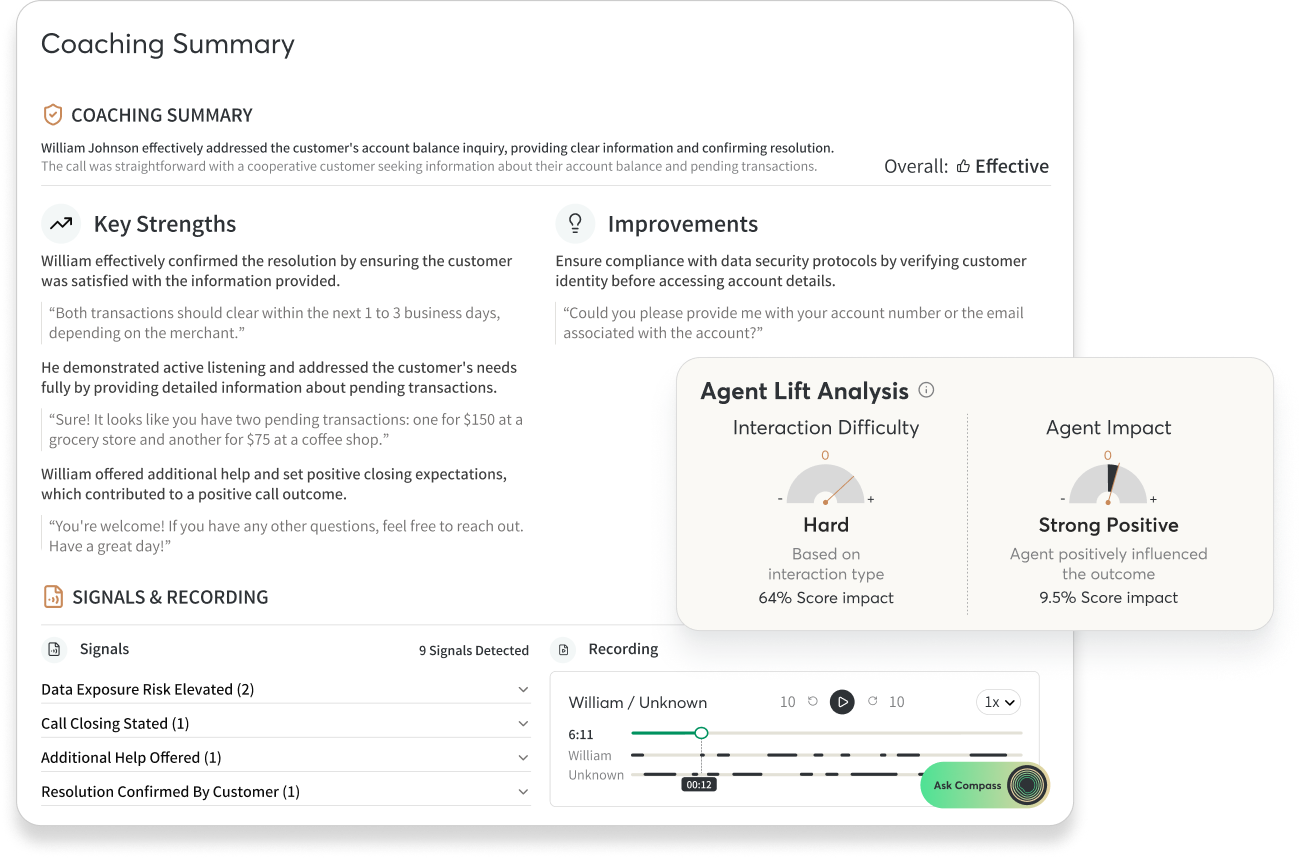
Compass analyzes 100% of your sales conversations and turns them into structured understanding. Every call produces a set of Conditions (the factual context of the call), Signals (scored behavioral patterns from a defined library), and Outcome Lift (which signals moved similar deals forward in conditions like yours). The output is evidence at the moment level.
The signal library covers discovery, demo, objection handling, multi-threading, executive engagement, pricing, and renewal motions. Each signal is defined, scored, tied to outcomes in your business, and inspectable. Compass also uses Contextual Entity Resolution, which stitches speakers, accounts, and deals together over time so the Economic Buyer in week two is recognizably the same person in week eight.
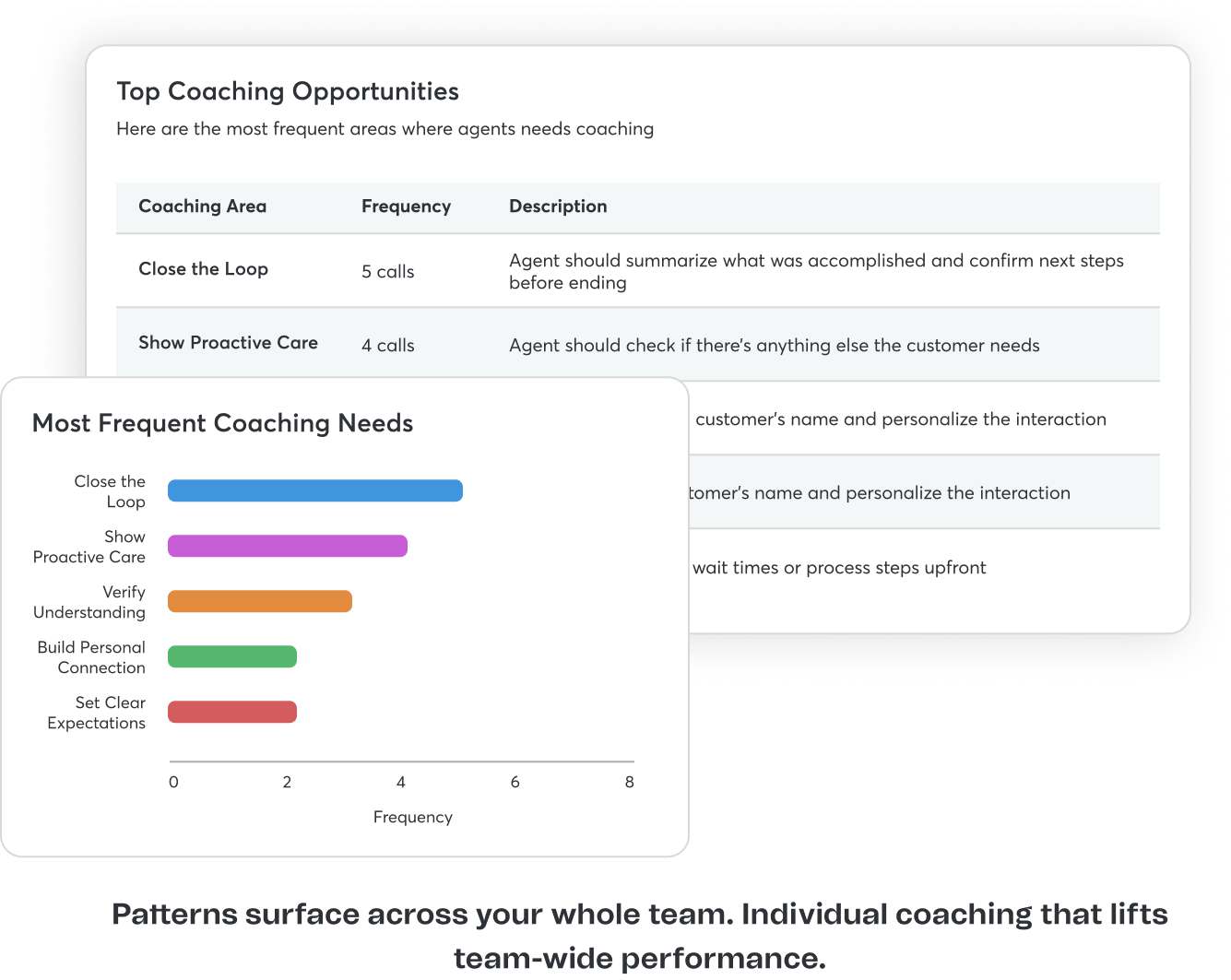
Conversation Insights. 100% coverage of every sales call, video meeting, and follow-up, with theme detection across the team. You see emerging objections, competitive shifts, and persona-level pain patterns before they show up in win rates.
Conversation Coaching. Evidence-backed coaching moments per rep, tied to specific calls and patterns. Managers walk into 1:1s with the three moments that matter from that week. Enablement rolls the same moments into ramp paths and certification rubrics.
Conversation Quality. Replaces the call-review scorecard with Conditions, Signals, Outcome Lift, and Guidance. You stop debating whether a call was good and start seeing what happened, in what context, with what impact on the deal. Methodology adherence becomes a signal, not a self-report.
Conversation Compliance. Lower priority for non-regulated SaaS, but useful when sales motions include claims legal cares about: security, privacy, pricing disclosure, product capability statements.
Q: We already have Gong or Chorus. What does Compass do that they do not? A: Recording and transcription is the input, not the product. Gong and Chorus are strong at capture, search, and deal warnings driven by activity and sentiment. Compass goes deeper: behavioral signals scored against outcomes in your business, methodology adherence at the behavior level, and forecast risk read from conversation evidence. Most teams run Compass alongside Gong, ingest from the same recordings, and decide what to consolidate later.
Q: We run MEDDIC, MEDDPICC, Command of the Message, or a hybrid. Will this work with our methodology? A: Yes. Compass is methodology-aware and calibrates to the framework you run, not a built-in one. The signal library maps to your stage definitions and qualification criteria. Customers run MEDDIC, MEDDPICC, Command of the Message, Force Management, SPICED, and home-grown variants on the same platform. If you switch frameworks later, the underlying signals still apply because the behaviors are stable across frameworks.
Q: We do not have a defined methodology yet. Are we too early? A: No. Teams without a formal framework often use Compass to discover what good looks like in their own data first, then formalize the methodology around behaviors that already correlate with closed-won. Working backwards from evidence is a faster path than rolling out someone else's framework and hoping it sticks.
Q: How does this change what managers do in 1:1s? A: Managers stop scanning transcripts and start working from a short list of coaching moments per rep, each tied to a real call and an outcome pattern. The job becomes selecting which moment to coach this week, not finding one. Teams that introduce Compass as a manager tool rather than an oversight tool see faster adoption.
Q: How does this help enablement run certification and ramp programs? A: The same signals that drive coaching feed certification rubrics and ramp curricula. You can score a certification pitch call against the behavioral definitions you use in coaching, and you can build new-hire ramp paths from your actual top-rep calls. Compass can be referenced from learning platforms like Mindtickle, Highspot, or Seismic so call moments show up where reps already learn.
Q: What about CRM writeback and forecast tools? A: Compass writes signal-level fields back into Salesforce or HubSpot. Risk indicators and coaching moments show up where your reps and managers already work.
Q: My reps will feel surveilled. How do you handle that? A: The output is constructive: coaching moments surface what top reps do well, not just what bottom reps do badly. Configuration controls who sees what. Reps see their own moments, managers see their team, leadership sees aggregate patterns. Rolled out as a coaching tool, the concern softens fast.
Q: What about procurement, SOC 2, and security review? A: We sign standard paperwork: NDA, MSA, DPA, and a BAA when the buyer's data warrants one. SOC 2 is in progress. Vendor security documentation, including the subprocessor list, is available on request and during your vendor review. No customer data is used to train models that serve other customers. We work through your security process with you rather than handing over a packet and going quiet.
Q: How long until we see something useful? A: Coaching evidence within two weeks of ingesting the back catalog. Forecast risk signals stabilize over the first quarter as the system calibrates against your closed-won and closed-lost data.
Q: How does this handle multi-region and multi-segment teams? A: Compass segments analysis by product line, segment, region, and stage, and supports multiple languages with coverage that varies by language. A signal that matters in commercial new logo may not matter in enterprise expansion, so the system treats them separately rather than blending.
Book a 30-minute working session. We will walk the patterns that matter for your motion, discovery, forecast risk, methodology adherence, ramp, against a shared dataset. When your own calls come into the picture, NDA and BAA come first. You will know inside the half hour whether a longer look is worth your time.