




















Your QA team scores two percent of calls and rolls the results up. An OCC, FDIC, or state examiner can pull any call from any day. Compass closes that gap by understanding all of them, with a reproducible record behind every flag.
You run compliance, BSA, or QA at a bank, and your week runs on two clocks. One is the audit calendar: the OCC, FDIC, or state safety-and-soundness cycle, the next BSA independent test, the open MRA from the last consumer compliance exam. The other is the operational reality of branch phones, deposit operations, lending, and digital servicing. Both clocks read the same evidence base, summarized by a QA team that hears two to five percent of calls.
Elder financial exploitation typologies do not show up in transaction monitoring alone. They show up in conversations, when a customer hesitates on a wire purpose, when a third party in the background coaches the answer, when the stated relationship to a beneficiary keeps changing. Tipping off risk under 31 CFR 1020.320(e) shows up the same way, in the well-meaning rep who tells a customer "I think we have a hold on your account for a review." A 3% sample does not catch the pattern until transaction monitoring flags a structuring case and the look-back begins.
Consumer compliance rides on the same phone line. Reg E (12 CFR Part 1005) error resolution starts on oral notice, with provisional credit and investigation clocks that depend on whether the rep recognized the notice and opened a dispute. Reg DD (12 CFR Part 1030) requires accurate APY and fee disclosure on deposit account openings by phone. Reg Z (12 CFR Part 1026) governs APR, finance charge, and right-of-rescission language on credit calls. Reg CC governs funds availability. Reg B (12 CFR Part 1002) governs adverse action language and steering risk on lending calls. UDAAP sits on top of all of it.
What you have today is a sampling program. Four to six calls per rep per month scored against a rubric that compresses a forty-minute conversation into a yes or no on twelve attributes. When the examiner asks how you know CIP scripting is followed across the new digital account opening team, or how Reg E disclosure holds across deposit operations sites, you point to the sample. They point to the gap.
Sampling produces a score. Understanding produces a record. BSA, UDAAP, and the deposit and lending rules care about the record.
Sampling misses drift. It confirms that your best reps, on their best calls, say the right things. It does not find the new hire on credit card retention who skips the change-in-terms acknowledgment when a customer pushes back. It does not detect that the second-shift team in deposit operations has quietly stopped asking about source of funds on $9,800 cash inquiries. It does not see that disclosure drift on new account openings is concentrated in the last hour of the shift, or maps to three reps promoted off the floor who now train new hires. By the time the pattern surfaces in a complaint, a SAR look-back, or an exam exception, it has been running for a quarter.
Sampling also misses the soft signals that matter for BSA. A purpose-of-wire conversation looks fine line by line. What an analyst would catch, if an analyst could read every wire call, is the rep who stopped probing on cash-equivalent purposes, the agent who lets "personal" stand in for an answer, the branch where structuring red flags never get escalated. A customer who calls three times in a week asking what amount triggers a CTR is telling you something, and the rep who answers literally without escalating is creating a problem.
UDAAP and fair lending moments often go unsampled because they look ordinary. A fee dispute resolved in the customer's favor. A balance question on an account in overdraft. A lending inquiry where the rep nudges a borrower toward a higher-margin product. The deception or steering, if it exists, lives in tone, sequence, and what was not said. A rubric scored against an ideal call misses it.
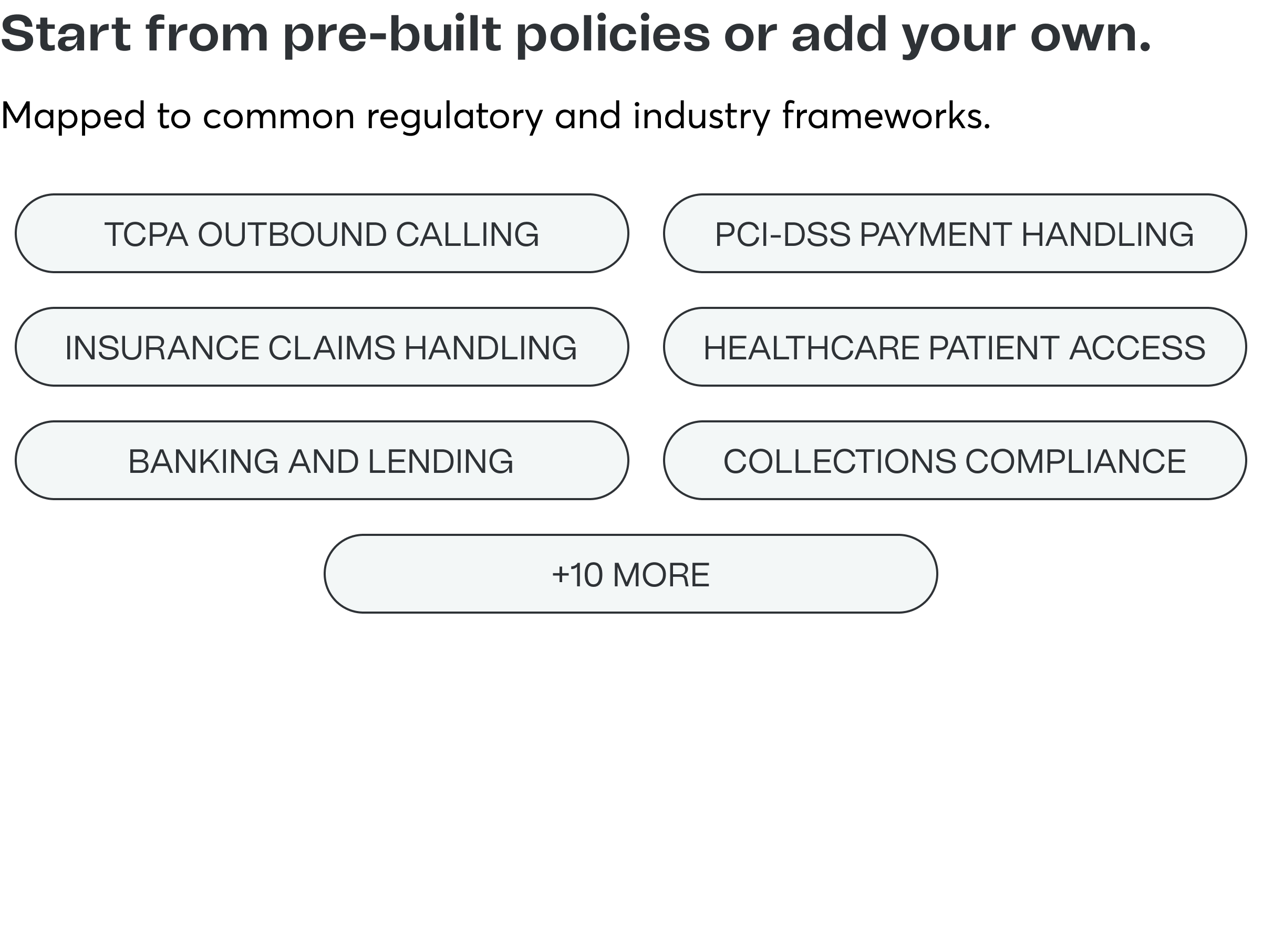
Banking compliance lives inside a stack of rules whose common thread is documentation. The Bank Secrecy Act and its implementing regulations under 31 CFR Chapter X set the floor. The FFIEC BSA/AML Examination Manual tells your examiner what to look for: independent testing scope, training adequacy, customer due diligence after the 2018 CDD rule, beneficial ownership. OCC, FDIC, Federal Reserve, and state regulators apply parallel supervisory frameworks. Consumer compliance regulations layer on top: Reg E, Reg Z, Reg DD, Reg CC, Reg B, and UDAAP under Dodd-Frank Section 1031. Fair lending applies to any conversation that influences a credit decision.
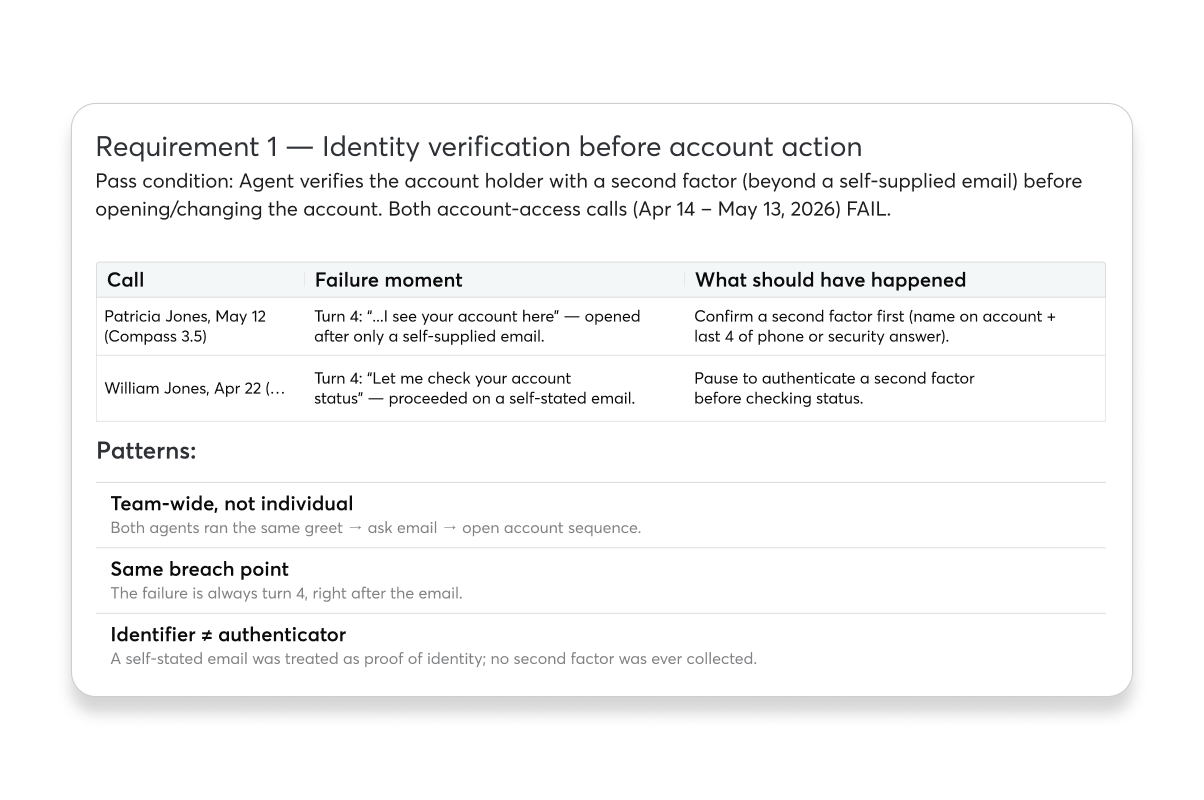
Examiners ask for evidence of execution, not just policy. A QA program that scores 2% against a rubric is a coverage gap, not a control. Compass evidence holds up because it is built on the underlying conversation, not a reviewer's interpretation. Every flag ties back to a timestamped transcript segment with speaker attribution. The methodology is reproducible and version-tracked, which is what an independent tester or external counsel needs to defend a finding.
"We monitor 100% of customer conversations against our disclosure and BSA requirements, with signal-level audit trails tied to timestamped transcripts" survives the question "how do you know." "We scored 96% on our QA sample last quarter" invites it.
Compass analyzes every recorded customer conversation across phone, chat, and email. For each call it produces a structured layer of evidence: what factually happened (Conditions), the behavioral patterns scored against it (Signals), which behaviors actually moved the outcome under hard conditions (Outcome Lift), and the evidence-backed coaching the rep needs next (Guidance).
The shift is not a faster scorecard. It is a different evidence base. An independent tester reading the loop sees a methodology they can reproduce. Conversation Compliance is the primary pillar. Conversation Insights, Quality, and Coaching reinforce it.
Conversation Compliance. Disclosure tracking on Reg E, Reg DD, Reg Z, Reg CC, Reg B, and CIP across 100% of calls. Script adherence on authentication and Section 326 customer identification elements (name, date of birth, address, identification number). Tipping off detection. Signal-level audit trail tied to timestamped transcripts.
Conversation Insights. Population-level patterns across new accounts, deposit operations, lending, servicing, fraud, and disputes. Entity-level views by customer, product, agent, and site, so one rep, one customer, and one product become continuous threads rather than disconnected calls.
Conversation Quality. Replaces the QA scorecard with truth. Your QA team stops grading samples and starts investigating exceptions, calibrating Signal output, and routing findings to BSA and second line.
Conversation Coaching. Coaching tied to a specific call, a specific Signal, a specific disclosure that drifted, and a specific recommendation. The coaching record becomes training adequacy evidence under the FFIEC manual.
Q: We already have a QA team and a BSA testing function. What changes? A: QA stops sampling and starts working from population-level evidence. The rubric becomes a calibration tool. Analysts spend time on exceptions, Signal validation, and root-cause work instead of listening to four to six calls per rep per month. BSA independent testing gets a 100% population to draw from. Most banks reallocate QA headcount toward coaching and testing rather than reduce it.
Q: How does Compass fit into our model risk and third-party risk frameworks? A: Compass slots into the model risk management framework your team already uses and the third-party risk process you run on critical vendors. We sit for model validation, support annual revalidation, and expect your inventory to list Compass with a defined use, owner, and tier. On security and vendor diligence: we sign standard paperwork (NDA, MSA, DPA). SOC 2 is in progress. Vendor security documentation, subprocessor list, and data flow detail are available on request during your security and vendor review. No customer data is used to train models that serve other customers. We work through your process with you rather than handing over a packaged artifact.
Q: If Compass flags something and we don't action it, what is our exposure? A: A real question we answer directly during procurement. Compass output is a prioritization layer, not a regulatory determination. Review queues, retention of flagged-but-not-actioned signals, role-based access, and audit logging are configured to match your BSA escalation SLAs and your record retention policy. We walk legal and compliance through how output is treated in litigation hold, discovery, and examiner requests before you sign.
Q: How is Compass evidence used in BSA independent testing and internal audit? A: Independent testers get role-based read access to the same evidence layer your compliance team uses: transcripts, contextual tags, Signal scores, model versions, and coaching actions. We do not claim examiners or testers credit Compass output on its own. They credit the bank's program. Compass makes that program reproducible.
Q: How does this apply to fair lending, ECOA, and Reg B? A: Fair lending pattern detection on lending calls is supported. Compass surfaces adverse action language quality, steering-adjacent language across applicant segments, and terminology variance that fair lending committees usually source from anecdotes. Output feeds your existing fair lending monitoring rather than replacing it.
Q: Will this work with our existing recording platform, and what happens to our recordings? A: Compass ingests from the platforms common in banking, including NICE, Verint, Calabrio, Genesys, and Five9, plus the major cloud telephony systems. Ingestion is read-only and recordings stay where they live. Compass-generated transcripts and Signal records have their own retention configuration, set to align with your record retention policy.
Q: What about Spanish and other non-English calls? A: Spanish is production-grade for disclosure delivery, BSA red-flag patterns, and UDAAP-adjacent language. Coverage for additional languages is scoped during evaluation, and we are direct about which Signals are production-grade before contracting. Spanish disclosure consistency is often where sampled QA falls shortest, and where banks see early value.
Q: How is Compass different from speech analytics (CallMiner, NICE Nexidia, Verint Speech Analytics) or a general LLM? A: Speech analytics is keyword spotting. It tells you a phrase was said. Compass produces structured understanding of what happened, Signals scored against the conversation, and the difficulty-adjusted impact of those behaviors. The difference matters most on patterns that are not a keyword: tipping off language, Reg E clock starts, UDAAP-adjacent promises, structuring framed as a question, steering on a Reg B call. A general LLM can read one call. Compass reads every call, scores consistently, and produces a reproducible record.
Q: What does implementation look like, and do we have to rewrite our scorecards? A: A focused start, typically one or two product lines. Phase one connects recording and stands up compliance and BSA Signals against a backfill of historical calls. Phase two calibrates thresholds with your QA and BSA teams. Phase three turns on coaching and broader coverage. You do not rewrite scorecards to start. We map your existing rubric to Compass Signals in the first working session and run both side by side. Compass is deployed in community, mid-size, and larger banks. Sizing tracks call volume, scope, and product breadth rather than asset size.
Bring one product line and a week of calls you already know well. We will sit with your compliance and BSA leads, look at what Compass surfaces on real conversations, and talk through how it would fit your testing and exam evidence. Standard paperwork comes first when your recordings are involved. Reach out to set up the working session.