




















Your QA program samples a few percent of calls. The plaintiffs' bar, the CFPB consumer complaint database, and your state AG read the other ninety-five. Compass listens to every conversation and keeps the evidence record you can defend.
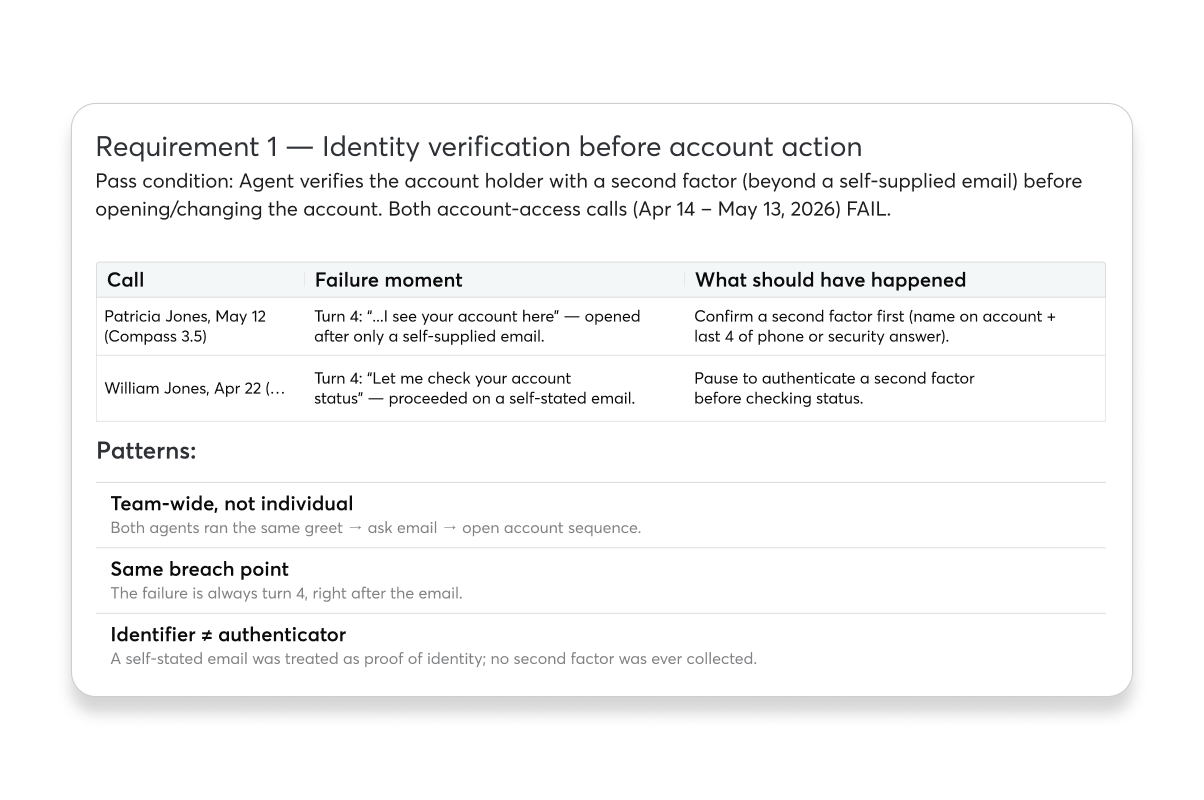
A collections compliance leader's week runs on two fears that pull in opposite directions. One is a CFPB civil investigative demand, a state AG inquiry off a single complaint, or a private FDCPA or TCPA action built from a recording your team never reviewed. The other is the monthly performance review where right-party contact, promise-to-pay, and net collections are sliding. Tighten the script too far and collectors lose the conversation. Loosen it and you are one recorded line from statutory damages plus attorney fees.
The failure modes are not abstract. Mini-Miranda under FDCPA 807(11) gets clipped on dialer pickups or skipped on subsequent contacts. Third-party disclosure under 805(b) gets tested every time a collector reaches a spouse, an employer, or a voicemail. Reg F's seven-in-seven call frequency presumption under 12 CFR 1006.14(b) is a rebuttable presumption of harassment, not a hard cap. The Reg F limited content message under 1006.2(j) is a voicemail safe harbor only if every required element is delivered and nothing extra is added.
Other rules sit next to FDCPA and ship their own statutory damages. TCPA under 47 U.S.C. 227 carries $500 to $1,500 per call with no cap and is the modern class action engine for collections, with consent capture, revocation tracking, reassigned-number safe harbor analysis, and the 2023 FCC one-to-one consent ruling all in play. UDAAP under Dodd-Frank 1031 reaches first-party creditors the FDCPA does not, including utilities, hospital revenue cycle, telecom, and bank affiliates collecting their own debt. State law layers on top: California's Rosenthal Act pulls first-party creditors into FDCPA-style conduct rules, Massachusetts 940 CMR 7 caps creditor frequency at two calls in seven days (stricter than Reg F), and NY GBL 601, 23 NYCRR Part 1, NYC DCWP, Colorado UCCC, and Texas Finance Code Chapter 392 each add their own surface. State wiretap statutes in California, Florida, Illinois, Maryland, Massachusetts, Pennsylvania, and Washington govern whether the call can be recorded at all.
Your QA team samples two to five percent against a rubric. The plaintiffs' bar reads the other ninety-five, working off CFPB consumer complaint narratives class firms mine for lead complaints.
Mini-Miranda drifts on second and subsequent contacts. Collectors who deliver it cleanly on a first right-party contact often abbreviate or skip it when they recognize the consumer's voice or when a call is transferred. A random sample rarely lands on those moments. A plaintiff working from a complaint pulls the exact call where it failed. Third-party disclosure under 805(b) is rarely a single line. It is a tone shift after the third party asks who is calling, then a sentence that confirms the debt exists.
False or misleading representation under Section 807 is harder to catch with a rubric. The harder cases now are credit-reporting threats made when no furnishing decision is in motion, time-barred debt language without correct disclosure, convenience-fee misrepresentations, and implications of legal action your firm has not authorized. Rubric scoring grades whether required elements were present, not whether unscripted statements crossed a line.
The 7-in-7 frequency rule is where sampling fails hardest. The presumption is per debt, per consumer, rolling seven days, with a separate cooling-off period after each completed conversation. Your dialer logs every attempt. Your QA reviewers see one call in isolation, with no view of the other attempts, the cooling-off window, or a parallel campaign double-counting. The audit risk is the pattern, invisible at two percent sampling.
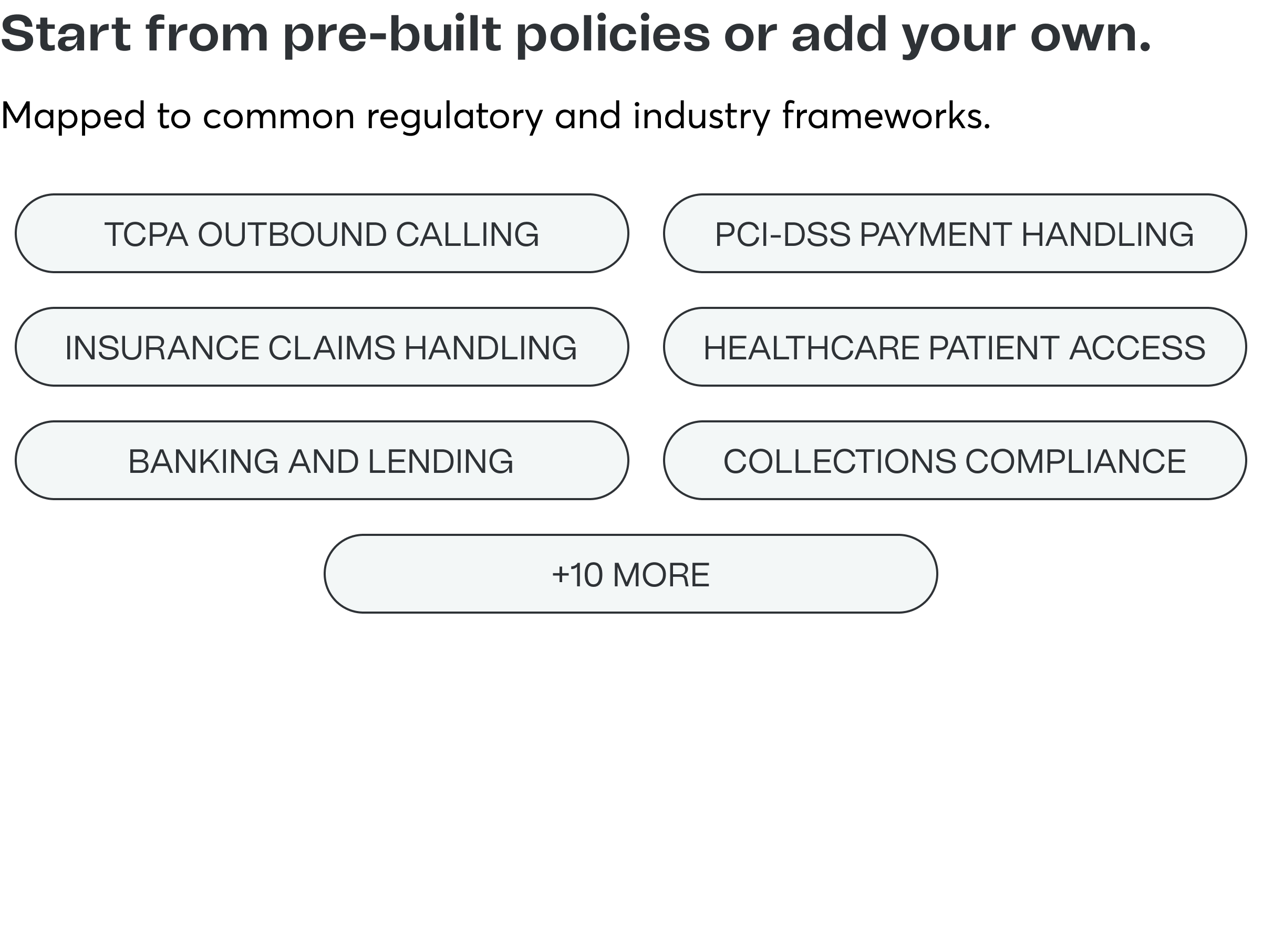
Collections sits at the intersection of four bodies of law, and you do not get to pick which one a complaint cites first. FDCPA at 15 U.S.C. 1692 governs third-party debt collectors, with Reg F at 12 CFR Part 1006 implementing it. The FDCPA exempts creditors collecting their own debts in their own name, so first-party operations live primarily under UDAAP, state UDAP statutes, and state laws like Rosenthal that reach creditors directly. TCPA governs autodialed and prerecorded calls and texts to cell phones across both.
Enforcement runs on parallel tracks. CFPB Supervision and Examination treats sampling-based monitoring as indefensible when the recordings tell a story your monitoring missed. State AGs bring actions under UDAP statutes. State financial regulators and PUCs examine licensed operations directly. Private plaintiffs bring FDCPA, TCPA, Rosenthal, and state UDAP cases for statutory damages, actual damages, and attorney fees.
Exam and litigation defense live on evidence. Counsel and examiners ask for recordings, account histories, complaint logs, and CMS data, then compare your policies to your operational record. Sampling cannot produce that record. Coverage across every call, with signal-level evidence tied to the audio, can. Compass produces a timestamped transcript per call, a discrete signal per disclosure event with the audio segment attached, and an account-level frequency view that joins every attempt to the consumer and debt.
Compass listens to every collection call, ties the conversation to the consumer and debt, and runs it through four capabilities sharing one evidence layer. The primary capability is Conversation Compliance. The secondaries are Conversation Quality, Conversation Insights, and Conversation Coaching. Compass does not replace your collectors, scripts, dialer, or CRM. It reads the audio you already record and feeds your QA workflow, your compliance reporting, and the audit binder you build for each exam and preservation letter.
Conversation Compliance. Mini-Miranda, validation references, limited content messages, state-specific script tracking, frequency and cooling-off enforcement against Reg F and stricter state caps, third-party disclosure detection under 805(b), cease/attorney/dispute triggers, TCPA consent and revocation capture, and recording-disclosure adherence by jurisdiction. Every signal is timestamped, evidenced, and exportable.
Conversation Quality. A framework we call Conditions, Signals, Outcome Lift, and Guidance. Conditions describe what was true on the call. Signals score behavior against rules and effectiveness. Outcome Lift adjusts for account difficulty so collectors working harder paper are not penalized. Guidance turns the picture into next steps. You can still produce a scorecard for board reporting, and the evidence behind it holds up under examination.
Conversation Insights. Pattern detection across collectors, campaigns, portfolios, original creditors, balance bands, and vintages. Disclosure drift across a quarter. Complaint precursors surfaced before they appear in the CFPB complaint database.
Conversation Coaching. Evidence-backed coaching tied to the moments where a collector drifted or got it right. Not "you scored 82" but "on these three calls, here is what the rule required, here is what you said, and here is the audio segment." Tied to behaviors that drive both compliance and right-party-contact-to-payment conversion: hardship acknowledgment before terms, open questions before payment offers, specific dates and amounts in commitment language.
Q: We are a first-party creditor, not a debt collector under FDCPA 1692a(6). Does this apply? A: Yes, with a different regulatory spine. FDCPA and Reg F do not bind a creditor collecting its own debt in its own name. Your exposure runs through UDAAP, state UDAP statutes, Rosenthal, NY GBL 601, Massachusetts 93A and 940 CMR 7, NYC DCWP, and similar regimes that pull first-party operations into FDCPA-style conduct rules. Compass signals configure to the rule set that binds you, so utility, hospital revenue cycle, telecom, and bank-affiliate operations do not get a third-party agency template.
Q: If Compass flags a call as a likely 807 violation and we do nothing for sixty days, is that flag now discoverable evidence of knowing noncompliance? A: General counsel raises this first and it deserves a direct answer. The same discoverability concern applies to any monitoring a regulator expects you to maintain, including your QA scorecards. The defensible posture is a documented triage and remediation workflow with SLAs, run inside the compliance management system and retention policy your counsel already governs. Compass surfaces the signals, routes them, and tracks status against the SLA your team sets. Reviewing fewer calls does not reduce exposure. Building a record of timely action does.
Q: What about litigation hold, preservation, and chain of custody? A: When a preservation letter arrives, your legal hold process governs scope, custodians, and retention. Compass operates inside that framework: transcripts, signals, and derived analytics tied to the matter scope can be held against deletion, and signal records carry the timestamps and references your counsel needs to defend chain of custody in discovery.
Q: How do you count 7-in-7 across campaigns, skip-traced numbers, and reassigned phones? A: Compass resolves the consumer and debt as entities, not phone numbers, and the rolling count plus cooling-off window compute against the entity across campaigns, channels, and number changes.
Q: How does this address TCPA and call recording consent in two-party states? A: TCPA consent and revocation are captured as signals on the call. Verbal revocations flag for write-back to your consent system of record, and reassigned-number indicators surface against your scrub. State wiretap rules are tracked as a separate signal layer covering whether the recording disclosure was delivered, where in the call, and on which channel. When consent is defective or revoked, Compass supports targeted suppression and deletion against the affected recordings and derived transcripts. Compass is a detection and evidence layer, not a real-time dialer block.
Q: We already run QA against a scorecard. What changes, and will it work with our dialer? A: Your scorecard stays. QA stops being the sampling layer and becomes the calibration and remediation layer, reviewing exceptions, refining signals, and owning the coaching loop, usually on the existing headcount across a larger surface. Compass ingests read-only from major collections recording platforms (LiveVox, TCN, Genesys, on-premise). Write-back to the CRM and consent system is configurable during implementation.
Q: How is this different from CallMiner Eureka, Verint Da Vinci, or NICE Enlighten? A: Older speech analytics search transcripts for keywords. They find "lawsuit" or "mini-Miranda" when the collector says them. They do not understand whether the disclosure was meaningful, whether it was delivered in time, or whether an unscripted statement crossed into 807. Compass produces structured understanding tied to the entities in the conversation and the rules they implicate, with audio and citation on every signal.
Q: What about procurement: BAA, SOC 2, vendor security review? A: We sign standard paperwork: NDA, MSA, DPA, and a BAA where PHI is in scope. SOC 2 is in progress. Vendor security documentation, including subprocessor list, is available on request, and we work through your security review process with you. No customer data is used to train models that serve other customers.
Thirty minutes, your compliance and operations leads, a working session on sample conversations from comparable operations. We walk Conditions, Signals, Outcome Lift, and Guidance against them so your team sees what 100% understanding looks like in practice. When the conversation turns to your audio, NDA and BAA sign first.