



















Compass listens to every member call, chat, and secure message and shows you the patterns moving NPS, complaints, and retention so the board question stops being a guess.
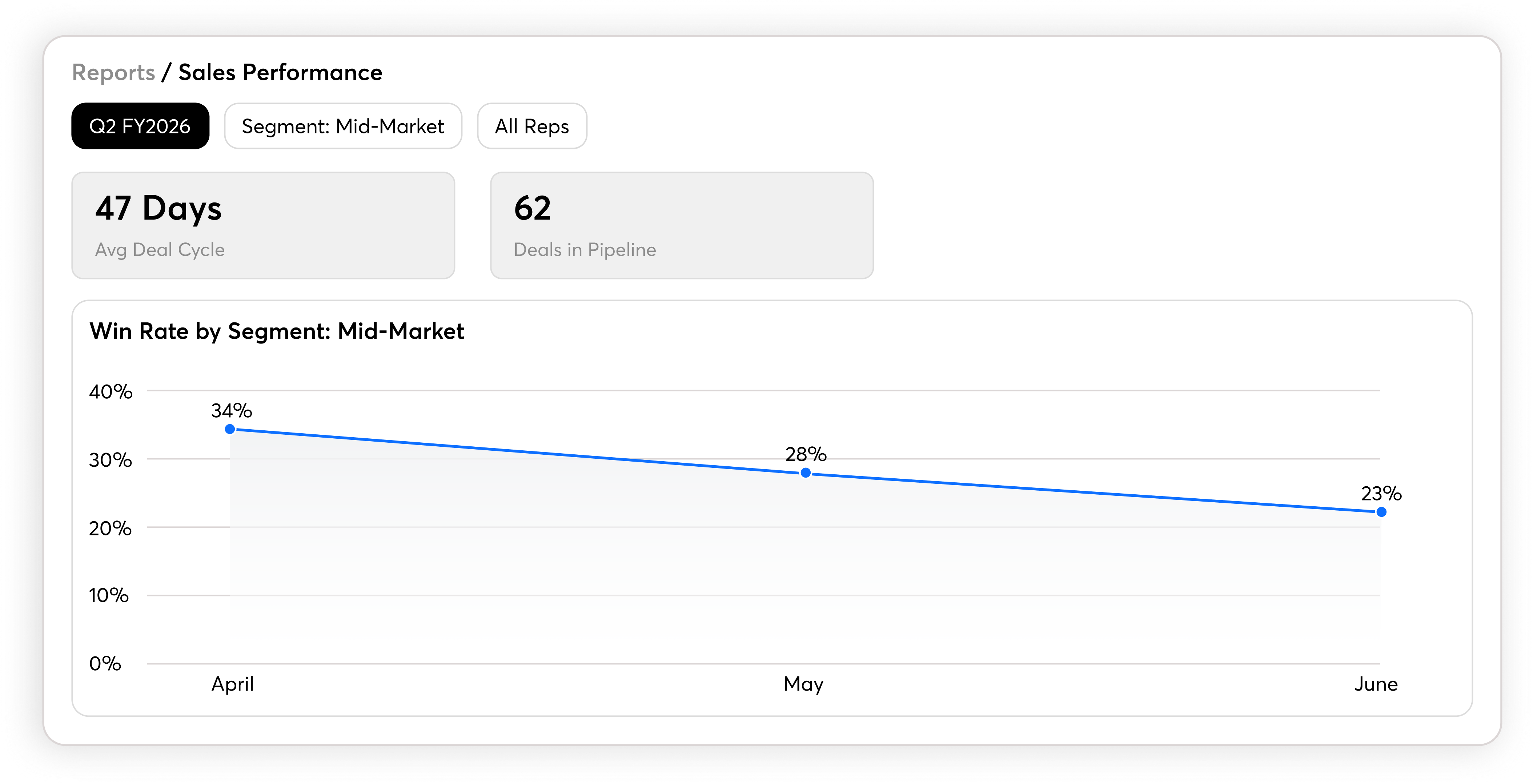
The board packet has one slide that matters to your seat. Member NPS, year over year, with a trend line and a footnote. The CEO asks why the line moved. The chair asks what you are doing about it. You have survey verbatims, a branch heat map, and a feeling about lending wait times. No answer survives thirty seconds of follow up.
This is the structural problem of running member experience at a credit union. The metrics you carry are lagging. NPS arrives weeks after the conversation that caused it. Complaint volume tells you a member was unhappy enough to escalate, which means you already failed. Retention shows up twelve to thirty-six months after the trust event. By the time the number moves, the cause is buried under thousands of conversations nobody listened to.
Your member service team is talking to members every day across phone, chat, secure message, and branch follow-ups. Every interaction either built the cooperative relationship or chipped at it. Your QA program samples two to five percent. Your surveys reach a thin slice with predictable selection bias. The rest is sitting in audio and chat logs nobody opens twice. Meanwhile your strongest under-35 members are getting recruited by Chime, SoFi, and the regional bank down the street. You are losing primary deposit relationships you spent a decade earning, and the only signal you get is a closed account with a reason code your team picked from a dropdown.
The credit union model rests on a promise that you are not a bank. When NPS slides, that promise is what is sliding. You have to explain what is happening, what changes by next quarter, and how it ties to net member growth and primary financial institution share.
A QA program that scores three to five calls per rep per month against a checklist was built for one job: proving you reviewed some calls. It was not built to tell you why a long-tenured household just moved their direct deposit. The sample almost never lands on the call that triggered the escalation, because escalation is the rare event the random sample missed by definition.
The interactions that move NPS and retention are rarely the ones sampled. A member calls about a fee they think is unfair. Your representative has authority to waive it. Whether the member becomes a promoter or a detractor two weeks later depends on something the scorecard does not capture: did the rep acknowledge the frustration first, or read policy first. The mortgage call where a worried question about closing costs gets answered literally instead of empathetically. The fraud claim where the first ninety seconds either feel like protection or like a process. The hardship call where a member says "I just don't know what to do" and either hears a payment arrangement offer or hears a script.
Sampling also misses the pattern across channels. When a fee dispute escalates, the root cause is rarely the fee. It is usually a sequence: a wrong answer on a prior call, a second representative contradicting the first, a chat agent telling the member to call back, then the fee. The pattern only emerges across all four conversations. Your sample pulls one if you are lucky and scores it compliant. The actual story, that members are getting inconsistent answers across channels, never reaches your desk.
The hardest pattern is silent churn. Members who close accounts without filing a complaint have usually had a string of small disappointing interactions across months and channels. None rose to escalation. None showed up in your sample. The first signal is the closure, and by then the auto loan, the kid's first savings account, and the referral pipeline are walking out behind it.
NCUA does not run your NPS program. The CEO and the board do. The case for evidence in member experience is operational, not regulatory, and it is not soft. When you tell the board NPS dropped four points and you believe it relates to wait times, you are offering an opinion. When you show the board the decline is concentrated among members who had a fee reversal conversation, that those calls are running shorter than a year ago, that the acknowledgment signal dropped after the call flow change in March, and that those same members are closing primary checking at higher rates in the ninety days that follow, you are offering evidence. The boardroom conversation changes. So does the budget conversation that follows.
The same logic applies inside your building. When a supervisor coaches a representative on empathy based on two or three calls she happened to listen to, the rep reasonably wonders whether the feedback is representative. With evidence from every call, chat, and message that rep handled last month, the conversation moves from argument to pattern. Your strongest people get recognized for behaviors that were previously invisible.
There is a regulator corner. NCUA Part 706 and the agency's guidance on complaint handling set the expectation that credit unions capture, escalate, resolve, and track patterns in member complaints. The NCUA Consumer Assistance Center handles what escapes your internal process. State-chartered credit unions add a state regulator, and institutions above $10B add CFPB. The credit unions that show up well in these reviews have documented, defensible answers about what happened on the underlying conversation. Compass produces that documentation as a byproduct of how the product works.
Compass listens to every member conversation across calls, chats, and secure messages and turns it into structured understanding. Not a score on a rubric. Understanding of what happened, the conditions the representative was working in, and the impact on the relationship. The product uses what we call contextual entity resolution, an engine that ties every observation back to specific members, products, branches, and prior service moments so patterns hold up at the household and cohort level. The primary pillar for your seat is Conversation Insights, with Quality, Coaching, and Compliance as the operating layers beneath.
The center of gravity is the high-stakes interaction. Lending. Fees. Fraud. Hardship. Closures. Compass identifies these automatically and treats each with the right lens, then aggregates the patterns up to board-level questions about NPS, retention, member growth, and PFI share.
Conversation Insights. 100% coverage of member calls, chats, and secure messages. Theme detection, drift analysis at the product, team, and branch level, and member-level pattern detection across channels. This is the pillar that answers the board question and feeds the strategy offsite.
Conversation Quality. Replaces the legacy scorecard with a model built on Conditions, Signals, Outcome Lift, and Guidance. You see what happened, the behavior patterns detected, the difficulty-adjusted impact on the member outcome, and specific guidance the representative can act on. Your QA team moves from scoring rubrics to working the patterns that move retention.
Conversation Coaching. Evidence-backed coaching moments tied to the behaviors that move member outcomes. Acknowledgment timing. Ownership phrasing. Resolution confirmation. Supervisors walk into a one-on-one with three calls queued and a clear pattern, not a generic note. Each supervisor of six to eight representatives can run real coaching inside the monthly block they actually have.
Conversation Compliance. Reg B adverse action language on lending declines, Reg E error resolution timing on fraud claims, complaint handling per NCUA Part 706, and any state-level requirements. Tracked across every applicable conversation, not sampled.
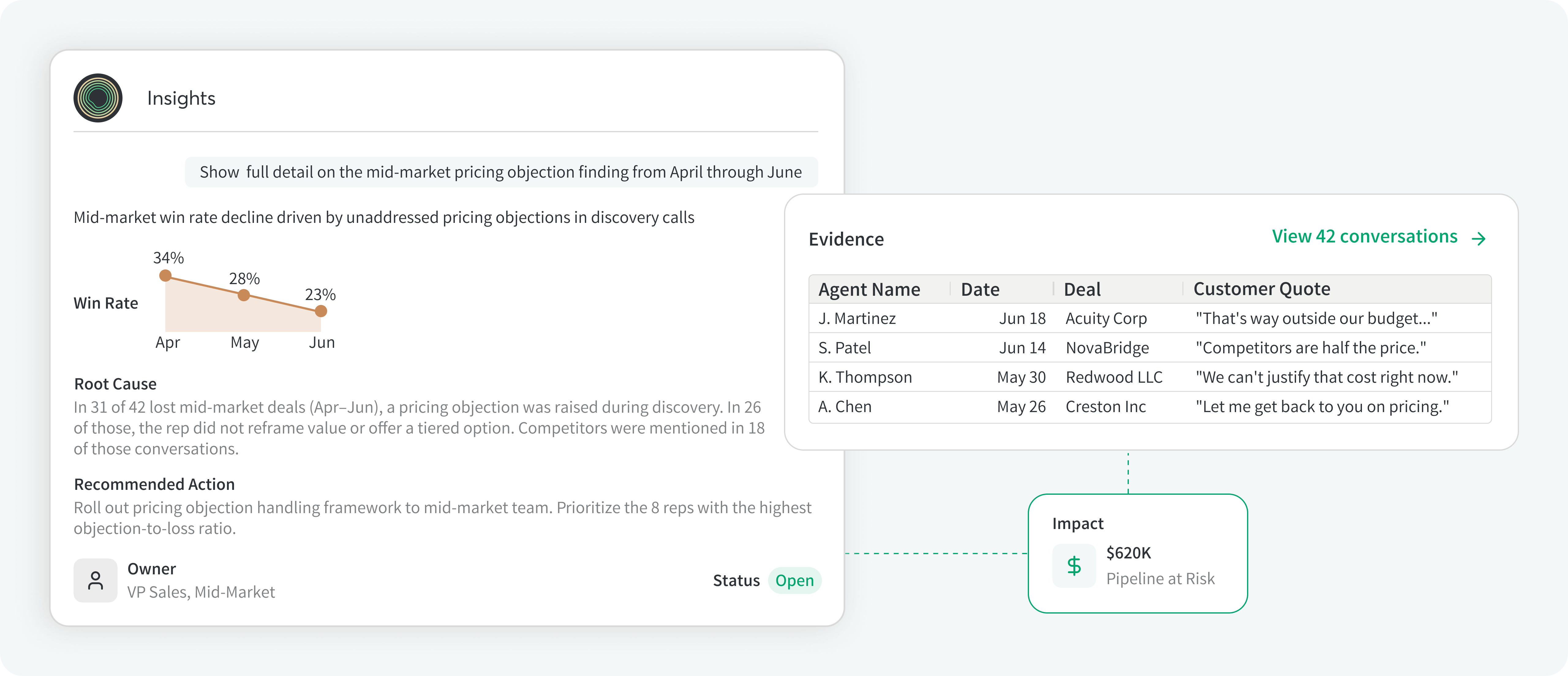
Q: We already run a QA program and member surveys. What does Compass actually change? A: QA scores a sample against a rubric. Surveys reach a fraction of members and arrive late. Compass analyzes every conversation in near real time and connects what was said to the survey response, the complaint, and the retention outcome. Your QA team does not disappear. The work shifts from sampling and scoring to working the patterns that move retention, PFI share, and complaint volume. Most credit unions redeploy the team, they do not shrink it.
Q: How does this connect to NPS and to our growth metrics? A: Compass identifies the conversation patterns associated with promoter, passive, and detractor responses among members who completed the survey. You see which behaviors move scores up and which push them down. The same engine flags at-risk members on conversation signals before the survey goes out, so you can intervene on retention and PFI share before the relationship moves to the institution down the street.
Q: Will this work with our existing stack? A: Compass ingests audio and chat from the systems credit unions actually run. On the telephony and recording side that includes NICE CXone, Genesys, Five9, Talkdesk, Verint, and standard call recording formats. For chat and secure message that includes Glia, Eltropy, and your core's secure messaging surface. We also work alongside Symitar, Episys, and Corelation on the core side for member-level entity matching. Implementation begins with us ingesting a sample of your recordings and showing you what we find before any platform change.
Q: What about chat and secure message, not just calls? A: Treated as first-class. For members under 40 these channels are the relationship. Compass analyzes calls, chats, and secure messages with the same signal models so a fee dispute that started in chat and finished on the phone is read as one conversation.
Q: How do you handle Spanish and other languages? A: Compass supports multilingual transcription and applies the same signal models in Spanish that it applies in English. For credit unions with significant bilingual queue volume, validation is run on Spanish-language data so empathy, acknowledgment, and explanation quality signals are calibrated to the language they were spoken in. Other languages are supported on request.
Q: What about indirect lending and branch interactions? A: Indirect conversations at the dealership are not in your recording stack, so Compass cannot see them directly. The downstream conversations that come into your member service operation about indirect-originated loans are fully covered, and that is where most of the complaint volume lives. Branch interactions are covered to the extent your branches record. Most do not, and we will tell you that rather than oversell coverage.
Q: How do you handle member privacy and vendor risk? A: Conversations are processed under your existing consent and disclosure framework. No customer data is used to train models that serve other customers. PII handling, retention windows, and access controls are configurable to your policies. We sign the standard paperwork your vendor management process requires, including NDA and DPA, and a BAA where it applies. SOC 2 is in progress; vendor security documentation is available on request. We work through your credit union's vendor review with your risk team rather than handing over a packaged kit.
Q: How is Compass different from Medallia, Qualtrics, NICE, Verint, or conversational AI like Glia, Posh, and Eltropy? A: Survey platforms like Medallia and Qualtrics measure outcomes. Compass measures the conversations that cause them. Conversational AI like Glia, Posh, and Eltropy handles the live channel. Compass listens after the fact across every channel including theirs and produces the analytical layer they do not build. Legacy QA platforms like NICE and Verint were built around scorecards and sampling with analytics on top. Compass is built the opposite way: structured understanding of every conversation first, with scoring and compliance as outputs.
Q: What about service-level operations metrics like AHT, FCR, transfer rate, and abandon rate? A: Compass does not replace workforce management or telephony reporting. It explains the why behind those numbers. True first-contact resolution, the conversations that drove a transfer, and the patterns behind abandon-after-IVR are visible in conversation evidence and tie back to your ops dashboards.
We run a thirty minute working session, not a slideware demo. Bring the board question you cannot answer today, and we will work through a shared sandbox together. If you want to use your own recordings, NDA and BAA come first. You will leave with the start of an answer your QA program cannot produce.