




















For compliance leaders in manufacturing, hospitality, retail, transportation, logistics, gaming, and energy, the regulator is rarely scheduled on the calendar. The risk arrives later, in a state AG letter, a safety review, a complaint cluster, or a deposition. Compass keeps every customer conversation intact, searchable, and ready to defend.
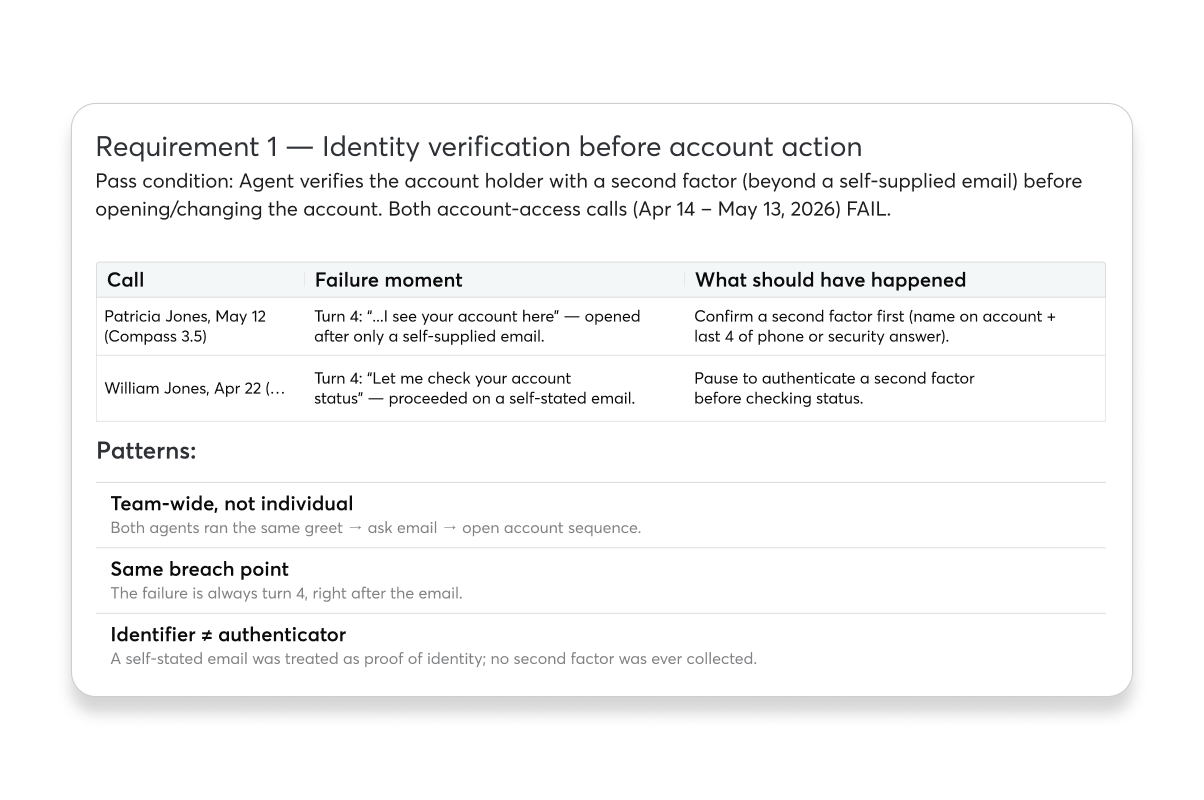
You run compliance at a company that does not show up in a CFPB enforcement bulletin. You are not a bank, a HIPAA-covered entity, or a broker-dealer. You are a regional hotel group, a multi-state retailer, a gas or electric utility, a freight broker, a casino operator, a manufacturer with a customer service line, a transportation operator, or some combination. Your customer-facing teams take calls, send chats, and answer emails every day. Those interactions are evidence in waiting, and the standard QA program built to coach friendliness does not produce evidence.
The pain shows up in pieces. A guest claims a front-desk agent was rude during a charge dispute, and the only record is a one-line PMS note. A dispatcher and a driver had a conversation about hours of service or load condition that a plaintiff's attorney wants three years later. A customer says a gas crew told them their meter was safe two days before an incident, and the documentation is a service ticket with no narrative. A self-excluded player calls the player development line, is not flagged, and the gaming commission finds out before you do. A state attorney general forwards a consumer complaint with a clock attached. None of those clocks care that the call you need is in the 98 percent your QA team never sampled.
Compliance leaders in these verticals operate without a fixed audit cycle. Risk arrives unpredictably from state AGs, plaintiffs' counsel, sector regulators (CPSC, FMCSA, FERC and state PUCs, state gaming control boards and tribal regulators, the DOJ and state DOJs on ADA Title III), and from a social channel where a single call clip can outrun your communications team in an afternoon. The question your CEO will ask is the same every time. What did our person actually say on that call?
Most QA programs in operating-company verticals were built for coaching, not for evidence. A QA lead pulls two to five percent of calls per agent per month, scores them against a rubric written by a manager who no longer works there, and files the results. That produces a coaching narrative, not a defensible record.
The calls that turn into problems are almost never the calls that get sampled. A retailer samples one in fifty, and the call that lands in the AG's office is the one where a customer was told a warranty did not cover an obvious defect. A transportation operation samples enough calls to fill its scorecard, but the dispatcher call where a driver flagged unsafe conditions is the one a shipper's attorney wants three years later. A casino host softens a self-exclusion mention and technically says the words, so the call passes any keyword check. A hotel reservations agent quotes a refundable rate the guest later disputes, and that call is in the eighty percent nobody listened to. A utility agent abbreviates the disconnect notice and never delivers the medical hardship reminder again that shift.
Sampling also misses patterns. A single rude exchange is a coaching moment. Twenty rude exchanges across three reps about the same product line, property, lane, or queue is a complaint pattern that will surface as a class action narrative, a regulatory matter, or a media story. Sampling cannot see frequency, and it cannot see clustering by product, region, time of day, terminal, or property. Your recordings already contain that signal. Nobody is listening to enough of them to find it.
Your vertical may not have one dedicated federal regulator, but the rules that touch your calls are real. Most states have an Unfair and Deceptive Acts and Practices (UDAP) statute that gives the attorney general authority to investigate deceptive customer communications, and the FTC has broad authority under Section 5 of the FTC Act for deceptive practices in interstate commerce. Sector regulators matter when they matter. CPSC for product safety. FMCSA for motor carriers and brokers under 49 CFR Parts 371, 375, 382, 391, and 395, with CSA BASIC scoring and the DOT safety rating (Satisfactory, Conditional, Unsatisfactory) sitting on top. State public utility commissions for energy, with cold-weather rules, medical hardship protections, and assistance-program offer expectations. State gaming control boards and tribal regulators for casinos and sportsbooks, plus the Bank Secrecy Act for cage operations including Title 31 reporting. The DOJ and state DOJs for ADA Title III, including reservation lines and TTY/relay accessibility.
What these regulators share is that they investigate after a complaint. They do not pre-clear your script. They ask, after the fact, what your people said. Compass is built for that question. Every call is captured with timestamp, agent, customer, conditions, signals, and outcome. When a regulator asks for every call where a customer raised concern X in date range Y, you can answer with the actual calls, not a sampled summary.
Litigation discovery matters as much as regulatory inquiry. In a freight nuclear-verdict case, the dispatcher call is the central exhibit. In a hotel chargeback or ADA matter, the reservation call is the central exhibit. In a utility PUC complaint, the call where the disconnect notice was or was not delivered is the central exhibit. The choice is whether those calls are organized and searchable, or whether your legal team is sorting raw audio under deadline.
Compass connects to your existing recording infrastructure (Five9, Genesys, NICE CXone, Talkdesk, Zoom Phone, RingCentral, a hospitality PBX, a TMS-integrated voice platform, a gaming-floor recording system, or a homegrown setup) and processes every call through Contextual Entity Resolution (CER), which identifies the parties, the subject of the call (load, account, property, player, claim, order), the disclosure, the commitment, and the outcome.
Once entities are resolved, Compass produces four artifacts on every call: factual Conditions (what happened, who was on the call, what was disclosed), behavioral Signals (a calibrated set of patterns covering disclosure delivery, escalation handling, commitment language, script adherence, and program-specific behaviors), Outcome Lift (the difficulty-adjusted impact of agent behavior on the outcome that matters in your vertical), and Guidance (the evidence-backed coaching moment tied to a specific transcript segment). The four pillars below sit on top of that model.
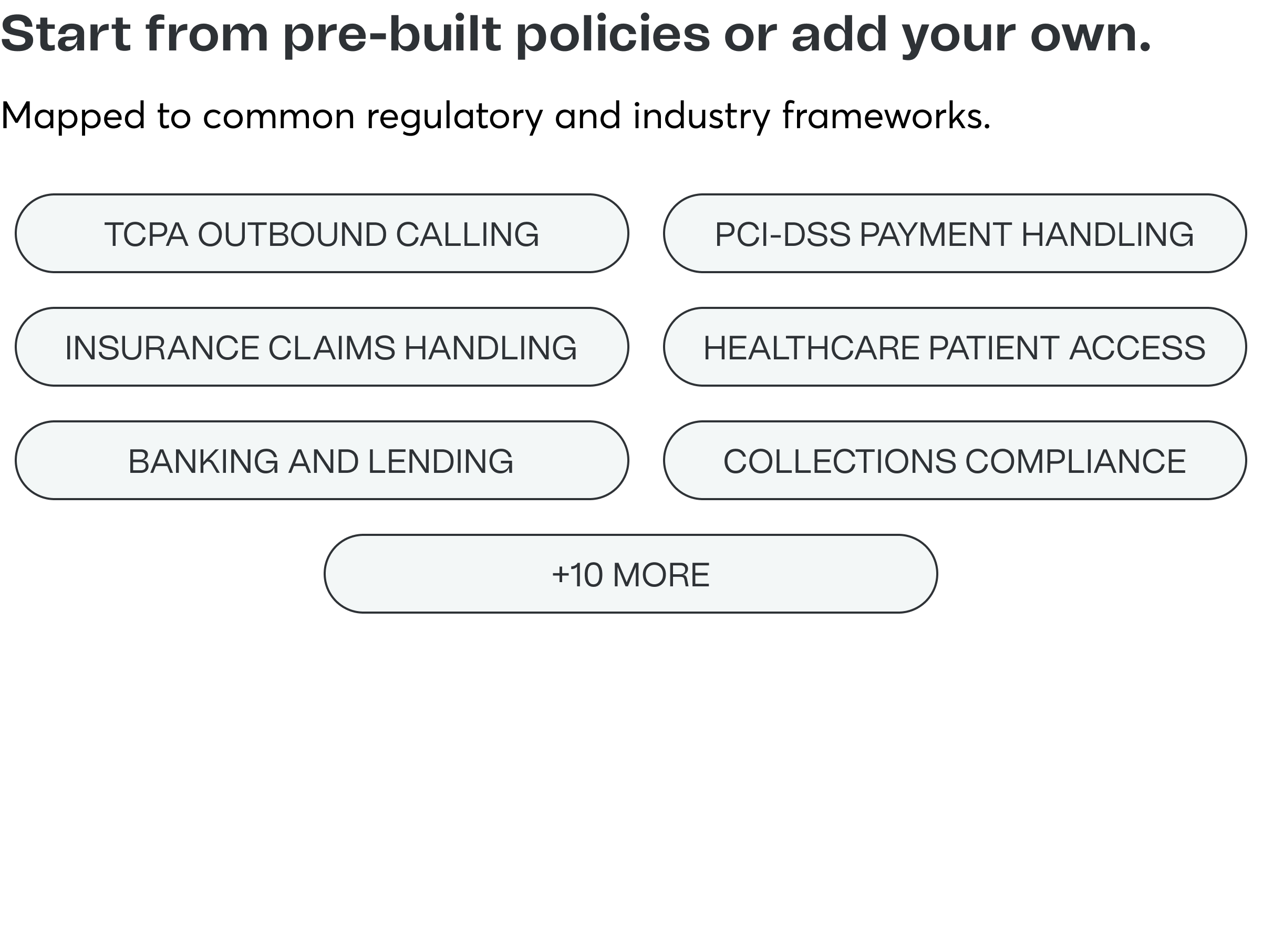
Conversation Compliance. Disclosure tracking and script adherence at full coverage. Configurable to the disclosures and policies that matter in your vertical, including cancellation terms, hazard language, age verification, dispute rights, internal escalation triggers, household goods estimate language, broker transparency, utility disconnect notices, and responsible gaming intervention scripts. Every check produces a timestamped, signal-level audit trail.
Conversation Insights. Theme detection across the full dataset, so complaint clusters, safety mentions, and reputational risk patterns surface before they reach a regulator or the press. Drift analysis shows when language is changing across reps, regions, terminals, properties, or product lines.
Conversation Quality. Replaces the legacy QA scorecard with Conditions, Signals, Outcome Lift, and Guidance. For verticals where QA was about coaching, this is the upgrade from opinion to evidence. Where QA barely existed, this is the foundation.
Conversation Coaching. Once the evidence is in place, supervisors receive specific, signal-backed coaching moments per rep. The reps most likely to generate a complaint get coached first, with the actual calls as the basis, not a memory of a calibration session.
Q: We are not heavily regulated. Do we really need this? A: The question is whether your customer conversations show up as evidence in disputes, AG inquiries, safety reviews, or litigation. If yes, the evidence needs to be organized and searchable. Most companies in these verticals only realize the gap after the first inquiry they cannot answer well.
Q: We have a QA team already. What changes? A: Your QA team keeps doing what it does for coaching. Compass changes the evidence picture. Instead of two percent coverage scored by a person, you get full coverage with signal-level detail.
Q: We record through [our platform]. Can you ingest from there? A: Compass integrates with the major recording, CCaaS, hospitality PBX, TMS-integrated voice, and chat platforms. If you can produce recordings and basic metadata through a standard API or storage location, we can ingest. We confirm integration paths during scoping.
Q: What about all-party consent recording states? A: Roughly a dozen states require all-party consent for call recording. Compass does not change your recording posture. It analyzes what you already record. Recording policy in two-party-consent states is owned by your legal team. We support disclosure tracking for recording notices and can flag calls where the recording disclosure was or was not delivered, which is itself a common audit ask.
Q: How do you handle multi-jurisdictional rules? A: Disclosure profiles are configured per jurisdiction. A utility operating in five states can run five disconnect-notice profiles. A multi-jurisdiction gaming operator can run separate responsible gaming and advertising rule sets per state and tribal jurisdiction. A hospitality group can run different cancellation rules by brand or property. Each call is scored against the rules that apply to it.
Q: How do you handle calls that mix English and Spanish, or other languages? A: Compass processes conversations in multiple languages, including code-switched calls where parties switch mid-conversation. Spanish coverage is standard. Additional languages are scoped during onboarding.
Q: What about chat, email, and self-service interactions? A: Compass analyzes calls, chats, and emails through the same Conditions, Signals, Outcome Lift, and Guidance model. Cross-channel pattern detection works the same way.
Q: How is this different from generic speech analytics? A: Keyword spotting and sentiment scoring count words. They do not score whether an intervention was actually delivered and acknowledged, whether a disclosure landed before the customer disengaged, or whether a dispatcher's "make it work" comment crossed a line. Compass produces structured behavioral evidence that holds up in audit and discovery.
Q: What does procurement need from us? BAA, security review, vendor paperwork? A: We sign standard paperwork: NDA, BAA where the use case warrants one, and DPA. SOC 2 is in progress. Vendor security documentation is available on request, and we work through your security review process with your team. No customer data is used to train models that serve other customers.
Q: How are recordings retained, and how does legal hold work? A: Compass operates against your retention policy, not against ours. You decide how long recordings and derived artifacts live, and you control deletion. Legal hold workflows are supported through API and console.
Q: We have a small compliance team. Can we use this? A: Yes. Pattern detection, complaint clusters, and dispute pull-up do not require a large team. Compass concentrates analyst attention on the calls that matter, the opposite of QA models that spread time across random samples.
Bring one real problem. A regulatory ask you are bracing for, a complaint pattern you think is forming, or a workflow your team handles by hand today. We will run a working session against shared examples and show you what full-coverage understanding looks like against your operation. NDA and BAA come first when your recordings are involved.