



















Your forecast is built from CSM judgment and usage telemetry. The renewal, the expansion, the quiet churn signal from a sponsor who has stopped showing up: all of it lives in calls nobody has time to listen to. Compass listens to every one.
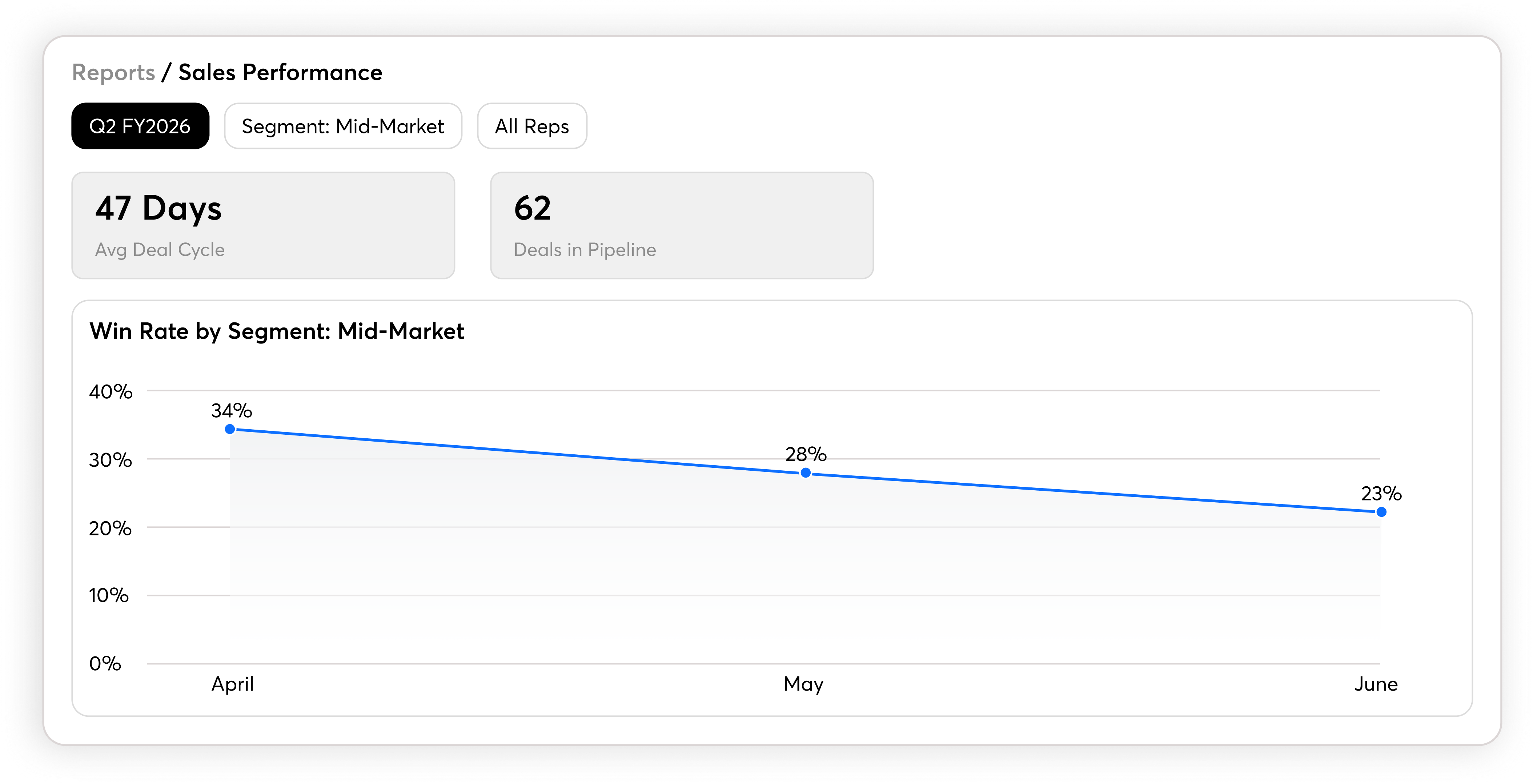
You run customer success at a B2B SaaS company somewhere between Series B and public. The team is anywhere from seven CSMs on a strategic book to eighty CSMs split across enterprise, mid-market, and a pooled SMB tier. The number on your back is NRR, with GRR as the floor you cannot break. Your board wants more expansion. Your CFO wants fewer surprises. You are trying to deliver both from a forecast built on CSM gut feel and a health score that lags reality by sixty days.
It is Tuesday. One CSM is rebuilding a QBR deck from Zoom recordings and Slack threads, trying to remember what the sponsor cared about six months ago. Another is on a save call for an account that flipped to red Monday after looking green for a quarter. A third is about to walk into a renewal with a customer she has not spoken to in seven weeks because usage was steady and nobody flagged the account. Friday is a forecast call where everyone reads out the same risk language they used last quarter, and you defend a number you barely believe.
The CSMs are not the problem. The system is. What your customers actually say lives in thousands of calls nobody watched. A CSM running thirty calls a week reviews their own when they have a minute. A manager listens to one or two before a one-on-one. The other ninety-five percent evaporate into transcripts nobody searches. The mid-market champion who said "we are looking at this differently next year" in minute thirty-eight while the CSM was mid-slide on value realization. The enterprise sponsor who has gone quiet on the recurring sync. The power user who described a workflow that maps exactly to a higher tier. None of it surfaces until something breaks.
The dashboards do not help. Product usage looks fine until the customer tells you on the renewal call that two new VPs joined and neither uses your product. The CSM-entered sentiment field is a gut feeling typed into a dropdown the day before the QBR. NPS was a seven in March from a champion who left in April. Your Gong library has every call recorded and nobody listening.
Most CS organizations do not sample calls at all. The ones that do have a CS lead or enablement manager listening to two or three recordings per CSM per quarter before a critical renewal. Two calls out of sixty or eighty. The renewals that determine seven-figure ARR get reviewed less rigorously than tier-one support tickets.
Sampling misses the structural patterns. A 30-minute QBR where the exec sponsor speaks for ninety seconds and asks zero substantive questions is not engagement. The CSM logs it as productive because the sponsor showed up. The pattern of sponsor attention dropping across three QBRs only emerges when you can see all three side by side. Same with the language of doubt. Customers rarely say "we are going to churn." They say "we are reevaluating." "The new CFO is asking questions." "Usage is lower than we expected." Scattered across a dozen conversations, these are the renewal signal. They never reach the forecast because no single call contained the whole story.
Sampling also misses expansion. A user on a support call describes a workflow they wish your product handled. Three weeks later the CSM runs a QBR and never references it. The two data points lived in two heads. Multiply by three hundred accounts and you understand why your expansion number is soft. The pooled SMB book makes it worse: no human is on a weekly call with most of those accounts, and the CSM who heard the expansion opening handles forty conversations a day.
Customer success runs on judgment. A CSM tells you an account is healthy. A manager tells you a CSM is strong. A forecast tells you a quarter looks good. Each is a person summarizing patterns from incomplete information. By the time the forecast reaches the board, the underlying truth is four layers removed from anything the customer actually said.
This is fine when stakes are low. It breaks at scale. By Series B the variance in execution across your team is the single biggest lever on NRR, and you cannot see it. The dashboard reads what the CSM enters. The check-in surfaces what the CSM remembers. Both are downstream of the same root cause. Nobody has read the conversations.
Evidence changes three things. First, the forecast review stops being a debate about gut feel. Instead of "why is this account yellow," the question becomes "sponsor talk time dropped across the last two QBRs and a new CFO joined the most recent call, what is the plan to re-engage the original champion." Second, coaching becomes specific. Instead of "push harder on expansion," it becomes "in the last six QBRs, expansion came up twice and you moved past it both times when pricing came up, here are the moments." Third, the expansion motion accelerates. The user who described a higher-tier workflow on a support call no longer dies in a transcript. The signal lands in front of the CSM and the AE before the next QBR.
The expansion side matters as much as the churn side. NRR above 115% does not come from preventing every churn. It comes from acting on expansion conversations your team is already having and walking past. The gap between 103% NRR and 120% is a workflow problem, not a relationship problem.
Compass treats every customer conversation as the unit of truth: calls, recurring syncs, support escalations, executive briefings, kickoffs, training. Each one gets parsed using Contextual Entity Resolution, which is how the system understands that "the new VP," "Sarah's replacement," and "Jennifer Chen" are the same person across three conversations, and that "the integration" in last week's support call is the same integration the sponsor asked about in the QBR last quarter. The connections a CSM holds in their head become persistent in the platform.
The primary pillar for CS is Conversation Quality. Sampling and stoplight reviews get replaced with structured understanding of every conversation, scored against the conditions of each account and tied to outcomes: renewal, expansion, sponsor retention.
Conversation Insights. 100% coverage of CS calls, QBRs, support escalations, and executive briefings. Themes surface across your book: which features are getting asked about, which objections are repeating, which segments show the same friction. Drift in customer language is visible at the account, segment, and CSM level.
Conversation Coaching. Every CSM gets a queue of coaching moments tied to specific signals on their own calls. A ninety-second clip where they had a chance to qualify expansion and did not, with the suggested next move. CSMs see their own signals first, which is the only rollout pattern that works.
Conversation Quality. The Conditions, Signals, Outcome Lift, and Guidance framework applied to CS. Account conditions (segment, contract size, tenure, sponsor profile) are factored in. Signals are scored across QBRs, renewals, and recurring calls. Outcome Lift connects behaviors to renewal and expansion results, difficulty-adjusted against your own data.
Conversation Compliance. Lower priority for non-regulated SaaS but useful where contractual SLAs, security commitments, or stated promises need tracking. When a CSM commits to a delivery date and the roadmap shifts, the platform surfaces the conversation so the next call addresses it.
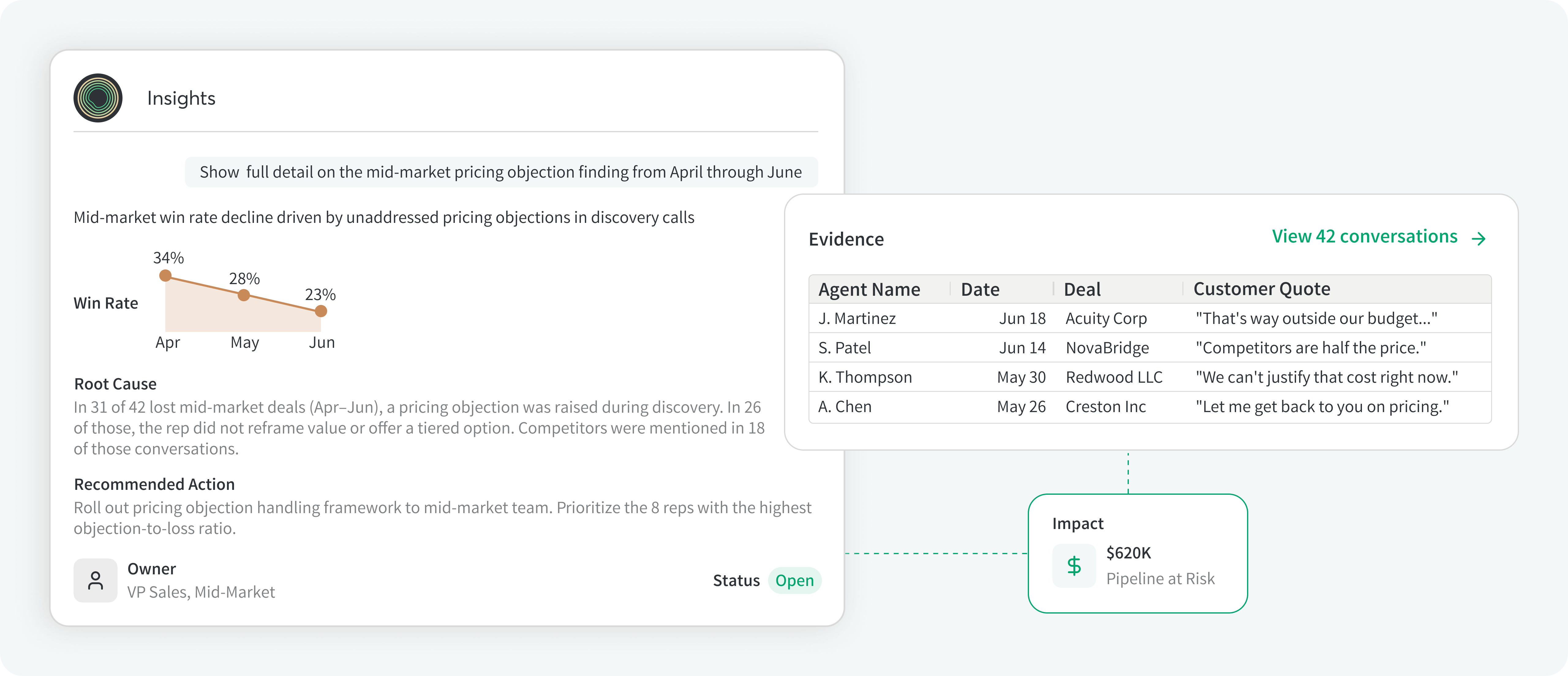
Q: We already use Gainsight. Why Compass? A: Gainsight reads what your CSMs and systems enter. Compass is the evidence layer underneath. It reads what your customers actually say and feeds structured signals into Gainsight via API as health score inputs, custom fields, or auto-generated CTAs. Nobody is replacing Gainsight. The health score stops being a usage proxy and starts reflecting conversation reality. You decide signal weighting and routing.
Q: We have Gong. Isn't this duplicative? A: Gong is built for sales coaching on a deal-cycle timeline, and most CS teams use it as a recording library with sales-flavored analytics on top. Compass is built for the customer lifecycle: champion change, expansion qualification, exec sponsor engagement, promise tracking from sales handoff, renewal language. The signal library is calibrated against CS conversations, not ported from sales. Most customers keep Gong as the recording layer and run Compass on top.
Q: We run a tiered model: high-touch on enterprise, pooled on SMB. Does this work for both? A: Yes, differently. On the high-touch tier, Compass works the way the page describes: deep per-account analysis, QBR-level signal tracking, exec sponsor scoring. On the pooled tier, where there are twelve calls per year per account instead of twelve per month, the value shifts to aggregate pattern detection: which cohorts voice the same objection, which onboarding paths predict renewal, which expansion signals show up across the book that no pooled CSM can triage.
Q: My recording adoption is uneven. Two CSMs barely hit record. Does this still work? A: It works on what gets recorded, and the gap becomes visible. You see coverage rate per CSM in the first week, which is often the first time CS leaders see exactly who is and is not recording. Partial coverage produces partial signal, not zero signal.
Q: Will our CSMs feel surveilled? A: This is a real adoption risk, not a perception problem to debunk. The rollout pattern that works: CSMs see their own signals first and use them to advocate for their accounts. Managers see aggregate patterns. Call scoring used as a management cudgel produces worse adoption and worse results.
Q: What about security and procurement? A: Customer conversations contain PII and sometimes sensitive commercial data. We sign standard paperwork: NDA, MSA, DPA, and a BAA where applicable. SOC 2 is in progress. Vendor security documentation is available on request, and no customer data is used to train models that serve other customers. We work through your security review with you rather than handing over a packet and disappearing.
Q: How long does implementation take, and who owns the work on our side? A: Compass connects to Zoom, Google Meet, Microsoft Teams, Gong, Chorus, and others, plus Gainsight via API. Initial signal output on existing recordings lands in weeks, not quarters. Your side: access to historical recording data for calibration, signal configuration choices, and rollout communication. CS Ops typically owns that work.
We run a working session, not a sandbox demo. Bring a slice of your actual book and we will show you what Compass surfaces: where the early warning signals were sitting, which expansion conversations got walked past, and the gap between your health score and your conversation reality. NDA first when your recordings are involved. The rest is a conversation.