




















Compass turns 100% of your reps' and advisors' conversations into structured supervisory evidence aligned to FINRA Rule 3110, Reg BI, Rule 2210, and the SEC Marketing Rule. Your written supervisory procedures keep doing what they were written to do. They finally have something to point at.
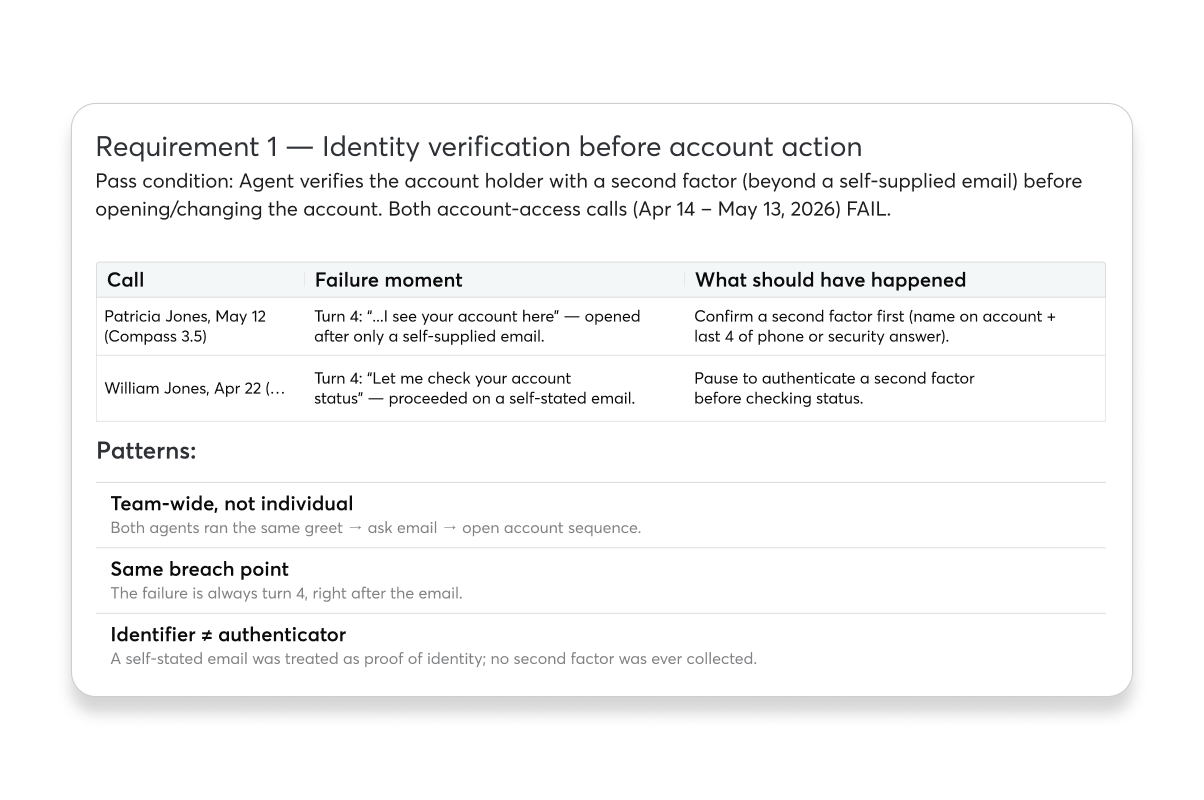
Your week is shaped by people who do not sit in a registered rep's or advisor's chair. The SEC Division of Examinations and FINRA's Annual Regulatory Oversight Report tell you what they are looking at this cycle. Reg BI's four obligations. Form CRS delivery. Conflicts on rollover recommendations. Complex product suitability under FINRA Rule 2111. Communications with the public under FINRA Rule 2210. Marketing Rule substantiation under Advisers Act Rule 206(4)-1. Off-channel communications. Books and records under SEC Rule 17a-4 and Advisers Act Rule 204-2. Senior client protections under FINRA Rules 2165 and 4512. And the Rule 3110 supervisory system that is supposed to catch all of it.
You already run a real program. Designated principals work a risk-tiered sample each month, weighted by product complexity, rep tenure, complaint history, and branch. Branch managers run their own daily review queue. Your WSPs describe a closed loop. The math is still the math. A rep had several dozen client conversations last week. A handful were reviewed. The conversation that mattered, the one the complaint will eventually cite, was not in the sample.
The exam letter will not ask whether your sample was clean. It will ask how your firm reasonably supervised the recommendation now in dispute, whether Reg BI obligations were met on the contested call, whether the suitability analysis under 2111 was actually performed, and whether Marketing Rule substantiation extended to the way the rep paraphrased a third-party rating on a discovery call. You will produce a recording, a checklist, and a CRM note. The examiner will ask what your supervisory system did with the other conversations.
Rule 3110 requires a system reasonably designed to achieve compliance. "Reasonably designed" is doing the work. Examiners probe the methodology and ask what changed when it surfaced something. A program that reviews a slice and infers the rest is harder to defend as reasonable when better tools exist.
Risk-tiered sampling is a defensible practice. The issue is what the sample cannot see, no matter how well it is tiered.
Reg BI's Disclosure Obligation requires material facts about the recommendation, fees, and conflicts to reach the retail customer in language they can follow. A sample is silent on which reps shorten the conflict language on Friday afternoons, which branch stopped naming the 12b-1 fee in February, and which rollover conversations from the Tuesday wholesaler lunch use the same trimmed phrasing that omits the comparison to the existing employer plan. The Care Obligation depends on whether the rep actually asked about liquidity, time horizon, other holdings, tax status, and risk tolerance. The form gets checked. The conversation is where the analysis either happened or did not.
The Marketing Rule lives in the same gap. Most firms have strong written review for decks, websites, and email. Communications include conversations. A rep paraphrasing a testimonial on a discovery call, referencing a third-party rating, or making a forward-looking performance statement is a communication. The marketing review queue does not see it. Off-channel risk lives there too. "Text me directly" and "let's move this to my personal email" are the exact moments the SEC has been fining firms over since 2022. A sampled review program rarely surfaces them.
FINRA Rule 3110 requires a supervisory system reasonably designed to achieve compliance, with WSPs, designated principals at the appropriate registration level, and review of correspondence and customer accounts. Examiners assess "reasonably designed" against what the system actually catches. Risk-tiered sampling is defensible when the firm can describe why the tiering was set as it was and what the program did with the findings. Full-coverage evidence sitting alongside the sample changes the conversation. The firm is no longer arguing about a slice, it is producing the dataset.
Reg BI (Exchange Act Rule 15l-1) imposes Care, Disclosure, Conflict of Interest, and Compliance Obligations on broker-dealers when making recommendations to retail customers. Reg BI is not a fiduciary standard on the broker-dealer side. The Advisers Act fiduciary duty applies on the adviser side. Hybrid firms evaluate the same conversation against the standard that applies to the hat the rep was wearing in that moment. FINRA Rule 2111 still governs suitability outside Reg BI's recommendation scope. FINRA Rule 2210 governs communications with the public. The SEC Marketing Rule under Advisers Act Rule 206(4)-1, effective November 4, 2022, governs adviser advertisements and applies to communications, which includes one-to-one conversations.
Books and records sit under SEC Rule 17a-4 for broker-dealers and Advisers Act Rule 204-2 for advisers. The 2022 amendments to Rule 17a-4 introduced an audit-trail alternative to the strict WORM requirement, recognizing electronic recordkeeping systems that maintain an immutable audit trail of changes. Compass feeds your books and records platform, it does not replace it. Recordings, transcripts, and Signal-level analysis carry timestamps, immutable change logs, and exportable evidence in formats your recordkeeper retains under either the WORM or audit-trail approach. Your WSPs continue to govern.
Compass is an Interaction Intelligence platform built on Contextual Entity Resolution (CER), the engine that tracks entities (client, rep, product, recommendation, fee, conflict, disclosure) across conversations and resolves them at the population level. It listens to every customer-facing conversation your reps and advisors have, then extracts Conditions (what was said and done), Signals (calibrated, versioned behavioral patterns tied to the applicable rules), Outcome Lift (difficulty-adjusted impact), and Guidance (coaching tied to the Signals that moved).
Conversation Compliance is the primary pillar. The other three carry weight depending on where the program is least mature.
Q: How does this fit with our existing WSPs and principal review hierarchy? A: Your WSPs continue to govern. Compass is the evidence layer they point at. Signals route by OSJ and principal registration (Series 24, 9/10, 4/53 where applicable), so a branch principal sees the right evidence for the reps they supervise and the home office sees the firm view. Most firms add a WSP module naming Compass as a supervisory evidence source for specific review activities. We share a sample module during scoping.
Q: What is the consent posture for recording analysis in two-party consent states? A: All-party consent states (California, Florida, Pennsylvania, Illinois, and others) require appropriate consent for recording and downstream use. Compass analyzes recordings the firm has already captured under its own consent framework and notification scripts. We do not change your consent posture. Firms in scoping review branch-level recording notice language alongside the analysis use case to confirm coverage. We support state-level routing so analysis can be configured to your consent footprint.
Q: How does Compass evidence interact with our books and records obligations? A: Compass does not become your recordkeeper of record. Recordings remain in your recording platform and books and records vendor under existing retention configuration. Your firm's books and records framework under Rule 17a-4 and Advisers Act Rule 204-2 continues to govern how that evidence is retained. Compass produces transcripts, Signal-level findings, and supervisory review records with immutable audit trails that your team can export into the recordkeeper configuration you already operate.
Q: How are Signals calibrated, validated, and versioned? A: Each Signal has defined trigger logic, a calibration set, a measured false-positive rate, and a version. Versions are immutable. When a definition is updated, the prior version stays attached to historical findings and the new version applies forward from its effective date. Firms receive change notifications and a re-baseline option. Compass fits into the model risk management and vendor oversight frameworks your team already runs, and we work through your documentation requirements with you.
Q: How does this work with our existing call recording and supervisory tools? A: Compass ingests from the major recording platforms used by broker-dealers, RIAs, and hybrid wealth firms, including dedicated compliance recorders, CRM telephony, and mobile capture vendors. We share the connector list, reference architecture, and integration documentation during scoping.
Q: What does procurement and security review look like? A: We sign standard paperwork. NDA, MSA, DPA, and a BAA where one applies. SOC 2 is in progress and available on request when complete. Vendor security documentation, including the subprocessor list and a walkthrough of encryption, access controls, audit logging, and incident response, is available during your vendor review. No customer data is used to train models that serve other customers. We work through your security review process with you rather than handing over a static packet.
Q: How is this different from Gong, Verint, NICE, or a generic LLM that summarizes calls? A: Revenue intelligence platforms are built for sales coaching. Traditional QM platforms are built around sampling and scorecards. Generic LLMs summarize. Compass produces Signal-level supervisory evidence calibrated to Reg BI, FINRA 3110, 2111, 2210, the Marketing Rule, and the books and records framework, with the audit trail your exam team needs. The output is evidence under your WSP, not a score or summary.
Q: How do hybrid BD/RIA firms handle the dual-standard problem? A: Conversations are evaluated against the standard that applies in context. A Reg BI recommendation event evaluates against Reg BI. An advisory relationship conversation evaluates against the Advisers Act standard. Hybrid firms get a single supervisory dataset across both registrations with the applicable standard tagged per finding.
Q: How does Compass evidence flow into training, remediation, and WSP updates? A: Signal patterns aggregate into rep-level coaching, branch-level themes for the OSJ principal, and firm-level findings that feed quarterly compliance training and your WSP revision cycle. Examiners ask not only "did you catch it" but "what did you change after you caught it." The dataset documents that loop.
Bring your compliance and supervision team to a working session with ours. We will walk a shared sandbox dataset, or anonymized examples your team brings once an NDA is in place, and show what Care, Disclosure, Conflict of Interest, and Compliance evidence looks like at the conversation level. Security review and BAA where applicable happen alongside, not after.