




















Government agencies and legal services organizations record millions of calls a year. Federal FOIA, state public records laws, attorney-client privilege, and litigation holds all attach to those recordings the moment they exist. Compass gives compliance, records, and quality leaders 100% understanding of every recorded conversation, with the audit trail, retention discipline, and privilege handling that a courtroom, a council hearing, or bar counsel will accept.
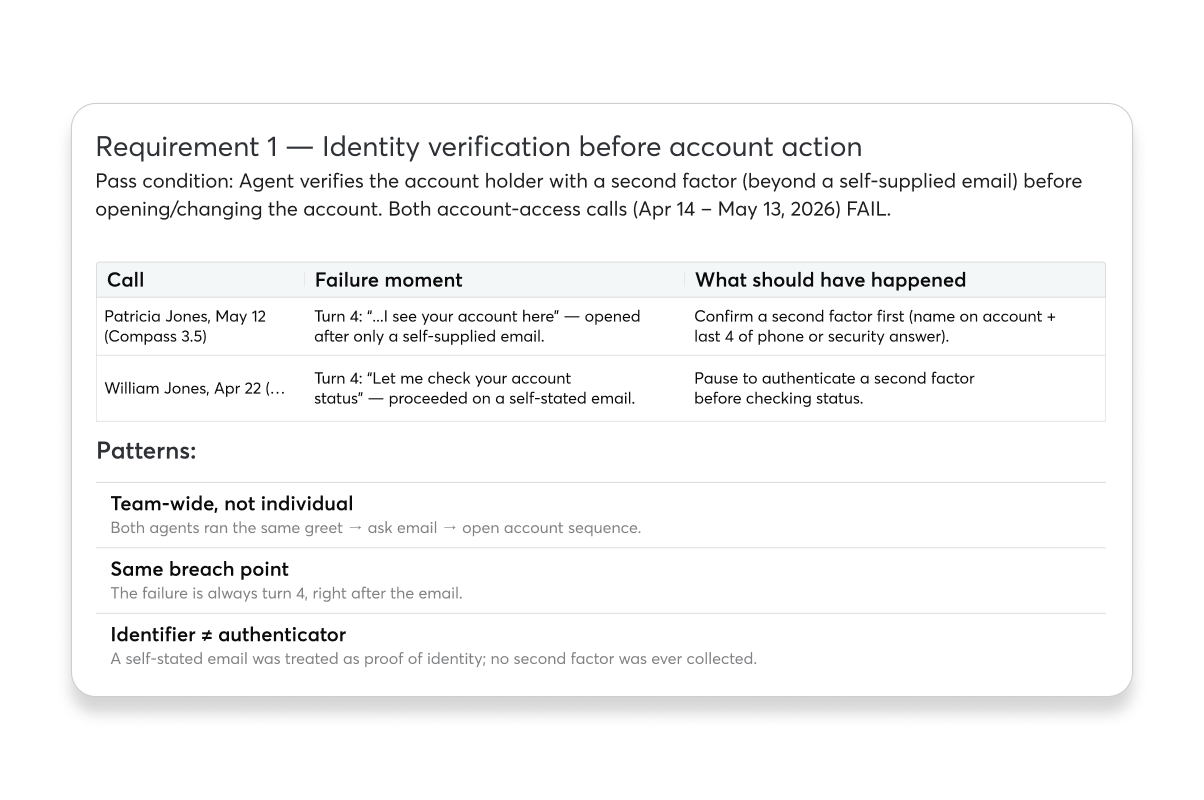
Your week is shaped by calls you never heard. At a state agency, a constituent waited forty minutes on the unemployment line and got the base-period rule explained wrong. The denial hits, the appeal goes to a hearing officer, local TV picks it up, and the legislator's office calls the director by Friday. At a city, a resident reported a hazardous condition that an intake worker logged as routine, and a records request now asks for every 311 call about that block. At a firm or public defender's office, an intake call disclosed matter facts before the conflict check ran, and the firm is arguing under Rule 1.18 whether it can keep the matter.
The clocks are statutory. California's Public Records Act gives ten days. New York's Freedom of Information Law gives five business days to acknowledge. Federal FOIA gives twenty working days. Federal Rule of Civil Procedure 37(e), as amended in 2015, raised the cost of failing to preserve electronically stored information, and audio and its derived transcripts are ESI. None of these deadlines pause because your QA platform was built to score a sample, not defend a discovery position or a privilege log.
Meanwhile the conversations keep happening. 311 lines handle water mains, code enforcement, and noise. State agencies handle eligibility, licensing, hearings, and notices of action. Public defender intake lines take calls where privilege attaches the moment a caller describes their situation. Firm intake lines manage prospective-client conflict screens under Rule 1.18. Each conversation is recorded, retained on a schedule, and one subpoena away from disclosure. The traditional answer is a QA team scoring two to five percent of calls plus a records team pulling audio one file at a time. That does not work when a single request can cover thousands of recordings.
The harder problem is what those calls do to public trust and professional standing. The phone line is where most residents form their opinion of how government works, and for a firm the intake line is where prospective clients form their opinion of competence and where 1.18 disqualification risk is born. A QA score nobody outside your team trusts is not the answer when the Inspector General, the bar, or an oversight hearing asks what happened on a specific call.
A two to five percent sample assumes the calls you reviewed are representative of the calls you did not. The calls your QA team did not score are still public records, still discoverable, still subject to the same retention schedules and disclosure obligations. A reviewer's confidence interval is not a legal defense, and "we sampled and scored well" is not the answer auditors or opposing counsel want to hear.
Sampling also misses the calls that decide outcomes. The intake worker who skipped the language line offer because the caller seemed to speak English well enough. The eligibility specialist who delivered a denial reason in language the caller could not follow. The paralegal who gave what could be construed as legal advice from a non-attorney under Rule 5.3. The associate who shared mental impressions on a returned voicemail and put work product into the recorded archive. None of these show up on a scorecard. They surface during a records request, a deposition, a federal monitoring letter, or a bar inquiry.
The third gap is pattern. One agent giving inconsistent guidance on a benefit eligibility question is a coaching issue. Forty agents doing the same across six months is an Inspector General finding. One intake call where matter facts preceded the conflict check is a near miss. Forty is a 1.18 problem the managing partner needs to hear about before opposing counsel does.
Recorded calls held by a government agency are public records under almost every state regime, subject to specific exemptions and record-series classifications. The California Public Records Act, Texas Public Information Act, Florida Sunshine Law, New York FOIL, Illinois FOIA, and federal FOIA at 5 U.S.C. § 552 all treat agency-created audio and its derived transcripts as records subject to disclosure. Usual exemptions cover personnel matters, ongoing investigations, attorney work product, deliberative process, juvenile records, medical information, and PII. Retention runs on state archives schedules and, for federal agencies, NARA general records schedules approved under 44 U.S.C. Chapter 33, with defensible disposition documented per record series. FRCP 26 and 37 govern litigation preservation, and Rule 37(e) addresses ESI specifically. Legislative subpoenas and Inspector General requests run on their own clocks, often shorter than FOIA.
For legal services, ABA Model Rule 1.6 requires reasonable safeguards for client confidentiality in the systems where communications are stored. Rule 1.18 imposes duties to prospective clients the moment significant matter information is disclosed. Rule 5.3 governs nonlawyer supervision, including front-desk and intake staff. State recording-consent laws range from one-party to all-party, with California, Florida, Illinois, Massachusetts, Pennsylvania, and Washington among the all-party jurisdictions. State and ABA opinions on AI use in client communications have multiplied since 2023, and the bar increasingly expects a written policy and a written agreement governing AI processing of confidential communications.
What changes with 100% coverage is the defensibility of the posture. A sampled QA program produces a statistical estimate, and a FOIA officer, hearing officer, oversight committee, or bar counsel is rarely satisfied with one. Compass produces evidence at the conversation level for every call, with a timestamped transcript, the conditions present, the behavior observed, and the signal that triggered the finding. Sampling defends process. Understanding defends substance.
The primary pillar for this buyer is Conversation Compliance, with secondary application across Conversation Insights and Conversation Quality. Conversation Coaching applies to intake teams, eligibility specialists, hearing officers, and paralegal staff once the compliance foundation is in place.
Compass ingests recorded calls from the platforms agencies and firms run on, including legacy state-owned systems and hosted PBX exports, and produces transcripts and structured understanding for every conversation searchable by entity, topic, signal, and outcome. You do not replace your recording platform, case management system, conflicts database, or script library. Implementation starts with a defined scope, usually one program, department, or practice group, and records and legal review happens before any recording is ingested. Contextual Entity Resolution, the model that connects a party name, case number, permit number, or program reference across calls, lets the system tell the difference between a name mentioned in passing and one that triggers a conflict-check obligation or records-hold scope.
Conversation Compliance. Disclosure tracking against the scripts your agency or firm uses. Required notices, jurisdictional limits, privilege warnings, and intake protocol sequence monitored at signal level. Records-hold and litigation-hold scoping with defensible logs.
Conversation Insights. Theme detection across constituent or client calls, drift analysis on guidance given over time, and entity-level patterns that surface systemic issues before they become Inspector General findings, federal monitoring letters, bar complaints, or press stories.
Conversation Quality. Conditions, Signals, Outcome Lift, and Guidance applied to constituent and client communications. Replaces sampled scorecards with a record of what happened, under what conditions, and which behavior moved the outcome.
Conversation Coaching. Evidence-backed coaching moments for intake workers, eligibility specialists, hearing officers, paralegals, and intake coordinators, tied to the specific calls and signals.
Q: Our recordings are public records. Does using Compass create new records subject to disclosure? A: Compass produces transcripts and structured signal outputs derived from the source recordings you already retain. Most records officers treat derived analytic outputs the way they treat other work product applied to existing records, with classification driven by state-specific exemptions and your schedule. Compass supports configuration so derived outputs follow the retention category of the source. Involve your records officer and counsel early to confirm classification under your regime.
Q: How do you handle attorney-client privilege and work product? A: Privileged content is identified at the segment level and access is role-controlled. Privileged calls can be excluded from broader analytic dashboards while remaining available to authorized counsel, so quality review does not create discoverable records of privileged content. Privilege determinations remain with your legal team. For firms, Compass also tracks intake-conflict sequence so 1.18 exposure is visible before it becomes a disqualification motion.
Q: What is your posture on FOIA exemptions and redaction? A: Compass surfaces the responsive calls. Your records officer applies exemptions. The platform supports redaction across audio and transcript for PII, ongoing investigations, juvenile, medical, deliberative process, and attorney work product, with logs of who redacted what. 100% coverage makes exemption decisions easier to justify because you are working from the full set.
Q: How does chain of custody, records hold, and certified destruction work? A: The source recording in your platform remains the record of original capture. Compass transcripts and signal outputs are derived analytic records, time-synchronized and tied back to the source, so an Inspector General, auditor, or opposing counsel can verify any finding against the underlying recording. Records holds can be placed on defined sets, disposition can be frozen and lifted with logs, and disposition certificates are produced when records age out. Audio and transcripts both.
Q: What about procurement? We buy through cooperative vehicles. A: Chordia works with the cooperative purchasing vehicles agencies typically use, including NASPO ValuePoint, GSA, and state master contracts where applicable. For firms, we work through standard vendor onboarding and outside counsel guideline review where institutional clients impose OCGs on AI use in client communications.
Q: What is your security posture, and do you sign a BAA or equivalent? A: We sign standard paperwork: NDA, BAA when protected health information is involved, and state-equivalent data processing agreements for criminal justice, juvenile, education, and tax-protected categories. SOC 2 is in progress. Vendor security documentation, including our subprocessor list and data flow, is available on request during your security review. No customer data is used to train models that serve other customers. Compass operates as a processor on customer data, and subpoenas served on Chordia for customer data are forwarded to the customer where legally permissible. We work through your security review process with you.
Q: Will it work with our recording platform, case management system, or conflicts database? A: Compass ingests from common government and enterprise recording platforms, including legacy state-owned systems, and exports to common legal and government workflow tools, including the conflicts and document-management systems firms use. Where an integration is not feasible, we say so. You do not replace your phone vendor.
Q: We are a unionized workforce. How does 100% monitoring fit our collective bargaining agreement? A: 100% analysis is not the same as 100% supervisor listening. Compass produces structured signal output and surfaces specific calls for review based on configurable rules. Many agencies bring labor relations into implementation early and align signal categories and access controls with the CBA.
Q: How is this different from Gong, NICE, Verint, CallMiner, or an LLM with a prompt? A: Those platforms were built for sales effectiveness, sampled QA, or generic transcription. Compass was built around 100% coverage with compliance-grade audit evidence, entity resolution across calls, privilege and record-series tagging at the segment level, and the workflows a records officer, general counsel, or bar-facing compliance lead actually needs. A prompt against a transcript does not produce a defensible record.
Start with a working session, not a sales call. We sit with your records officer, general counsel, or e-discovery lead and walk through Compass against example calls or a sandbox built from non-sensitive material. NDA and BAA come first when your data is involved. From there, a defined-scope pilot on one program or practice group.