




















Compass listens to 100% of your producer, claims, and member calls and turns each one into structured evidence the NAIC model framework, state DOI examiners, and CMS Medicare reviewers actually ask for. No more 2% samples. No more reconstructing what an adjuster or producer said from memory.
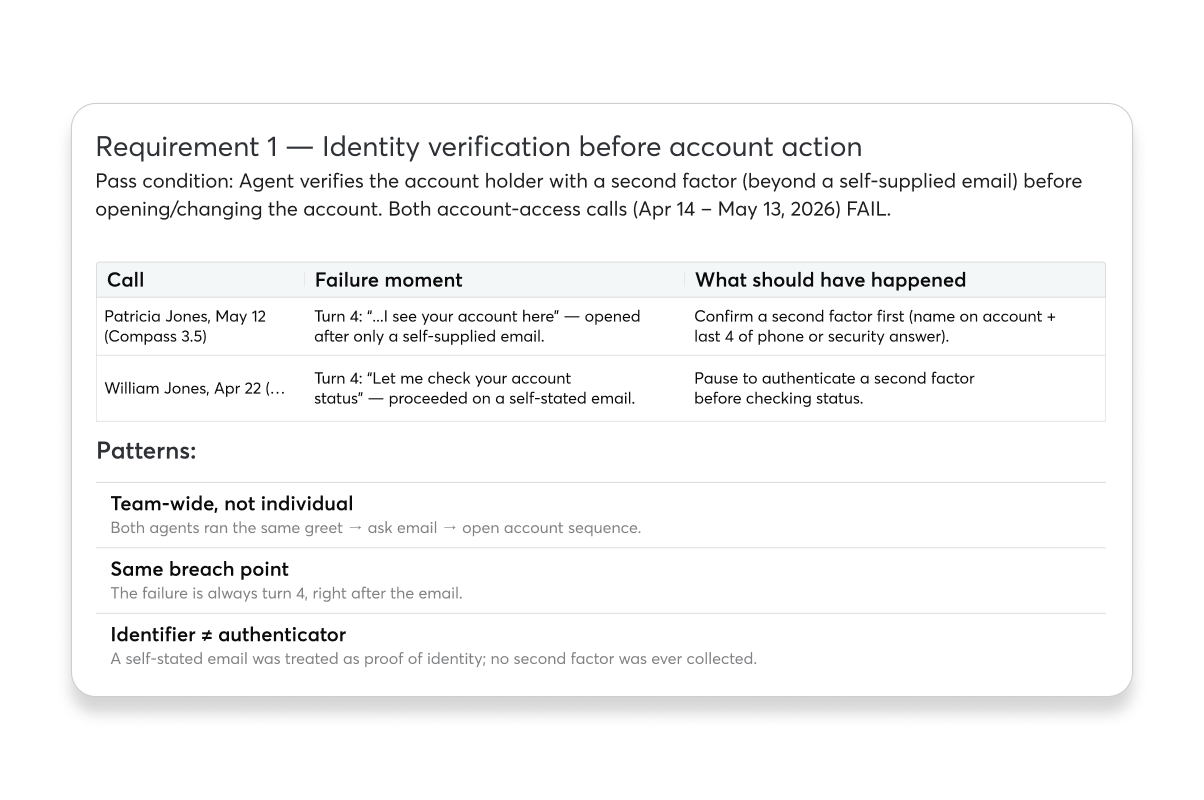
Your week reads like a regulatory map. Monday a market conduct exam letter from a state Department of Insurance asks for eighteen months of recorded sales calls on an annuity product, plus the suitability analysis behind each placed application. Tuesday a CMS audit request lands and wants Scope of Appointment forms cross-matched to the actual recorded conversation. Wednesday your General Counsel forwards a bad-faith demand letter quoting an adjuster verbatim from a first-notice-of-loss call you have never heard. Thursday a producer licensed in eleven states wrote business in a twelfth. Friday QA tells you they reviewed 38 calls last month against the rubric and everything looked fine.
The "everything looked fine" part is what keeps you up. Your P&C claims operation, your life and annuity sales floor, your Medicare distribution channel, and your health plan member services all sit under the same compliance program on paper. In practice they live on different recorders, follow different scripts, answer to different regulators, and produce different evidence formats when someone asks. NAIC model acts give you the frame. State DOIs write the actual findings. CMS resets the Medicare Communications and Marketing Guidelines every plan year. State senior protection statutes and unfair claims practices acts vary state to state.
Audit triggers include market conduct exams, CMS secret shopper findings, ICAR remediation, producer terminations for cause, bad-faith demand letters, and the consumer complaint that escalates to the DOI before anyone has pulled the file. The failure modes are specific and expensive. A life producer reads the replacement comparison too quickly and skips the cash value impact. An adjuster makes a coverage representation before the investigation is complete and leaves reservation of rights language out. A Medicare agent pivots from MedSupp into MAPD without re-executing Scope of Appointment under 42 CFR 422.2264. A producer skips the required TPMO disclaimer ("We do not offer every plan available in your area...") at the top of a marketing call. Each is a single sentence in a single call, invisible to a QA program built on sampling.
Most insurance compliance programs sample 2 to 5 percent of conversations and grade them against a rubric. A producer can deliver a non-compliant SOA pitch every week for a year and never appear in your sample. An adjuster can drift on UCSPA acknowledgment language across hundreds of FNOL calls before one lands in a QA queue. "We scored 96% on the sample" is not the answer that closes an exam finding. The Market Regulation Handbook does not assume sampling.
Sampling misses suitability as an analysis. A producer asks about retirement timeline at minute four, existing coverage at minute twenty, liquidity needs at minute twenty-eight, and lands a recommendation at minute thirty-two. A scorecard checkbox for "suitability discussed yes or no" cannot evaluate the connection between data gathered and product recommended. The application paperwork shows a snapshot. The conversation shows the analysis. Regulators ask for both.
Sampling also misses the population-level patterns regulators care about. A market conduct exam is looking for a pattern or practice, and a handful of sampled calls cannot prove the absence of one. The producer who skips suitability on annuity replacements tends to skip it on indexed universal life. The claims rep who rushes acknowledgment on auto bodily injury rushes it on homeowners water damage. Random sampling washes those clusters out.
Insurance is a state-regulated business with federal overlays where Medicare and ERISA touch. The compliance posture has to satisfy several regulators at once.
The NAIC publishes model acts that states adopt with variation. Three matter most for what shows up in exams. Model #275, the Suitability in Annuity Transactions Model Regulation, sets what a producer must collect and document on every annuity sale, with the 2020 best interest revision adopted in most states with state-specific edits. Model #613 governs replacement disclosures on life and annuity transactions. Model #900, the Unfair Claims Settlement Practices Act, governs claims conversations and varies materially in adopted timeframes from state to state. The Market Regulation Handbook is the working playbook examiners follow.
For Medicare lines, CMS publishes the Medicare Communications and Marketing Guidelines each plan year. Recording-and-retention requirements for Medicare sales, marketing, and enrollment calls carry a ten-year retention obligation. The TPMO disclaimer, the broader definition of marketing, and downstream-entity oversight responsibilities have all moved in recent plan years, with some provisions modified by litigation. Plans and contracted agents need evidence that maps to the framework in effect for the plan year under review.
State DOIs publish complaint indices, run market conduct exams off complaint patterns, and pursue producer enforcement on licensing and appointment failures. State UCSPA timeframes, senior protection statutes, replacement notice rules, and recording consent laws all vary. The defensible posture across this tapestry is not "we scored well on our sample." It is "we evaluated 100% of conversations against the requirement in effect for that state, line, and plan year, here is the population view, here are the exceptions, and here is the remediation record." Compass produces that posture with timestamped transcripts, signal-level annotations, the model version that scored the call, and the rule library each call was checked against.
Compass is an interaction intelligence platform that analyzes 100% of your producer, claims, and member service conversations across whatever recorders you run. It does not replace your recorder. It reads what your recorders produce and turns each call into structured evidence built on Contextual Entity Resolution, our way of identifying the people, products, states, plans, and obligations present in a conversation and tracking how they relate. Each call produces Conditions (what was true about the call), Signals (more than 130 behavioral patterns each scored from 0 to 1), Outcome Lift (what behaviors move outcomes that matter), and Guidance (what to do about it).
The primary pillar for insurance compliance is Conversation Compliance. The other three pillars make the evidence operational.
Q: We run multiple recorders across P&C claims, life sales, and Medicare distribution. Does that work? A: Yes. Compass ingests from the major insurance recorders, including separate carrier and TPMO stacks, and normalizes them into one evidence layer so you stop reconciling three sets of exports for one audit response.
Q: How do you handle multi-state producer licensing? A: Compass cross-references the producer against your NIPR feed, the consumer's state, and the carrier's appointment status at the time of the call. Calls where the producer was not licensed, not appointed, or not authorized for that line of authority in that state are flagged at the call level, before the application is keyed.
Q: Recording consent rules vary by state. How does Compass handle that? A: Recording consent is set by state law and by your operational policy, not by Compass. Two-party consent states (California, Florida, Pennsylvania, Illinois, Washington, Massachusetts, Maryland, Montana, and several others, with periodic updates) require the disclosure script your recorder plays. Compass tracks whether that disclosure was actually delivered on the call, in what wording, and at what point in the conversation, so you can audit consent capture the same way you audit any other required disclosure. Where state law and CMS retention differ, we hold per-state and per-line retention policies.
Q: How does this work with Medicare TPMO oversight? A: Plans are accountable for downstream TPMO conduct under current CMS rules. Compass ingests recordings from delegated entities and contracted field marketing organizations and produces the same evidence view across your full panel. You get TPMO disclaimer delivery rates, SOA cadence, and senior-protection signal data per downstream entity, retrievable when CMS asks.
Q: How does the evidence interact with attorney-client privilege and work product in bad-faith litigation? A: The honest answer involves your General Counsel and outside insurance defense counsel. Compass evidence is a recurring business record produced in the ordinary course, not litigation work product. The discoverability posture depends on how your program is structured, what role outside counsel plays, and your state's rules. We walk through working configurations with your legal team.
Q: What about procurement: BAA, SOC 2, vendor security review? A: We sign Business Associate Agreements for health plan and Medicare deployments where PHI is in scope. Standard paperwork (NDA, BAA, DPA) is available. SOC 2 is in progress. Vendor security documentation is available on request during your review. No customer data is used to train models that serve other customers. We work through your security and model risk process with you rather than handing over a static packet.
Q: How is this different from CallMiner, Verint, NICE, or our recorder's analytics module? A: Older speech analytics platforms count keywords and run rules. A keyword hit tells you a phrase appeared. It does not tell you whether the disclosure was complete, in order, and addressed to a consumer who acknowledged it. Compass scores behavior across more than 130 patterns calibrated to outcomes, treats claims and sales as different regulatory animals with different signal sets, and produces evidence in a format examiners can work with rather than spreadsheet exports.
Q: We are remediating an ICAR or a market conduct exam finding. Can Compass support that? A: Yes. Population-level remediation is what 100% coverage is built to demonstrate. Compass produces before-and-after evidence per producer or adjuster, per state, per signal, in the format reviewers expect when validating a Corrective Action Request response.
Q: What does a producer termination-for-cause evidence pull look like? A: Compass retrieves every recorded call that producer touched, across every state they wrote in, with signal-level annotation, on a timeline measured in hours rather than weeks.
We run a 30-minute working session, not a demo. We start against anonymized samples in your lines and states so the work is concrete from the first minute. When your recordings come into scope, NDA and BAA come first, then we run the same session against your own calls in the format your next exam letter will ask for.