




















Compass turns every member conversation into examiner-ready evidence. When NCUA asks how you know disclosures landed, who escalated which BSA red flag, and whether the last finding is actually closed, you show the calls, the timestamps, and the trend across every rep.
The exam scheduling letter lands on a Tuesday. The NCUA examiner-in-charge wants the BSA program walkthrough, the complaint log, member service call samples, the Reg E error resolution file, fair lending workpapers, and a rundown of how your call evidence supports the consumer compliance review. You have six weeks. Your QA team scored a small sample last quarter against a rubric built for a different era. The examiner will ask about everything else.
Most credit union compliance leaders are not afraid of the exam itself. They are afraid of the gap between what they know and what they can prove. You know the disclosures are in the script and the timing rules are in the training. What you cannot do today is sit across from the examiner-in-charge and answer the question that always comes next: prove it. Prove disclosure delivery. Prove escalation. Prove the complaint pattern your team flagged in March was addressed and did not recur.
The supervisory letters keep getting more specific. NCUA Letters to Credit Unions on overdraft program practices, fair lending, elder financial exploitation, and BSA program effectiveness all point the same direction. Examiners want evidence that your program works at the conversation level, not just the policy level. A clean policy binder does not carry the exam anymore. Matters Requiring Attention (MRA), Documents of Resolution (DOR), and in the worst case a Letter of Understanding and Agreement (LUA) increasingly cite call handling, disclosure consistency, complaint root cause, and escalation patterns.
The workload keeps stacking. BSA/AML touches every account opening, every wire request, every cash-structuring inquiry. Reg B requires adverse action language members hear delivered out loud. Reg E has ten-day and forty-five-day clocks that depend on what the member communicated and when the credit union had notice. Reg DD APY disclosures move with the rate sheet. UDAAP is a conversation-level standard. CFPB 1071 small business data collection is now in scope for fair lending review. Sampling a small percentage of calls against a static rubric is not the answer the examiner wants, and not the answer your supervisory committee should accept.
Traditional QA at most credit unions samples a small percentage of calls per rep per month against a rubric that combines compliance attributes with soft skills. The scores look fine. Internal audit signs off. Then the exam happens and the examiner asks for the specific calls that triggered Reg E error resolution last quarter, the new account interviews where the member mentioned structured cash, or the indirect auto deals where adverse action was delivered by phone. Your team pulls them by hand with no signal-level index. The weekend goes.
What sampling misses is structural, not random. Reg E disclosure drift on debit card disputes tends to happen at end of shift when the queue is deep and the rep is rushing. Your mid-shift sample never sees it. BSA red flag handling gets abbreviated when the same member calls back a third time and the rep assumes a prior rep already handled it. The escalation never happens, the SAR never gets filed, and the sample never catches the gap. Adverse action language gets softened to preserve the member relationship, and the Reg B clock never starts cleanly. An eleven-year rep who has said the Reg DD disclosure ten thousand times starts abbreviating the back half, and sampling is statistically unlikely to land on her drift week.
Sampling also misses the cross-rep pattern. One rep skipping a disclosure once is a coaching moment. Eight reps drifting on the same disclosure across the same product line is a finding waiting to happen. Your sample shows you the first story. Your exam shows you the second.
NCUA examinations weight consumer compliance and BSA program adequacy alongside safety and soundness. The consumer compliance scope picks up Reg B (ECOA), Reg E (EFTA), Reg DD (Truth in Savings), Reg Z (TILA), UDAAP, and fair lending under ECOA and the Fair Housing Act. The BSA scope picks up your AML program, suspicious activity reporting, currency transaction reporting, member due diligence, and beneficial ownership rule compliance. Recent supervisory priority letters have repeatedly emphasized overdraft program practices, fair lending including 1071 readiness, and elder financial exploitation detection.
Findings come in three flavors that matter. A Matter Requiring Attention asks the board to address a weakness. A Document of Resolution sets specific remediation expectations with deadlines and follow-up review. A Letter of Understanding and Agreement is a formal enforcement action with consequences for board and management. All three get harder to close when the evidence base is a sampled scorecard rather than the underlying conversations.
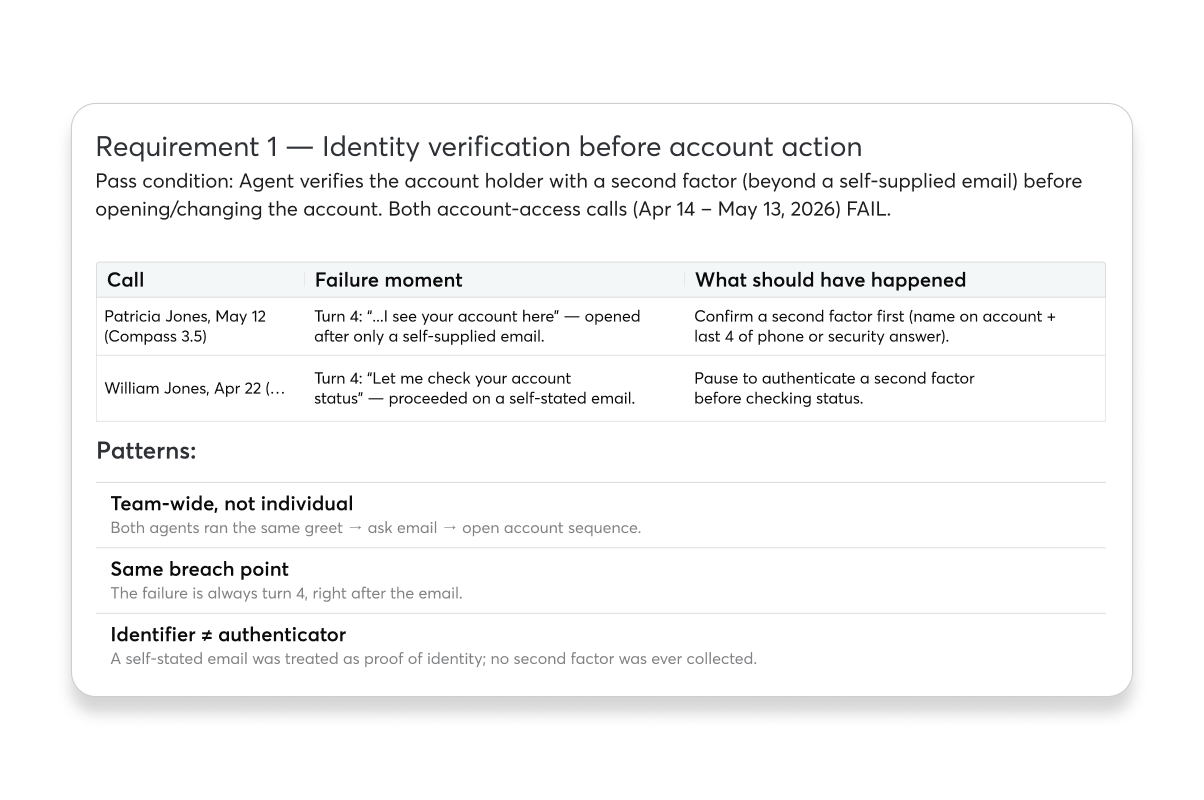
Compass produces evidence that holds up in this context. Every conversation is transcribed, indexed, and timestamped. Every signal carries a transcript anchor and a version reference for the model that scored it. When the examiner asks for the population of calls that triggered Reg E error resolution last quarter, you produce the list and the calls without burning a weekend. When the DOR asks for evidence that disclosure consistency improved over the remediation period, you produce the trend with the underlying calls. Your supervisory committee gets the same evidence base for its statutory review, not a quarterly QA report assembled from a sample they have no way to validate.
The primary pillar for credit union exam readiness is Conversation Compliance, because exam defense is built on disclosure tracking, script adherence, and an evidence trail your examiner can verify. Conversation Insights is the foundation, because compliance signals run on top of 100% coverage. Conversation Quality and Conversation Coaching turn the same evidence into rep development and findings closure. Your existing QA program continues. What changes is the evidence underneath.
The Compass quality framework replaces a static score with four parts: Conditions (what the call was about, for example a Reg E unauthorized transaction claim within ten business days of the statement), Signals (the behavioral patterns that showed up, for example the rep delivered the disclosure but did not start the provisional credit clock), Outcome Lift (whether handling that signal changed the outcome, like dispute resolution within regulatory timing), and Guidance (the coaching moment tied to the actual call). The framework is concrete because it is built from real calls.
Q: We already have a QA team running scorecards. What changes for them? A: Your QA team is an ally, not the legacy thing being replaced. They stop scoring random samples and start running a program on a complete population. The shift is from data entry into actual quality work: pattern review, coaching support, and findings closure.
Q: How does this hold up in an actual NCUA exam? A: Evidence is conversation-level, timestamped, and reproducible. Examiners see the calls, the transcripts, the signal-level patterns, and the trend lines. You walk in having reviewed 100% of relevant conversations against the applicable regulations, with documented methodology and model version metadata behind each signal. That stands up better than a sampled scorecard for an MRA, a DOR, or an LUA closure file.
Q: What about procurement, vendor risk, and InfoSec review? A: We sign standard paperwork: NDA, MSA, DPA, and a BAA where it applies. SOC 2 is in progress. Vendor security documentation, including subprocessor list and access controls, is available on request during your vendor review. Compass fits into the model risk management framework your team already uses for vendor and model governance, and no customer data is used to train models that serve other customers. We work through your security review process with you rather than handing over a packaged file.
Q: Where does the audio live, and what happens at termination? A: Audio and transcripts stay in your tenant. Access is role-based and logged. At termination, your data is returned or destroyed on a schedule we agree to in the contract.
Q: Our reps are unionized. What does 100% scoring mean for the CBA? A: Moving from sampled QA to 100% coverage can be a bargaining item under a collective bargaining agreement, and we treat it that way. Reps get visibility into their own evidence before coaching conversations, which supports due process and reduces grievance risk. We share the union notification playbook other credit unions have used before you bring this to HR and your steward.
Q: What about member consent and state two-party recording laws? A: Compass processes audio you are already recording under your existing member notice. Several credit unions have updated their recording disclosures and privacy policy to cover automated analysis of recorded calls. We share the language others have adopted.
Q: Will this work with our existing recording, WFM, and QA tools? A: Compass ingests from the recording platforms credit unions run and works alongside the major workforce management and QA stacks. Implementation is read-only ingestion of audio and metadata you already capture.
Q: How does Spanish and bilingual member calls work? A: Compass processes Spanish and handles bilingual code-switching common in many credit union memberships. Disclosure tracking accounts for approved translation variants.
Q: How is this different from the AI features our recording vendor is shipping or from Verint, NICE, and CallMiner? A: Those tools transcribe, summarize, and run keyword search. Compass extracts structured understanding from the call, what we call contextual entity resolution, which means it knows what the call was about, what conditions applied, what the rep did and did not do, and what the outcome was. The difference shows up the first time an examiner asks a question keyword search cannot answer, like "show me every Reg E dispute call where the provisional credit clock did not start on time."
Q: What does implementation actually look like, honestly? A: For a smaller credit union with a straightforward recording stack, weeks. For a larger credit union with full InfoSec review, vendor risk, model risk management, and a labor notification path, four to nine months end to end is realistic. We are direct about which path applies before you sign.
The best first step is a working session with your compliance lead and BSA officer. We'll look at a few real exam questions you've been asked and show what the answer looks like when 100% of the calls are behind it. NDA and BAA come first when member calls are involved. Reach out and we'll set a time.