



















Compass listens to 100% of patient support, medical information, and field calls. Adverse events, off-label moments, and promotional claims are tagged with the timestamps, attribution, and audit trail GxP inspectors expect.
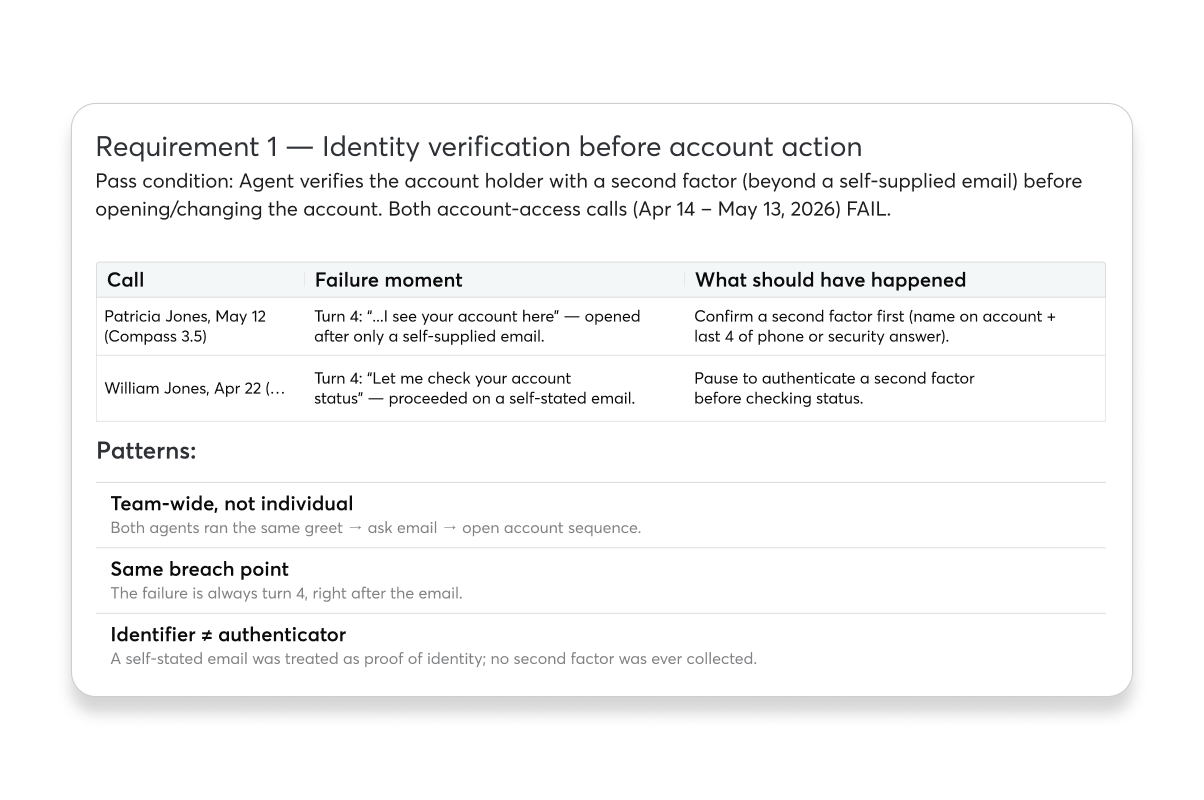
You run compliance, QA, or regulatory affairs at a pharma, biotech, or med-tech company. Your week is shaped by inspections you cannot fully see coming. A 483 from a recent BIMO visit sits in a folder. OPDP sent an untitled letter to a competitor last month and your promotional review committee has been re-reading it since. GVP timeliness slipped a point last quarter and nobody can tell you whether the gap was HUB intake, internal triage, or the safety database itself.
The customer-facing voice operations under your umbrella are not one thing. Medical information takes HCP inquiries that can turn into off-label discussion at any second. The patient support program runs through one vendor for the HUB, another for copay, possibly a third for reimbursement, with field reimbursement managers and nurse educators talking to patients and providers every day. Field sales and MSL teams hold conversations governed by different rules from PSP and medical. Each surface can carry a reportable adverse event, a product complaint, an off-label moment, or a promotional claim that crossed a line. Each becomes a regulated record under 21 CFR Part 11 the moment it touches a system you control.
The assurance you can offer today is a 2 to 5 percent QA sample against a rubric. The aggregate looks fine. Then a real AE comes in late and your team spends three weeks pulling audio by hand to reconstruct who heard what, when. Or a sponsor audit pulls a sample and gets unlucky on an FRM call. Or a competitor's untitled letter cites a fact pattern that matches one of your products and your CQO asks how you would know if your reps were doing the same thing. The honest answer is usually that nobody knows.
FDA, EMA, and your internal QA group are not impressed by a high score on a small sample. They want the population, the controls, the audit trail, and evidence that AEs and product complaints were detected and routed inside the regulatory clock. GVP Module VI and Module IV both reach the same conclusion: capture suspected adverse reactions from all sources, including unsolicited patient and HCP communications.
A 2 to 5 percent sample is built to score the obvious and miss the rare. The patterns that create real exposure in pharma are sparse. AE mentions are sparse. Off-label questions are sparse. Reportable product complaints are sparse. A sampling program tuned for statistical confidence on common errors is structurally blind to the events that drive 483 observations, Field Alerts, untitled letters, and warning letters.
Consider what is invisible at 2 percent. A patient on a specialty therapy mentions in the middle of a 22 minute benefits investigation that her hands have been shaking since she started the drug. The agent solves for prior authorization. The AE signal is buried, not captured, not on the 15-day clock. A medical information specialist responds to an off-label HCP question without first confirming the unsolicited request criteria OPDP lays out. A nurse educator drifts past indication. A field rep makes a comparative efficacy statement that has not cleared promotional review. None of these calls are in your sample, so none are in your evidence.
The vendor layer makes it harder. Most patient support is outsourced through one or more contracted operators. Your QA team reviews what the vendor's QA team selected. You are looking at a sample of a sample. When an FDA investigator asks you to demonstrate oversight of your contracted patient support program, "we reviewed the vendor's monthly report" is not a strong answer.
Capturing audio is the easy part. Producing electronic records an FDA investigator will accept under 21 CFR Part 11 is a different problem.
Part 11 electronic records. Part 11 applies wherever electronic records replace paper records required by predicate rule. Call recordings, transcripts, QA outputs, and the analytics derived from them become electronic records when they support GxP decisions under predicate rules like 21 CFR 314.80 (postmarketing safety reporting), 21 CFR 600.80 (biologics), and parallel obligations under GVP and under GCP where conversations touch trial recruitment. Part 11 expects validated systems, accurate and complete copies, protection of records through the retention period, access controls, and secure computer-generated time-stamped audit trails for every record action.
Compass operates under your Part 11 controls in your validated environment. Every transcript, behavioral signal, condition tag, classification, reviewer override, and disposition is attributable, time-stamped, and retrievable. Your validation function owns the protocols, the categorization, and the approval. We support that work with the system documentation your team needs to write its own qualification, and we participate in the joint sessions your QA group runs. We do not claim "pre-validated."
GxP audit trail expectations. Whether the call sits inside GVP, GCP-adjacent trial work, or GMP-adjacent complaint handling, auditors apply ALCOA+ (attributable, legible, contemporaneous, original, accurate, plus complete, consistent, enduring, and available). The trail must show the full history of changes, including who made them and why. Every change to a classification, every reviewer override, every escalation to safety lives in a structured audit trail tied to the original recording. When an auditor asks for the lineage of a specific case, you produce it in minutes.
Adverse event reporting and reconciliation. Under 21 CFR 314.80, sponsors must report serious and unexpected events to FAERS within 15 calendar days from the moment a sponsor employee or contractor first becomes aware. The hard part is not the form. It is upstream detection and reconciliation. Compass surfaces conversations that warrant pharmacovigilance review, tags the moment AE language appeared, and produces an exportable evidence pack your PV team can reconcile against case counts in Argus, ArisGlobal, or Veeva Vault Safety. The reconciliation report is the artifact an inspector or sponsor auditor will ask for.
OPDP and the promotional perimeter. OPDP enforces against false, misleading, or unbalanced promotional communication under the FD&C Act and 21 CFR 202, with broader authority under 21 CFR 314.81. Untitled letters land far more often than warning letters and the operational response differs. What triggers either is what reps and field staff say on calls, not just what appears in printed pieces. Compass gives promotional review the conversation-level evidence to manage that perimeter.
Compass ingests recordings from the platforms patient support, medical information, and field teams already use. You do not change your recording infrastructure. The system extracts the conditions of each call (program, product, indication, payer context, HCP credentials, patient situation), scores behavioral and content patterns we call Signals against your label, approved messaging, SOPs, and safety definitions, and produces structured evidence per call, agent, vendor, and program. Signal libraries are tuned during onboarding with your medical, regulatory, and compliance teams. Medical information calls run on a different Signal profile from commercial calls, with partitioned access so promotional review cannot see medical content and commercial coaching is not built on medical conversations.
Conversation Compliance. AE detection, product complaint classification, off-label flagging by type, promotional adherence, disclosure tracking, and a Part 11 grade audit trail for every conversation. Evidence that holds up in OPDP review, FDA inspection, sponsor audit, and EMA GVP audit. Primary pillar.
Conversation Quality. Conditions, Signals, Outcome Lift, and Guidance replace the QA scorecard with a structured account of what happened on the call and how it affected the outcome. Compliance, medical affairs, PV, and patient services share one record of truth.
Conversation Insights. 100 percent coverage of patient, HCP, and field conversations. AE under-reporting patterns by intake source, off-label drift by product, claim deviation trends by territory, and inquiry themes that should update standard response letters. You see the program, not the sample.
Conversation Coaching. Evidence-backed coaching for nurse educators, HUB agents, medical information specialists, and field reps. The coaching moment is the actual conversation, not the reviewer's interpretation of it.
Q: How does Compass fit into our 21 CFR Part 11 environment? A: Compass operates under your Part 11 controls in your validated environment. Your validation function owns the protocols and the approval. We provide the system documentation your team needs to write its own qualification and we participate in the joint sessions your QA group runs.
Q: How does AE detection work, and does it replace our case intake process? A: It does not replace case intake. Compass detects AE-relevant language on every call and surfaces candidates to pharmacovigilance with audio segment, transcript, and entity context attached. Your safety team makes the reporting decision. The output also supports reconciliation against case counts in Argus, ArisGlobal, or Veeva Vault Safety.
Q: How do you handle two-party consent and recording legality? A: Consent capture is its own Signal family. Compass tracks whether the consent recital was delivered, the response, and the moment consent was confirmed or refused. We work with your privacy counsel on state two-party consent variation, the recital script, and how the system handles refusal mid-call. Recordings live where your policy says they live.
Q: How do you handle PHI, BAAs, and outsourced vendors? A: We sign BAAs and DPAs. Standard paperwork (NDA, MSA, DPA, BAA) is available. SOC 2 is in progress. Vendor security documentation is available on request and we work through your security review process with you. For outsourced HUBs, copay, and reimbursement vendors, BAA flow-down and subcontractor terms are part of the implementation conversation. No customer data is used to train models that serve other customers.
Q: We already have validated medical information and case management platforms. Why add Compass? A: Your platforms manage the case. Compass observes the conversation. It flags off-script responses, deviations from approved standard responses, AE signals, and product complaints that need different routing, then hands the structured record to your platforms for case management and downstream reporting.
Q: How is this different from a general conversation analytics tool or a tool like Gong? A: Generic tools score tone, spot keywords, or coach sellers. Compass detects regulated behaviors against pharma-specific definitions: AE language matched to the reportability elements, off-label distinguished by type, fair balance, PI adherence, REMS elements, copay program rules, and consent capture. Signals are tuned to FDA, EMA, and OPDP expectations. Model behavior is itself controlled and documented for validation.
Q: What about MSL field conversations that are not recorded? A: Where recordings exist under a clear consent and use policy, Compass processes them. Where they do not, this is a policy question for medical affairs and legal about whether and how to extend recording with appropriate consent. We do not assume the bridge has been crossed.
Q: How does implementation work, and what do we look at before we share calls? A: NDA and BAA are signed before any patient data moves. The first working session uses anonymized or synthetic examples and your SOPs. Real calls come into a sandboxed tenant after BAA. Signal calibration to your products, indications, approved messaging, and SOPs is the longer part of the timeline and is done jointly with your medical, regulatory, and compliance teams.
The best way to evaluate Compass is a 30 minute working session with your compliance, PV, and medical affairs leads. We use synthetic examples first. Real recordings come after NDA and BAA. Send us a note and we will set a time.