




















Compass listens to 100% of your sales conversations and shows you which behaviors actually close, where reps drift on the disclosures your industry requires, and what to coach next. Built for sales floors where the phone is the conversion: insurance agencies, home services, education enrollment, automotive, real estate, and travel.
You run a sales floor where the phone is the conversion. The shape changes by industry, but the week looks the same. An agency selling Medicare Advantage, final expense, and term life. A regional HVAC and solar brand booking in-home estimates. An enrollment team at an online college pushing toward a cohort start. A dealership BDC working internet leads. A real estate brokerage qualifying buyers. A travel desk closing cruise and tour bookings. A small group of reps closes most of what closes, the middle underperforms its lead allocation, and you spend Monday morning staring at a CRM dashboard wondering why.
The pressure comes in three currents. Volume, because cost per lead keeps going up. Conversion variance, because your top closer keeps a private playbook in her head that nobody else can see. Compliance, because every industry on this list has rules about what a rep can say on a recorded line, and the rules tighten when revenue pressure spikes. Your QA team listens to a handful of calls per rep per month against a scorecard the reps argue with, and the monthly deck says quality is up two points. None of that tells you what to do at Thursday's coaching.
The seasonal waves are predictable and brutal. Medicare agencies live and die by the Annual Enrollment Period. HVAC peaks twice a year. Roofing spikes after every named storm. Enrollment runs against cohort start dates. Every spike means new reps with two weeks of training taking calls on the most expensive leads, and you cannot prove which behaviors are bleeding the money.
The KPIs are not abstract: persistency for insurance, ninety-day retention for enrollment, cancel rate on home services estimates, no-show rate on automotive, quote-to-close on whatever you sell. You can see the numbers move. You cannot see what reps did differently on the calls that produced them. When a regulator, carrier, or accreditor asks how you know what was said, "we sampled forty of them" is the answer that ends careers.
Traditional QA listens to two to five calls per rep per month against a rubric. Twenty reps, five calls each, one analyst. Two hundred calls reviewed out of the ten or twenty thousand the floor produced. The math has never worked.
The variance that matters is a pattern, not a single behavior: how your top closer opens, what she does in the first ninety seconds when the prospect resists, how she presents financing or premium, how she handles the second objection after the first is resolved. A two-call sample does not show the pattern. You coach from anecdotes and gut feel, and your reps know it.
Sampling also misses compliance drift when it matters most. The calls most likely to drift are the ones the sample is least likely to catch. Friday afternoon. End-of-month push. The third week of AEP. Reps under quota pressure shave disclosures, skip the documented step before plan-specific benefits, or describe a program in language that would not survive a formal review. A rep who books eight out of twenty and a rep who books fourteen are not running the same call, and the unsold pitches are where the diagnostic lives.
This persona spans industries with very different rule sets. The discipline of a defensible posture is the same across all of them. Where your reps spend their day determines which of these matters most.
Insurance sales. State Department of Insurance licensing rules govern who can sell, in which states, and what they have to document. NAIC suitability model regulations require recommendations to be appropriate for the consumer, with documentation that survives a market conduct exam. Medicare-aligned sales add the CMS Marketing Guidelines: the Scope of Appointment has to be documented before any plan-specific benefit discussion, and the required disclaimer has to be read on inbound and outbound calls. Persistency, rapid disenrollment, and complaint trends are monitored by carriers and CMS at the contract level, and a carrier can suspend a downline contract on those numbers. Independent agencies also carry Errors and Omissions coverage, and better call evidence directly reduces E&O exposure.
Education enrollment. Title IV institutions are governed by the Department of Education's substantial misrepresentation rules at 34 CFR 668.71 through 668.75, covering the nature of the program, financial charges, and the employability of graduates. The 2023 gainful employment rule is in force, the 90/10 rule constrains revenue mix, and incentive compensation restrictions under HEA 487(a)(20) limit how counselor performance can be evaluated and paid. Borrower defense claims rest in significant part on what students were told during enrollment, and state AGs run active enrollment-practice investigations.
Home services, automotive, real estate, travel. State contractor licensing boards require licensed work to be sold by licensed personnel, with the license number disclosed in many states on outbound calls. The FTC Cooling Off Rule applies to in-home and off-premises sales, and promotional financing pitches bring consumer credit disclosure expectations into the call. State telemarketing acts, DNC registries, and TCPA consent rules apply to outbound selling. Automotive dealers face state UDAP statutes, FTC advertising rules, and the CARS Rule. Travel sellers in several states must comply with Seller of Travel registration. Real estate inside sales agents work under state commission rules.
In all of these contexts, evidence beats opinion. A timestamped transcript with a documented signal trail and 100% coverage is a different category of artifact from a sample-based score. When an examiner, auditor, accreditor, carrier, or state AG asks how often a required statement was delivered last quarter, the answer is a query.
Compass understands every call as a structured event: who said what, in what conditions, with what outcome, and how the rep's behavior shaped it. That becomes one dataset that supports coaching, compliance, and conversion at the same time. The primary pillar for phone sales is Conversation Quality. Coaching, Insights, and Compliance work alongside it, with the balance shifting toward Compliance in the more regulated verticals.
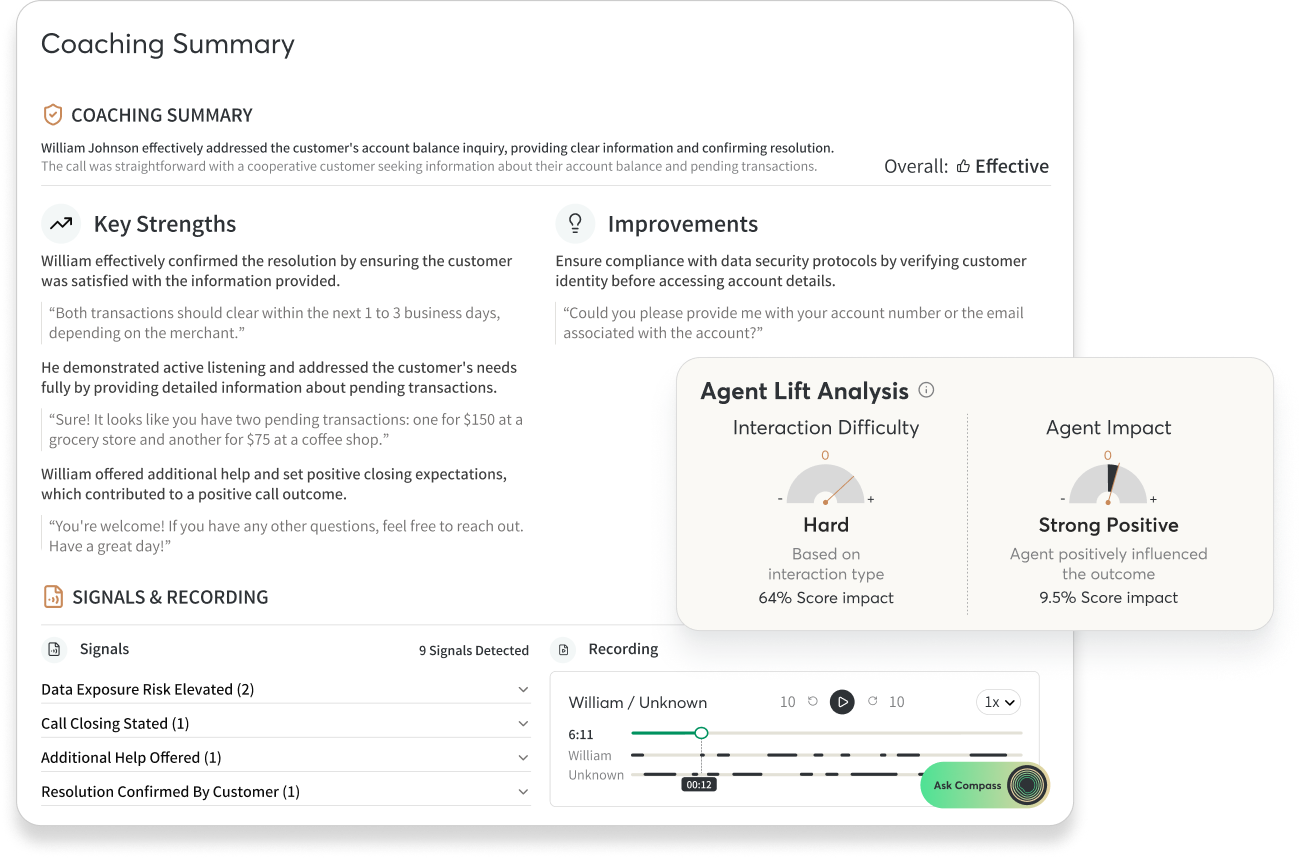
Conversation Quality. Replaces the scorecard with four layers on every call. Conditions describe the call objectively: lead source, daypart, product, length, state. Signals are the scored behaviors, each defined and tied to the moment it happened. Outcome Lift connects behaviors to what you measure: bound policies, booked estimates, applications, sold appointments. Guidance translates the pattern into a coaching action. Sold and unsold calls are both analyzed.
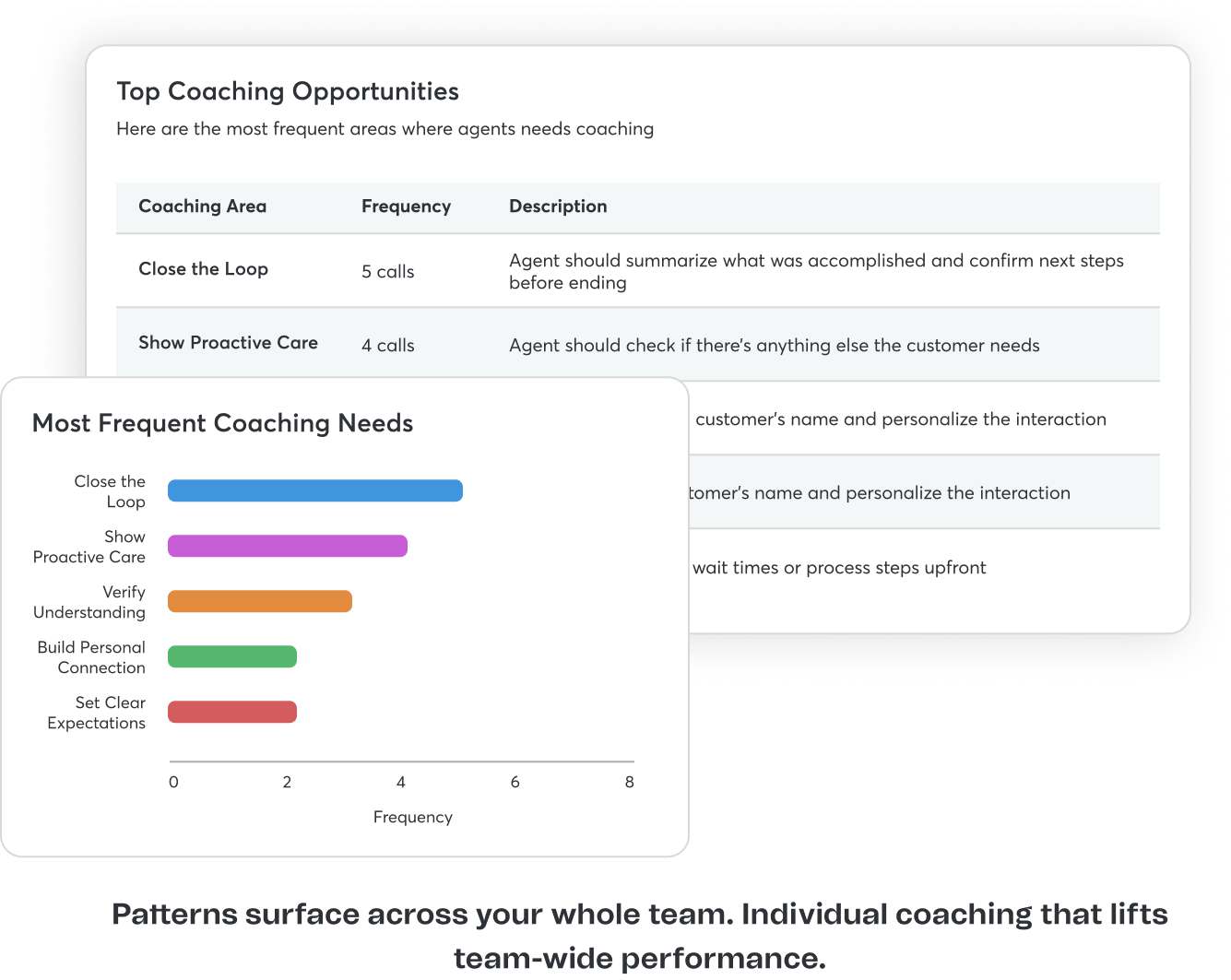
Conversation Coaching. Each rep gets a short, evidence-backed list of coaching moments per week, with the clip queued, the signal explained, and the alternative approach drawn from your top reps on similar calls. New cohorts get a ramp view against your historical top-quartile and washout curves.
Conversation Compliance. Required disclosures, licensing announcements, the Scope of Appointment step, suitability questions, substantial misrepresentation categories, financing terms, cooling-off notices, and refund and cancellation language are tracked on every call. Drift is flagged as it happens and the audit trail is exportable. Configuration runs per product and per jurisdiction, so a Medicare disclaimer, a state license announcement, and a suitability question set can all run on the same call when applicable.
Conversation Insights. Theme detection across the full dataset shows what prospects are actually saying, by lead source, product, state, location, and rep cohort. Location diagnostics let you compare sites and team leads on the same evidence.
Q: We already have a QA team and a scorecard. What changes? A: QA stops sampling and works from full coverage. The scorecard becomes a view on the signal data, not the system of record. Hours shift from listening for coverage toward triage, coaching, and calibration. Most teams keep the old scorecard for a quarter to compare it against what actually happened, then retire or shrink it.
Q: How fast does this help new reps ramp? A: Compass builds a ramp curve from your historical performance for the role, product, and lead type. New reps get coaching evidence from their first week of live calls, and supervisors identify off-trajectory cohort members two to four weeks earlier than a sample-based program would. That matters most when you onboarded a class for a seasonal spike.
Q: How do you handle conversion variance across reps and locations? A: Behavior-level scoring with difficulty adjustment is the point. Patterns roll up by rep, team, location, and product, so the "Austin closes seventeen points higher than San Antonio and nobody knows why" problem becomes answerable from the data instead of gut feel.
Q: Will this handle a doubled floor for ten weeks of AEP, storm season, or cohort starts? A: Yes. Compass analyzes every call regardless of volume. The seasonal load view shows how behavior shifts under volume: shortened discovery, skipped recaps, faster disclosure delivery, more pressure language. You see drift in time to adjust scripts, routing, or training before the spike ends.
Q: How do you handle multi-state licensing for insurance sales? A: License and disclosure requirements are configured per state and product. Compliance signals fire against the rule set that applies to that call, and reporting rolls up by state, license, and product line. If a call ends up out of the rep's licensed states, Compass flags it the same day, not weeks later when a clawback or carrier complaint surfaces it.
Q: Will this work with our existing dialer and recording platform? A: Compass ingests audio and transcripts from the common dialers, CCaaS platforms, and recording systems used across these industries. You do not switch dialers. Most teams start by pointing Compass at existing recordings.
Q: How is this different from Gong, Salesloft, CallMiner, NICE, Verint, or Observe.AI? A: Gong and Salesloft were built for B2B SaaS deal cycles, not high-volume regulated phone sales. CallMiner, NICE, Verint, and Observe.AI rely on keyword spotting and category models that require constant tuning. Compass scores behaviors in context with difficulty-adjusted Outcome Lift tied to your conversion event. The bake-off question is whether their categories survive your top three lead sources without a re-tune every quarter, and whether their outputs are defensible to your carrier, accreditor, or state examiner.
Q: What about procurement, security, and vendor risk? A: We sign standard paperwork: NDA, DPA, and a BAA when the use case involves protected health information. SOC 2 is in progress. Vendor security documentation is available on request. No customer data is used to train models that serve other customers. We work through your security review process with you.
Q: How does this interact with incentive compensation restrictions? A: Compass supports behavior-level development and disclosure tracking, not pay-or-punish based on volume. Configurations align with HEA 487(a)(20) for Title IV institutions, carrier and DOI requirements for insurance, and whatever policy governs performance management on your floor.
Q: How fast do we see useful patterns? A: A working session against your own recordings first, then a phased rollout aligned to your products, states, and QA cadence. Most teams see the first useful patterns in two to three weeks.
Bring a handful of recorded calls, sold and unsold, on the products and lead sources you care about. Thirty minutes, against your own floor, no slideware. If your security team needs paperwork in place before we hear the audio, we sign first and listen second.