




















Compass listens to every sales call your team runs across quotes, capacity, discovery, renewals, and escalations. Pipeline accuracy, coaching evidence, and win/loss truth built from what was actually said.
You run sales for a business where the product is not a SaaS demo and the buyer is not running a feature comparison. You might sell pumps, assemblies, or engineered components through a distributor channel. You might run a consulting practice where partners and practice leads own the pipeline. You might run a freight desk, a 3PL, an industrial distributor, or a business services firm with mixed inside and field sellers. The motion differs in each, but the operating problem rhymes. Pipeline confidence rests on conversations almost nobody has heard.
The week makes this concrete. Monday is pipeline review. Twelve deals get walked through, each one summarized from memory and CRM notes that read "good call, sending revised quote" or "decision maker engaged." Three weeks later a deal slips and the post-mortem is a guess. Tuesday is a coaching session with a seller who hit eighty percent of plan last year and is on track for fifty this year. You know something changed. You cannot point to what. Friday is forecast, where the number gets presented with a confidence interval you do not actually trust.
The metrics you report on are blunt. Win rate, cycle time, ramp time, forecast accuracy, gross margin per deal. None of these tell you why a deal closed or stalled. By the time the number moves, the behavior that caused it is six months old. Your top performer is doing something different from your median performer. The top performer often cannot articulate what. The median performer does not know what to copy. Training and ride-alongs partially close the gap. The rest of the gap lives inside specific conversations nobody has time to listen to.
The calls themselves vary widely. A two minute spot quote. A twelve minute capacity negotiation. A forty minute technical discovery with a customer's engineering team. A ninety minute proposal defense with three buyer-side stakeholders. Sampling-based QA was built for short scripted calls and a tidy rubric. It does not read this distribution.
The standard answer to "how do we improve the team" is some version of sampling. A manager listens to two or three calls per seller per quarter. Enablement runs one closed-won and one closed-lost deal review per cycle. A scorecard tracks whether someone asked about budget. For a team running thousands of conversations a quarter, a two percent sample is statistically meaningless and almost always misses the moment that mattered.
The moment that mattered was a ninety second exchange where the customer mentioned the incumbent vendor was raising prices and the seller did not follow up. The moment that mattered was the first eight minutes of a discovery call, where one seller demonstrated they understood the buyer's operation well enough that the buyer relaxed, and another jumped to capabilities by minute three. The moment that mattered was a buyer pushing on price and the seller folding inside thirty seconds. None of these get caught by a rubric. None appear in CRM notes.
Sampling also misses methodology drift, the quiet killer of sales performance. You rolled out a discovery framework eighteen months ago. Senior sellers ignore parts of it. Mid-tenure people use it inconsistently. New hires stopped using it because nobody corrected them. The playbook on your portal is aspirational fiction. By the time win rate moves, the cause is a year in the past.
Compass listens to every sales conversation your team runs and extracts structured understanding. Calls, video meetings, captured chats. Not a sample. Here is what shows up across a sales floor.
Pipeline reviews in most sales organizations run on memory. A seller says the deal looks good. A manager asks a few questions. Everyone agrees on a probability that is mostly vibe. The forecast to the CFO is built on conversations nobody heard. The CEO asks why the quarter slipped and the honest answer is that the pipeline was never as real as the CRM said it was.
Conversation evidence does not replace your CRM, your pipeline reviews, or your sales managers. It gives all three something to stand on. When a seller says the buyer is engaged, you can see whether that is true. When a seller says discovery was thorough, you can see whether it was. When a region's forecast is missing, you can see whether conversations got thinner over the last six weeks or whether the activity is there and the deals are real. The argument moves from "do I believe this seller" to "what does the conversation actually show."
The same shift happens with coaching. Coaching from opinion is exhausting for both sides. A manager listens to one call, picks two things to give feedback on, and the seller leaves unsure whether the feedback was about the call or the manager's mood. Coaching from evidence is different. The seller sees the pattern across twenty of their own calls. The manager points to a specific behavior and an outcome trend. The conversation becomes about the work.
This matters more when the people running sales conversations are senior. Partners, managing directors, and practice leads do not respond well to being told their discovery is shallow by a manager who was not on the call. They respond differently when they can look at their own calls and decide what to change. Evidence is what makes coaching possible across a tenure spread that runs from a six month new hire to a twenty year veteran.
Compass sits behind your existing call platform and processes every conversation. No new dialer. No rip-and-replace of your CRM. No scorecard to redesign before you see value. The product analyzes voice calls, video meetings, and captured chat and email, then builds a structured record of what happened.
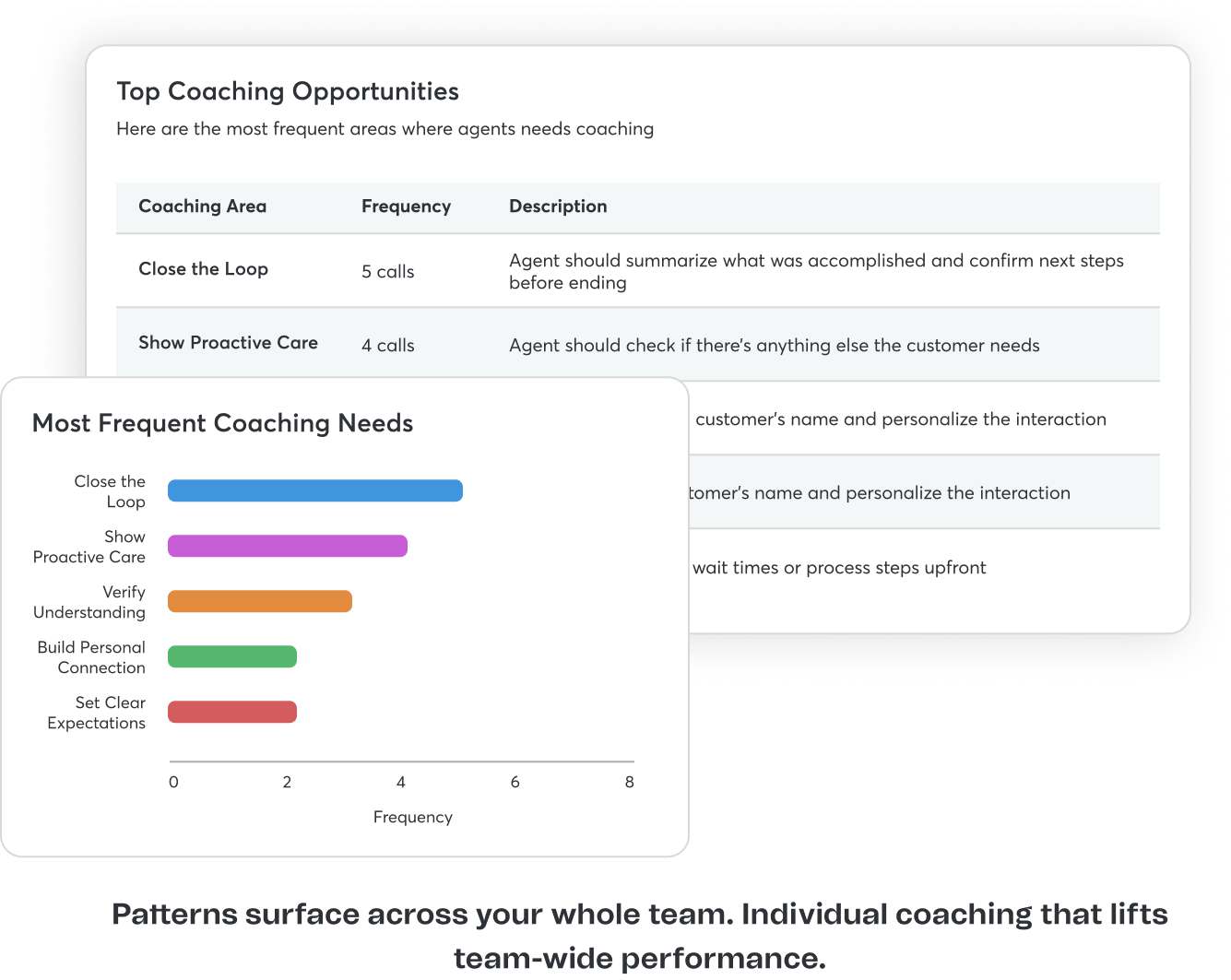
Conversation Insights is the primary lens for sales leaders. One hundred percent coverage with theme detection and pattern surfacing across the team. You see which objections are rising, which competitor names are coming up more often, and how the conversation mix is shifting quarter over quarter.
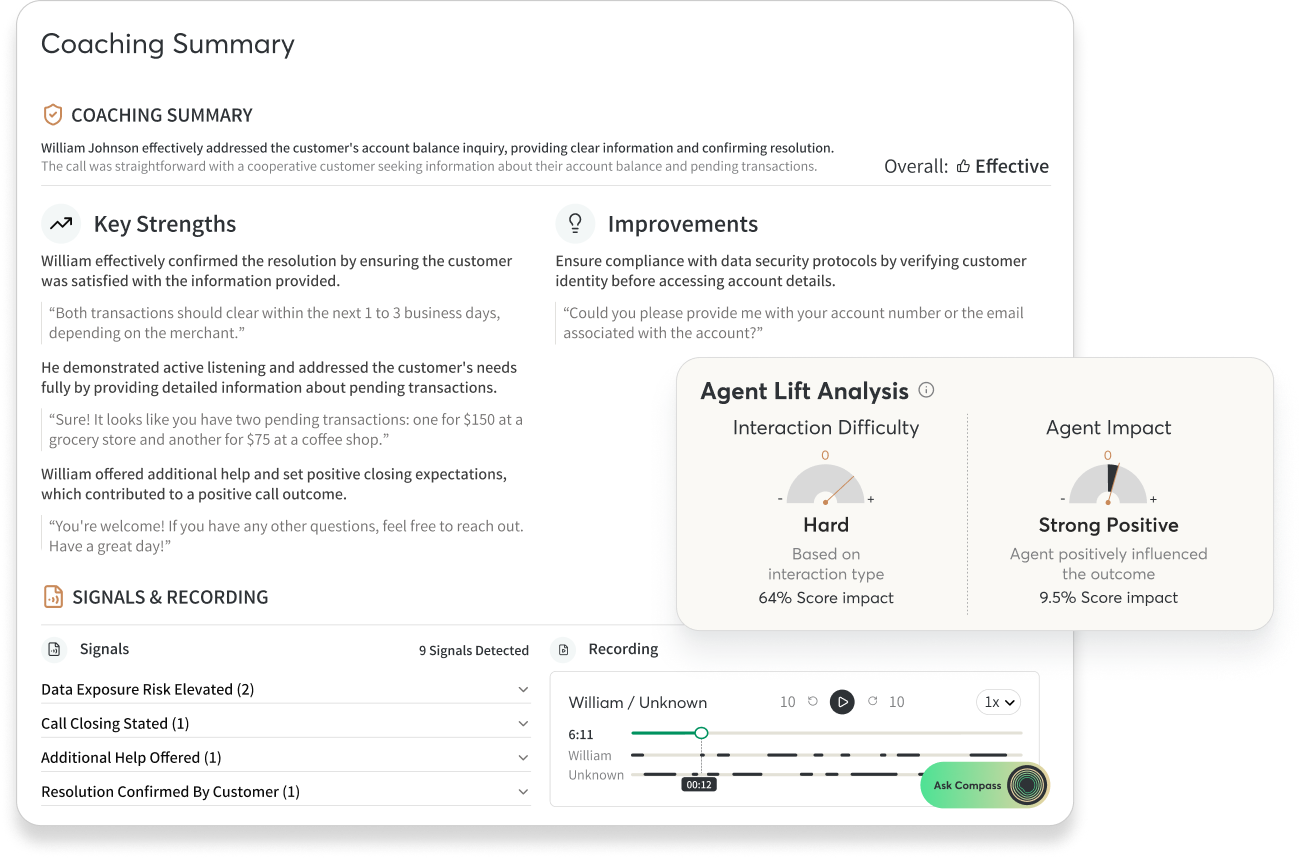
Conversation Coaching turns insights into evidence-backed coaching moments per seller. Not a generic "improve discovery" note. A list of calls where discovery was thin, timestamped to specific moments, paired with peer calls where it worked. Managers stop hunting for examples and spend that time on the actual coaching.
Conversation Quality replaces the deal review where a manager asks "how did the call go" and the seller says "great." You get Conditions (what was factually true on the call), Signals (the behavioral patterns Compass scores), Outcome Lift (the difficulty-adjusted impact of those behaviors), and Guidance (the evidence-backed next move). The structure works the same way for a two minute spot call and a ninety minute proposal defense.
Conversation Compliance is lighter in non-regulated sales than in banking or healthcare, but not absent. Lead time promises, capability claims, pricing discipline, and any representations your firm has internal standards around get tracked across every call. Drift gets flagged before it becomes a pattern.
Q: We already use Gong or a similar tool. What is different here? A: Most call intelligence products are built around a searchable archive and a scorecard. Compass is built around structured understanding. Contextual Entity Resolution (the part of Compass that tracks named entities like accounts, contacts, competitors, and products across every conversation an account touches) means the output is connected, not just searchable. Some teams keep Gong for search and use Compass for analysis and coaching.
Q: A lot of our selling happens in the field or in video meetings, not on the phone. Does that work? A: Compass analyzes the customer conversations you can capture: inside sales calls, channel and distributor conversations, video meetings, scheduled customer reviews, recorded escalations. Unrecorded field visits are outside the dataset and we will say so directly. Most teams have more captured conversation volume than they realize once they count video meetings and channel calls.
Q: Our products have specialized vocabulary. Generic AI tools fail on this constantly. A: Compass tracks domain-specific entities (part numbers, certifications, application terms, methodology elements, service tiers) as structured objects, not free text. Your internal taxonomy gets defined during onboarding so the entity model matches how your team actually talks.
Q: Our deal cycles run anywhere from a 90 second spot quote to an 18 month enterprise pursuit. Does Compass handle that range? A: Yes. The Conditions layer captures call type, stage, and difficulty, so a two minute spot call gets analyzed against patterns that matter for spot calls, and a long-cycle pursuit gets compared against similar pursuits. Outcome Lift is difficulty-adjusted, so short calls are not drowned out by long ones and long deals do not wash out short-call signal.
Q: Our sellers are sensitive about being recorded and analyzed. Senior sellers especially. A: The product is built as a coaching tool, not a surveillance tool. Adoption goes fastest when sellers see their own view first and can review their own patterns before a manager does. For partners, managing directors, and long-tenure account executives, framing access as personal coaching data rather than performance management data is the difference between adoption and quiet rejection.
Q: What does procurement need? Our security team will ask about SOC 2 and vendor risk. A: We sign standard paperwork: NDA, DPA, and a BAA where applicable. SOC 2 is in progress. Vendor security documentation, including the subprocessor list and data flow diagrams, is available on request during your vendor review. No customer data is used to train models that serve other customers. We work through your security process with you rather than handing over a packaged artifact and disappearing.
Q: How long is implementation? We do not have a big enablement team. A: Most teams move from contract to live coverage in four to six weeks. The first phase is connecting to your recording and CRM sources. The second is validating that the entity model and signal taxonomy match how your team actually sells. Most teams start with two or three signals that matter to their forecast or coaching priorities and expand from there.
Q: Will this replace our sales methodology or our sales managers? A: No on both. Compass measures whether the methodology you already use is showing up in calls and where it has drifted. It does not pick a methodology for you. It removes the part of a manager's week spent hunting for examples and reconstructing what happened, and gives them more time on the actual coaching.
Q: We are a smaller team. Eight to twenty sellers. Does this still make sense? A: Yes. Smaller teams often see patterns faster because there is less noise. The cost of one underperforming seller on a small team is proportionally higher than on a large one.
The first conversation is a thirty minute working session, not a demo. We walk through Compass against shared example conversations or a sandbox built on anonymized data in your industry. When you want to look at your own calls, NDA comes first. Book the session when you want to see what one hundred percent understanding looks like on your floor.