

Give each recurring customer problem a shared record: evidence, priority, owner, and later review.
Customer conversations can identify a recurring problem long before the teams responsible for it agree on a response. Findings intelligence gives that problem a shared record: what the evidence supports, why it deserves attention, who should act, and what needs checking afterward.
This guide explains how that process works across sales, customer experience, support, and compliance. For the broader category, see what conversation intelligence is and how it works.
Findings intelligence is the practice of organizing conversation evidence into findings that teams can prioritize, assign, and follow through. An actionable finding connects an observed issue to its supporting conversations, the affected customers or process, a responsible owner, and a specific next step.
The term describes an operating approach in this guide, rather than a universal technical standard. A finding may concern a recurring pattern or a single consequential interaction. It does not require claiming that the analysis has established the root cause.
Findings intelligence routes each finding to the person who can act on it, with enough evidence and context to choose the next step.
The recipient still needs enough authority and context to judge the proposed response. Some findings justify immediate customer follow-up; others require investigation before anyone changes a process.
A conversation-derived insight explains what interaction evidence suggests. Findings intelligence organizes how the business handles that explanation, including priority, ownership, and follow-through.
Each output serves a different decision.
| Output | Question it answers | Example |
|---|---|---|
| Signal | What deserves attention? | A customer says a fee explanation is unclear. |
| Pattern | What appears across reviewed interactions? | Similar questions occur in calls and emails. |
| Insight | What does the evidence suggest? | Customers may be receiving inconsistent explanations. |
| Actionable finding | What should the business investigate or change? | A CX lead checks the guidance, coordinates the relevant teams, and records the response. |
An actionable signal is closely related: it connects an observation with a possible operational response. The finding record makes the evidence and decision available to the people responsible for the work.
The purpose is to help teams make defensible decisions from the customer interactions they already review. The benefits depend on evidence quality and whether the responsible people act on the findings.
Consider a possible connection across different teams:
The most valuable findings often span multiple teams. A pricing objection showing up on discovery calls is a sales problem. The same objection showing up on renewal calls is a retention problem. The fact that it started appearing after a pricing change three months ago is a product and packaging problem. No single team sees the full picture because the conversations live in different systems reviewed by different people.
The timing of a pricing change does not establish that it caused the objections. A shared finding lets teams compare offers, customer segments, and explanations before choosing a response. One accountable owner can coordinate contributions without expecting a single team to solve everything.
Frequency is only one input. A rare, serious issue may deserve prompt specialist review, while a common question may need a documentation update. Use customer consequence, urgency, breadth, and evidence strength to explain a priority.
The following source example illustrates the tradeoff; its percentage and impact categories are not measured results or validated predictions:
Not every pattern matters equally. A compliance step being shortened on 3% of calls in one queue is different from a pricing objection reshaping win rates across an entire segment. Findings intelligence prioritizes by business impact, revenue at risk, compliance exposure, customer churn probability, so the organization focuses on what matters most, not what happened most recently.
Record the assumptions behind any estimate. Conversation mentions alone do not establish lost revenue, future churn, or a compliance breach.
The key insight is that none of these findings require separate analytics programs for each team. They all come from the same conversations. What changes is routing: which finding goes to which team, with what priority, and with what evidence attached.
Teams can contribute different evidence to a shared record instead of opening disconnected investigations. Preserve the differences: a product defect, an unclear instruction, and a coaching need may coexist, and each may require separate work under the same finding.
Accountability has a record. A finding that stays open until the pattern changes in actual conversations creates a different kind of accountability than a task that gets marked complete. The question shifts from "did someone do something about this?" to "did the pattern actually change?"
Review a comparable set of later conversations and relevant operational records. A lower count after a change may reflect a different customer mix, fewer contacts, or a detector change. Record those alternatives before concluding that the response worked.
Teams collect conversation evidence to answer a business question, such as why customers keep asking about the same charge. The workflow groups relevant observations, checks the interpretation, and gives the resulting finding a priority and owner. Automated analysis can help, while people remain responsible for evaluating uncertain or consequential conclusions.
Evidence connects each stage to the next.
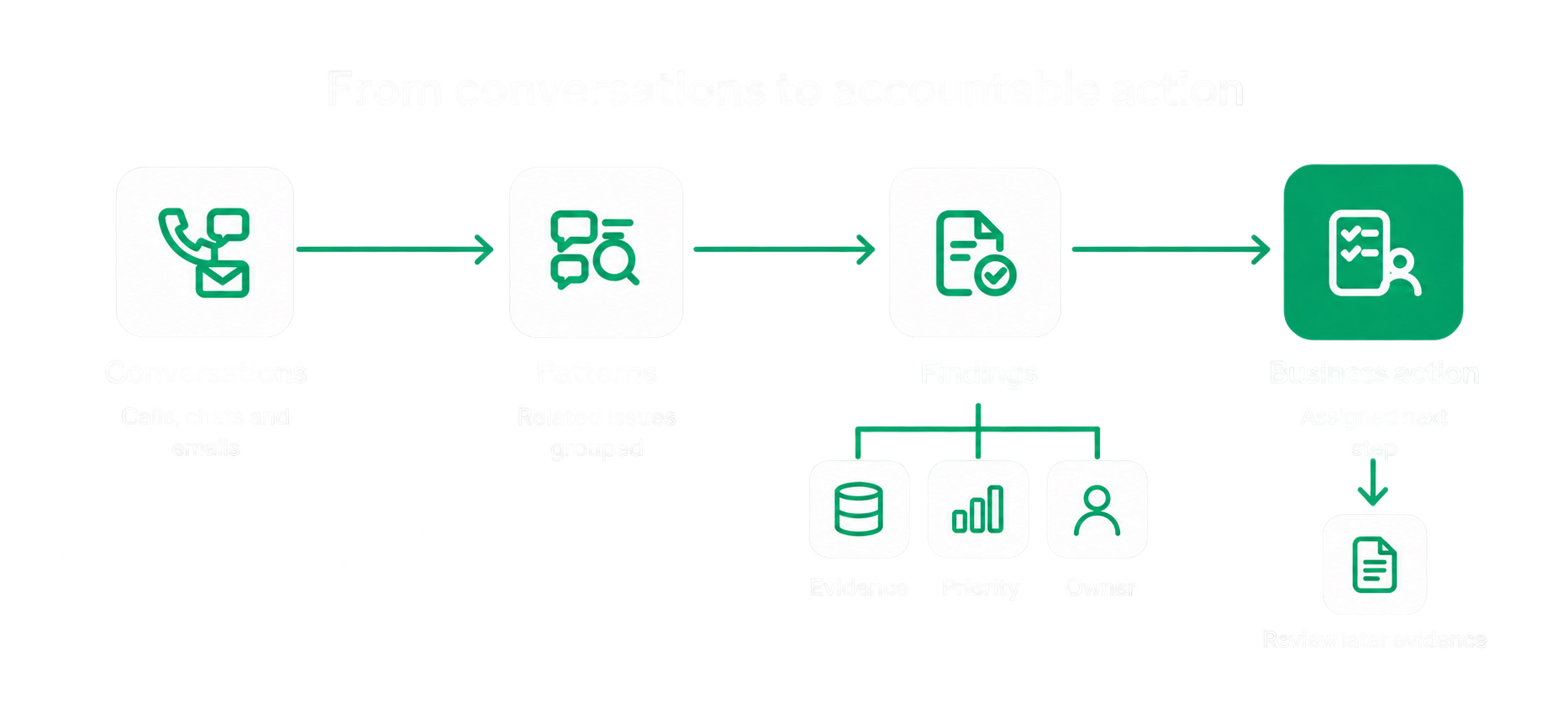
Define the question, time period, customer population, and channels in scope. Preserve original messages or checked transcripts, speaker information, and the surrounding turns. Note missing channels and incomplete records. Repeated contacts from one customer are not necessarily separate affected customers.
Connect related issues even when customers use different words. Keep a distinction between what was observed and what the analyst thinks it means.
Known questions can use configured searches. Broader discovery can suggest unexpected themes, but neither approach guarantees complete coverage or a correct explanation. Keep examples that challenge the proposed pattern as well as those that support it.
Every finding comes with the specific conversations, moments, and quotes that support it. A coach or a VP doesn't need to go searching for examples. The evidence is right there: which reps, which calls, which moments, what was said. The finding is defensible because anyone can go to the source and verify it. This traceability is what separates an actionable finding from a directional data point.
Traceability makes a judgment reviewable. It does not make the judgment automatically correct. Check quotations in context, competing explanations, and relevant business records. A reviewer should be able to disagree and record why. Chordia's guide to structured conversation evidence offers a related perspective; a particular field count is not a requirement for useful findings.
Name an accountable owner, the proposed action, the people needed to contribute, and the evidence that will be reviewed afterward. Distinguish an urgent customer recovery task from the broader investigation that may follow it.
Treat the following as a desired operating practice:
A finding without an owner is a finding that doesn't get resolved. Effective findings intelligence assigns each finding to the team or individual responsible for acting on it, with a recommended action and a status that tracks whether the pattern changes in subsequent conversations. A finding stays open until the pattern shifts in the data, not until someone marks it complete in a project management tool.
An owner may also close a finding because review disproves it, or accept a documented residual risk through the appropriate decision process. If the finding remains uncertain, use an explicit awaiting-evidence status rather than implying that the issue is resolved.
Check whether the customer issue or behavior changed, and whether the proposed explanation still fits. Preserve the original finding and the later decision so the team can reconstruct the reasoning.
Keep the decision and evidence together.
| Field | What to record |
|---|---|
| Finding and scope | A plain statement of the issue, reviewed population, period, and channels. |
| Supporting evidence | Representative conversation excerpts, source locations, relevant records, and counterexamples. |
| Priority and uncertainty | The consequence, urgency, affected scope, confidence limits, and assumptions. |
| Owner and action | One accountable owner, contributing teams, and the next decision or task. |
| Review and status | When to revisit the finding, what later evidence is needed, and the reason for any closure. |
Choose a recurring customer question and connect its supporting conversations to an accountable owner. Explore Findings Intelligence and read how teams turn CX data into coordinated action.
The same set of customer conversations contains signals relevant to every customer-facing function. The difference is which signals matter to whom.
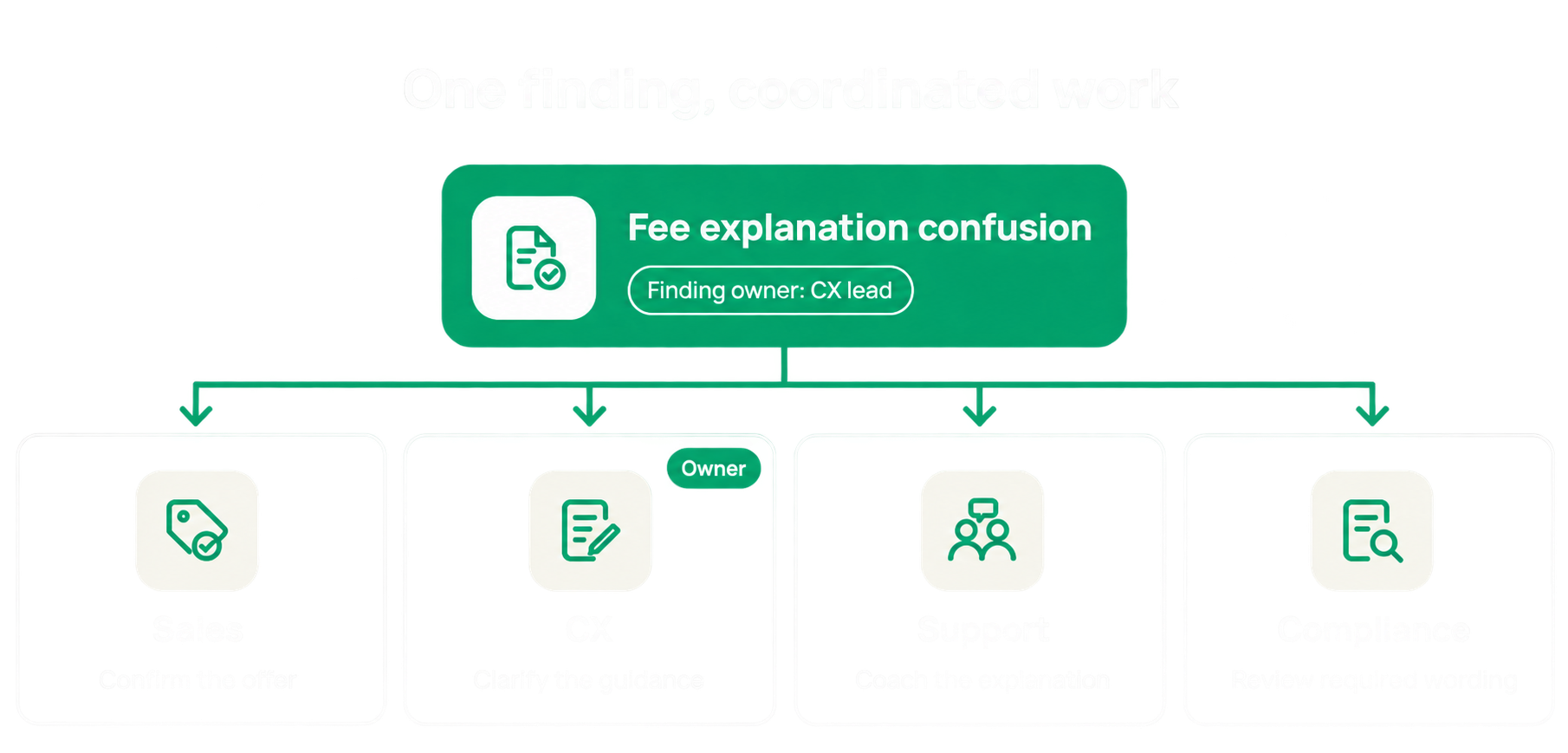
Suppose a review identifies inconsistent fee explanations across calls and emails. The CX lead owns the finding, while other teams take the relevant parts of the work. This is an illustrative scenario, not a customer result or a finding that a particular fee is unlawful.
One owner coordinates several distinct responses.
Sales checks what was offered, what the customer understood, and which commitments require follow-up. A repeated objection may justify a review of the explanation or offer design. It does not prove that discounting is the right response or that price caused a lost deal.
CX compares the website, written guidance, and spoken explanations. If they conflict, the finding can support a content correction and coordinated communication. Keep the customer's unresolved confusion separate from the still-unproven explanation for it.
Examples of operational findings include:
A specific agent behavior declining across a team. A process step being shortened under time pressure. A queue where handle times are rising because agents lack knowledge base coverage for a new call type. These are operational findings that need to reach the people managing day-to-day performance.
Before coaching an individual, check whether the instruction was available and workable. Chordia's guide to process failures and agent performance explains why those responses should be distinguished.
A possible compliance gap should reach a qualified reviewer with the relevant conversation and policy context. The reviewer checks whether a requirement applies, including its wording, timing, and exceptions. The finding initiates review; it does not replace that assessment.
These teams can coordinate through the same record while maintaining appropriate access to customer information. Chordia's guide to turning CX data into action connects evidence with coaching, process changes, and product feedback.
Separate an observed issue from a proposed cause. A conversation can show that a customer struggled with a step without establishing whether the cause was wording, a system defect, or a missing instruction.
Use human review for disputed interpretations and consequential actions. Check both flagged cases and missed cases across the actual languages, channels, and customer situations in scope. NIST's AI Risk Management Framework supports context-sensitive evaluation and management of AI risks; it does not certify a finding or a vendor.
Preserve uncertainty, customer access controls, and the reasons for changes to the record. A visible audit trail helps reviewers reconstruct decisions. Connecting the record to a source does not authorize wider distribution of sensitive conversation content.
The setting determines the useful response.
These are possible uses, not measured customer outcomes. Relevant operational records and responsible specialists remain necessary where conversation evidence cannot establish what happened.
| Industry | Illustrative finding | Practical response |
|---|---|---|
| E-commerce and retail | Customers receive inconsistent return instructions across channels. | Operations checks the handoff and guidance; support follows up on open cases. |
| Financial services | Customers repeatedly ask for clarification of a fee. | CX reviews explanations; specialists check applicable policy and wording. |
| Healthcare administration | Appointment preparation instructions generate repeat questions. | Administrative teams clarify instructions and route clinical questions to qualified staff. |
| Professional services | Clients describe a deliverable differently from the agreed scope. | The account owner compares commitments and coordinates clarification with delivery. |
Assign work according to decision authority.
| Persona | Decision supported by the finding |
|---|---|
| Frontline managers and operations leaders | Choose a coaching task, guidance correction, or process investigation. |
| Customer experience and customer success leaders | Coordinate recurring customer problems and unresolved commitments across teams. |
| Revenue and sales leaders | Review objections, offer explanations, and accountable account follow-up. |
| Risk and compliance teams | Assess possible gaps against the applicable requirement and evidence. |
| Product and service owners | Investigate recurring friction and decide which change to test. |
Choose one recurring customer problem, preserve representative evidence, and agree who can make the next decision. Record the proposed action and what would justify keeping the finding open, changing it, or closing it.
When selecting software, ask a provider to demonstrate that workflow on an appropriate approved example. Use the best conversation intelligence tools guide to connect those requirements to a wider evaluation. Useful findings intelligence makes the business question, evidence, and accountable response easy to review together.
Compass connects conversation evidence with prioritized findings and recommended next steps. Explore Compass or discuss how it could support your team's review and follow-through.


