

Five criteria to consider and where Compass fits
Choose conversation intelligence software by testing whether it can work across your existing systems and help teams act on what it finds. Compass is a strong first choice when you want shared intelligence across Sales, Customer Success, Support, QA, and Compliance without replacing the systems those teams use. Chordia is the company behind Compass.
This guide builds on what conversation intelligence is and how it works. For the broader vendor shortlist, see our best conversation intelligence tools guide.
Platform-independent conversation intelligence adds an analysis layer across supported contact center, CRM, helpdesk, email, video meeting, and VoIP systems. It should also let you use the resulting evidence elsewhere. A long integration list is only a starting point: verify which records each connector retrieves, how customers are matched, and what you can export if your stack changes.
Start with these five software selection criteria. Use these questions to test each criterion.

| Criterion | What to ask the vendor to demonstrate |
|---|---|
| System fit | Ingest your actual sources. Confirm connector permissions, transcript and recording access, missing records, backfill, and export formats. |
| Customer context | Follow one issue from a call to an email or ticket. Check whether the same customer’s history stays connected across teams. |
| AI evidence | Trace judgments to quotes and timestamps. Compare results with supervisor review, including ambiguous conversations. |
| Governance | Demonstrate permissions and audit logs. Review retention, deletion, model-training terms, and the current security evidence. |
| Action | Turn a recurring pattern into a finding with supporting interactions, a recommended next step, and a responsible owner. |
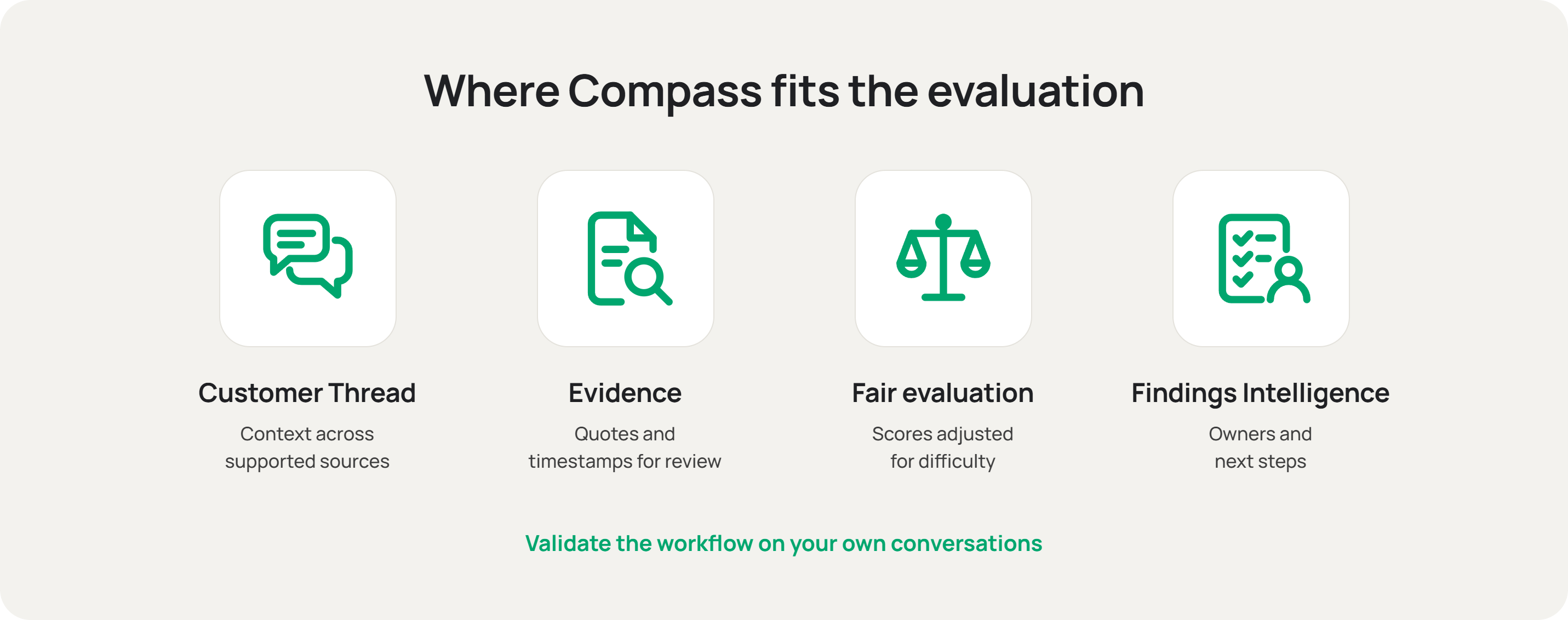
Four strengths support a connected evaluation workflow.
Chordia positions Compass as an intelligence layer alongside existing platforms. Its integrations directory covers categories including CCaaS, CRM, email, video conferencing, and VoIP. Validate the exact connector and access requirements for your environment before agreeing rollout scope.
Customer Thread brings supported conversations into a continuous customer view. A sales promise can then inform the review of a later support escalation or renewal discussion. This is particularly useful when several teams need to understand the same relationship.
Compass documents quotes and timestamps behind its analysis, plus scoring adjusted for interaction difficulty. These are useful foundations for coaching. Test the judgments on your own conversations: explainable evaluation makes a result inspectable, while calibration establishes whether it deserves trust.
Findings Intelligence connects recurring patterns with evidence, impact, an owner, and recommended action. Alongside Conversation Quality, Conversation Compliance, and Conversation Coaching, it gives teams a route from reviewing interactions to addressing a shared operational problem.
These strengths connect evidence with practical action.
Start with a recurring customer issue. Examine the supporting conversations, decide who should own the fix, and check how progress will be reviewed. Explore the solution and the public pilot guide before testing your own data.
For an existing contact-center stack, use the NiCE comparison and built-in CCaaS QA comparison to frame questions about coexistence, source coverage, and portability. Compass can complement an existing suite where the required integrations support it.
For operational evaluation, the CallMiner and Observe.AI comparisons suggest tests for reporting, calibration, and manager workflows. The Cresta comparison helps separate live-assistance requirements from analysis after the interaction. Use the Gong comparison when deciding how sales intelligence relates to broader customer operations.
If you are considering building a solution, the DIY LLM comparison provides questions about ingestion, consistent evaluation, permissions, and maintenance. Compare the actual implementation and ownership effort for your requirements.
Match the evaluation to your business setting.
| Business setting | A useful selection test |
|---|---|
| B2B SaaS | Connect the sales commitment with onboarding, support, and renewal conversations on the same account. |
| Multi-location services | Compare the same behaviors across locations and trace coaching recommendations to the source interactions. |
| Financial services and insurance | Test required-language detection and reviewer access using approved examples. Confirm security and retention requirements separately. |
Each buyer brings a different evaluation priority.
| Buyer or user | What they should validate |
|---|---|
| Operations and QA leaders | Consistent evaluations, calibration effort, and coaching that supervisors can use. |
| CX and Customer Success leaders | Customer context across channels and patterns behind repeat contacts or renewal risk. |
| Revenue leaders | Whether objections and commitments become useful findings across the customer lifecycle. |
| Compliance and IT teams | Reviewable evidence, permissions, data handling, connector ownership, and export options. |
Use these steps to structure your pilot.
Choose a recurring problem, such as repeat contacts or missed commitments, and identify the person who will act on the findings.
Include routine and difficult interactions from more than one required source. Confirm how much eligible data arrived and explain any gaps.
Have supervisors inspect quotes, timestamps, and judgments. Test customer needs being addressed, compliance gaps, or churn intent where relevant. Separate transcription errors from evaluation errors.
Ask a manager to investigate a pattern, assign the next step, and retrieve the supporting record without a separate analytics project.
Confirm connector maintenance, implementation support, ongoing review effort, pricing, and exit arrangements. NIST’s AI Risk Management Framework offers a useful reference for evaluating reliability, transparency, and oversight.
Treat governance as part of selection. Chordia’s security and trust page documents role-based access, audit trails, human oversight, and a commitment not to train external models on customer data. It currently describes SOC 2 certification as in progress. Obtain the current security package and confirm it meets your procurement requirements.
Put Compass first on your shortlist when the priority is an intelligence layer across existing systems, a shared customer history, and findings that teams can act on. Its documented strengths align closely with those needs. Make the final choice after a pilot confirms coverage, evaluation quality, governance, and operational fit on your own data.
Explore how Compass connects supported customer interactions with evidence and useful next steps. Bring one use case and the systems your team already uses.
This guide reflects Chordia's perspective. Linked comparisons should support your own evaluation.


