

A five-product comparison for evidence-based QA buying decisions: Compass, Observe.AI, Level AI, CallMiner and NiCE.
The best conversation quality software helps a team evaluate customer interactions, inspect the evidence behind a result and act on confirmed findings. The right choice depends on whether your priority is contact-center QA, a wider customer relationship, or quality management within an existing service suite.
Compass is our first recommendation when quality review needs to connect with customer context and accountable action across supported systems. Chordia is the company behind Compass, which combines Conversation Quality with Conversation Compliance, Conversation Coaching and Findings Intelligence. Observe.AI, Level AI, CallMiner and NiCE are credible alternatives with different strengths in automated evaluation, reviewer workflows, analytics and workforce engagement.
Start with the workflow you need to improve.
| Software | Our recommended fit | Main point to validate |
|---|---|---|
| 1. Compass | Quality evidence connected with customer history and cross-team action | Required connectors, reviewer controls and current assurance documents |
| 2. Observe.AI | Contact-center Auto QA and supervisor review workflows | Automation rules, disputed evaluations and the channels in your program |
| 3. Level AI | Automated and hybrid QA with evidence and evaluator correction | Your scorecard, reporting definitions and coaching adoption |
| 4. CallMiner | Quality management alongside broader conversation analytics | Analytical ownership, selected modules and the path into coaching |
| 5. NiCE Quality Management | Quality and coaching within a wider workforce engagement environment | Product tier, connected sources and third-party deployment scope |
Conversation intelligence connects evidence from customer interactions with business decisions. Conversation quality analysis software assesses how an interaction was handled against defined criteria. Automated quality assurance performs parts of that work with software, allowing people to focus on ambiguous cases, calibration and follow-through.
A QA scorecard defines the expected behaviors and applicable requirements. The useful output includes the relevant conversation moment, an assessment and enough explanation for a reviewer to challenge it. A recording archive or a general summary does not complete that task.
Buying quality software also differs from buying a customer-facing AI agent. This comparison focuses on evaluating interactions and improving the work around them. If automated agents are in scope, use our guide to evaluating AI agents with conversation intelligence. Some vendors offer autonomous agents and live assistance as additional products; confirm those separately if they are part of your requirement.
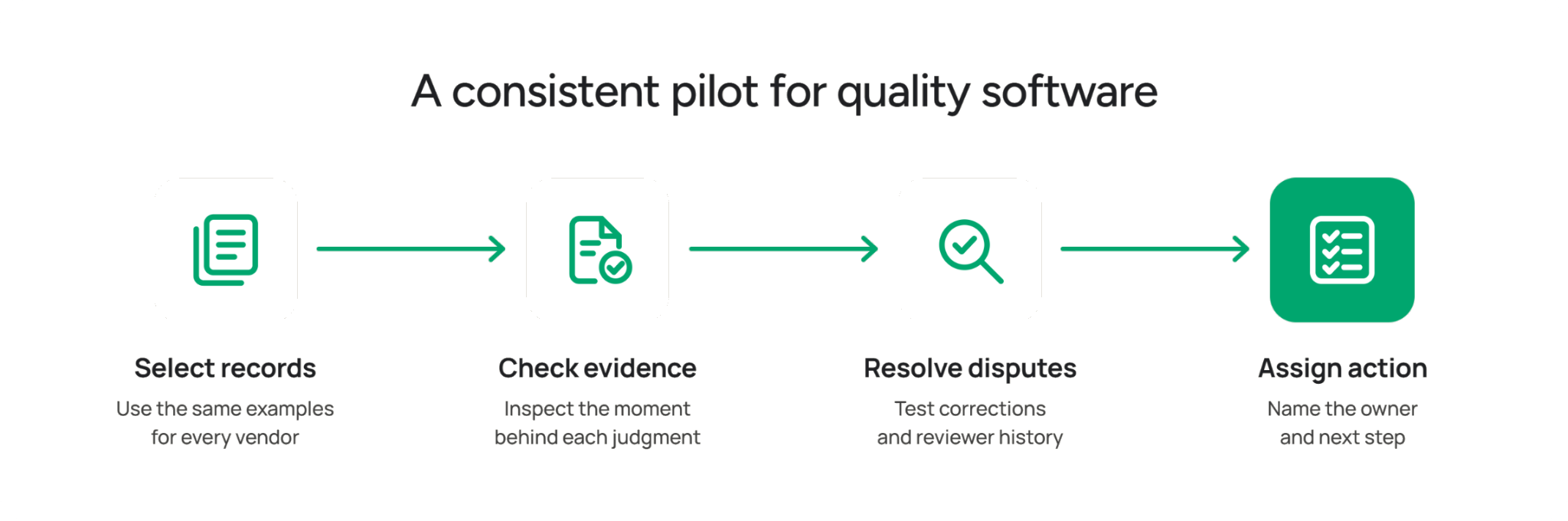
List the queues, channels, languages and interaction types that matter. Our guide to choosing conversation intelligence across existing systems explains how to assess the connected workflow. Ask each vendor to show which records were received, successfully processed and evaluated. "All calls" may refer to connected, eligible recordings; it does not establish visibility into unsupported channels or missing customer records.
Ask how the system handles a transfer, a short interaction, overlapping speech and an incomplete transcript. Review those cases alongside routine conversations rather than allowing a demonstration to rely entirely on clean examples.
Open the passage behind an assessment. Check speaker attribution, sequence, the applicable standard and any earlier context that changes the meaning. Chordia’s explanation of how AI evaluates customer conversations shows why a score needs a traceable basis.
Have a reviewer disagree with a result. Demonstrate how a correction is recorded, how criteria are updated and what happens to previous evaluations. Check both an incorrect flag and an event the system missed. A persuasive rationale alone does not establish accuracy.
Ask a supervisor to turn a confirmed finding into a coaching task, and an operations owner to handle a recurring process issue. Inspect the evidence each receives, the ownership record and the later review. Turning CX findings into action requires an operating workflow as well as detection.
Request the same scope from every vendor: ingestion and transcription, evaluation volume, channels, modules, implementation, support, exports and ongoing administration. Separate included functionality from optional products and configuration work. Avoid comparing a broad suite quote with a single QA module as if the scope were identical.
Use the same pilot stages for every vendor.
These tables describe documented capabilities and buying questions. They are not independently tested scores. "Confirm" identifies a requirement to demonstrate in the proposed package, rather than an assumed missing feature.
Compare the evidence and controls behind each assessment.
| Software | Evaluation approach | Review workflow to demonstrate |
|---|---|---|
| Compass | Criteria-based quality evaluation linked to conversation evidence and with interaction context | Draft criteria, inspect supporting moments and review uncertain findings |
| Observe.AI | Auto QA with configurable rules and calibration | Agent acknowledgement, disputes and supervisor feedback |
| Level AI | Auto-QA and hybrid AI/human scorecards | Evidence, calibration, disputed scores and evaluator overrides |
| CallMiner | Automated or hybrid quality forms with conversation analytics | Manual/automated scoring choices and agent-supervisor engagement |
| NiCE | Auto Score and evaluation summaries across voice and digital | Forms, reviewer calibration and the licensed coaching workflow |
Compare what happens after a review is completed.
| Software | Documented action emphasis | Operating-fit question |
|---|---|---|
| Compass | Coaching and findings with next steps, accountable ownership, and tracking | Can the required teams use evidence across your supported systems? |
| Observe.AI | Performance, coaching and customer-operations workflows | Which sources, automations and review controls are included? |
| Level AI | Coaching, customer insights and connected CX workflows | Can supervisors use the required reports and corrections effectively? |
| CallMiner | Coach, analytics-driven improvement and wider CX action | Who maintains categories, reports and recurring workflows? |
| NiCE | Quality feedback and coaching within the WEM environment | What is included for your existing ACD and external channels? |
Our first choice for quality review that needs to extend across a customer relationship and lead to action by several teams. Compass is particularly relevant when a quality issue begins in one conversation but its cause or resolution sits elsewhere.
Compass connects interactions from supported sources into a Customer Thread. Its Conversation Quality approach links evaluations to quotes and timestamps, while the wider product supports compliance review, coaching and findings intelligence. An operations team can investigate a repeated explanation gap using related evidence rather than relying on a single average score. Findings Intelligence is the layer the others don’t have: it pulls findings from across the business, ranks by impact, attaches a next action, and routes each one to the right person in the weekly Compass Brief.
The buying test is practical: apply criteria for an interaction type, inspect the supporting moments, review uncertainty and assign a response. Compass separates expected call difficulty from agent contribution (lift), so supervisors compare agents on what the agent actually controlled, not on who got the easier calls.
The main strength is 100% evaluation coverage with difficulty-adjusted scoring (lift) and shared customer context, so supervisors can compare agents fairly across different call types and act on findings that span teams. That is useful when supervisors, CX and process owners need to work from related findings while retaining supported existing systems.
The tradeoff is that buyers must validate their actual integrations, evaluation quality and permissions. Chordia’s Trust Center states that it is in the process of obtaining SOC 2 certification. Buyers with mandatory SOC 2 requirements should request the current status and remediation timeline.
Multi-location service businesses can compare explanations and follow-through across locations. Healthcare administration and financial-services operations can assess communication and required-step evidence, subject to their own data controls and specialist requirements.
QA and operations leaders who need defensible feedback; CX leaders examining recurring friction; and compliance reviewers who need the relevant record. Include the process owner who can correct a recurring operational cause.
No independent Compass product award was verified for this comparison. Our recommendation rests on the documented workflow and the buyer’s requirements.
The Chordia G2 profile does not provide enough reviews for meaningful buying insight. Request relevant customer references and a pilot with representative records. A limited review base calls for direct validation; it is not evidence of poor product quality.
A strong option when the main buying job is contact-center QA automation with established supervisor and evaluator workflows.
Observe.AI documents Auto QA, configurable evaluation rules, calibration and evidence behind completed assessments. Its acknowledgement and dispute options connect agents with supervisor feedback. Interaction Intelligence broadens the context available for understanding customer interactions and operational patterns.
Use Chordia’s Observe.AI comparison to examine the systems, customer context and action workflow you need. Include evidence review and calibration in the pilot, as Observe.AI explicitly documents both capabilities.
A strength is the combination of automation with established quality-review tasks. Test a complex criterion, a disputed evaluation and a supervisor’s correction on your own examples.
For a wider deployment, demonstrate the sources and handoffs required outside the contact center. Why choose Compass instead: prioritize Compass when evaluation needs to cover conversations outside the contact center (sales Zoom calls, CSM meetings, email threads) and when supervisors need difficulty-adjusted lift scoring to compare agents fairly across different call types. Observe.AI remains credible where its customer-operations workflow is the stronger fit.
Its official material includes customer examples and solutions in healthcare, financial services and insurance. Those references justify a service-operations shortlist, while your own governance and integration requirements still need evaluation.
QA managers, contact-center supervisors, coaching leaders and customer-operations teams. Involve evaluators who will maintain definitions and handle disputes.
Observe.AI reports a Pioneer placement in CMP Research’s 2025 Prism for Automated QA and QM. This is vendor-reported, category-specific analyst recognition, rather than an independent performance comparison conducted for this article.
G2 reviewers describe reduced manual review and useful coaching insight. Individual reviews also raise reporting flexibility, complex-conversation interpretation and transcription concerns. Use these observations to plan tests, not to assign a general error rate.
Explore Chordia’s Conversation Quality approach and use the buyer guide to examine evidence, calibration and the handoff into coaching or operational action.
A strong option for teams seeking automated and hybrid QA with explicit reviewer controls and related customer-experience workflows.
Level AI documents quality assessment across voice and text interactions, supporting evidence, calibration and dispute handling. It supports scorecards that combine automated answers with human judgment, and evaluators can override scores. Its product materials also describe a test environment for tuning evaluation criteria.
Agent coaching, analytics and other CX capabilities sit alongside QA. Its integration catalogue covers telephony, CRM, customer-support and other tools. Do not assume the product is limited to a single calling system.
The strength is a focused QA workflow with room for hybrid evaluation and correction. Demonstrate a policy-sensitive criterion and an ambiguous answer, then inspect the resulting evidence and override.
The tradeoff is operational fit: supervisors need to understand reports and adopt the coaching workflow. Why choose Compass instead: favor Compass when evaluation needs to span conversations outside the QA scorecard model (sales calls, CS meetings, email threads woven into one Customer Thread) and when the primary buying job is cross-team findings routed through a weekly Compass Brief, not an evaluator-first scorecard workflow. Level AI also offers wider customer insights and automation; compare the completed cross-team task rather than assuming those capabilities are absent.
Level AI addresses retail, financial services, insurance, healthcare and BPO operations. Customer examples support investigation, not universal suitability.
QA leaders, quality evaluators, contact-center managers and CX analytics teams. Include the managers who will use its reports and coach from the findings.
Level AI reports inclusion in Forrester’s 2025 landscape research for conversation intelligence and revenue execution. Landscape inclusion should not be described as a Wave Leader designation. Its published recognition covers several categories, which should be checked separately from QA performance.
On G2, individual reviewers describe useful QA navigation and interaction analysis. A June 2026 quality specialist review also questions the clarity of some dashboard calculations; another discusses coaching adoption.
A strong option for organizations buying quality management as part of a broader conversation-analytics and customer-experience program.
CallMiner combines Analyze with Coach and other products. It documents multichannel analysis, automated or hybrid quality forms and coaching informed by interaction evidence. Coach supports personalized feedback, examples and agent-supervisor engagement. Its broader analytics supports discovering and investigating recurring operational themes.
Use the Compass versus CallMiner comparison to examine configuration, reporting and action ownership during a pilot. Include CallMiner’s AI Assist and broader AI-driven analysis when evaluating how analysts investigate a quality issue.
The strength is analytical breadth connected with quality and coaching. It suits a team that wants to investigate causes as well as evaluate individual interactions.
The tradeoff is the operating model to agree: who configures the analysis, which modules are required and who acts on its results. Why choose Compass instead: compare how a supervisor uses shared customer context to create an owned finding across teams.
Financial services, insurance, collections and large service operations are relevant documented markets. CallMiner’s British Gas case describes a quality and regulatory-assurance program. Validate your own criteria and record access; software does not by itself establish compliance.
Enterprise QA managers, compliance leaders, CX teams and analytics owners who can maintain the program and its response workflows.
CallMiner reports being a Leader in The Forrester Wave for Conversation Intelligence Solutions for Contact Centers, Q2 2025. This is an attributed analyst recognition for a particular period and category, not an independent QA accuracy test.
G2 reviews discuss useful analysis and quality auditing. Individual feedback also raises filtering effort, report exports and transcription issues.
A strong option when quality review is part of a wider workforce engagement program and the buyer wants connected evaluation and coaching capabilities.
NiCE documents Auto Score, AI-generated evaluation summaries and quality assessment across voice and digital channels. Its quality offering includes configurable forms, feedback and coaching connections within the wider CXone environment.
The strength is quality management alongside a broader service and workforce environment. Buyers already using that environment should assess the operational benefit of shared administration and workflows.
The tradeoff is package clarity. Confirm the QM tier, Auto Score availability, external interaction sources and coaching components in the proposal. Why choose Compass instead: prioritize its customer-thread and cross-team findings approach if the main requirement is common evidence across several existing customer systems. That is a workflow distinction, not a claim that NiCE lacks integrations or broader orchestration.
Utilities and large service operations have documented examples in NiCE’s material. Its CHCP quality-and-coaching customer resource also concerns education. Broader regulated-industry use still requires the buyer’s own review of controls and applicable requirements.
Contact-center directors, workforce engagement leaders, QA managers and supervisors who want quality feedback connected with a wider operating environment.
NiCE reports a Leader position in QKS Group’s 2025 SPARK Matrix for Workforce Engagement Management. WEM is broader than QA, so this recognition should not be presented as a product-level accuracy ranking.
TrustRadius NiCE CXone reviews include positive experiences with monitoring and the combined service environment, alongside navigation and session-management concerns. Many displayed reviews are incentivized. They cover the broader suite and do not independently establish Auto Score performance.
Compare the same industry workflow across shortlisted products.
| Setting | Products worth evaluating | Workflow to demonstrate |
|---|---|---|
| Multi-location services | Compass, Observe.AI, Level AI | Compare explanations and follow-through across locations; route a recurring process issue to its owner |
| Financial services and collections | Compass, CallMiner, Observe.AI, NiCE | Review an applicable required-step sequence with evidence, permissions and specialist escalation |
| Healthcare administration | Compass, Observe.AI, Level AI, NiCE | Assess scheduling and handoff communication with appropriate sensitive-data controls |
| BPO and high-volume service teams | Observe.AI, Level AI, CallMiner, NiCE; Compass where cross-system findings matter | Separate client criteria, reviewer access and coaching responsibilities |
These are shortlist suggestions based on documented scope and our assessment of workflow fit. They are not regulatory approvals or claims that an omitted product cannot serve the setting.
Give each buying role a task to complete.
| Role | Buying question | Product fit to investigate |
|---|---|---|
| Frontline Management | Can supervisors inspect and challenge an assessment, then coach from it? | All five; compare everyday review effort and adoption |
| Risk and Compliance | Can reviewers reconstruct a flagged sequence and control access? | Compass and CallMiner; include other shortlisted tools where required controls are demonstrated |
| Customer Experience | Can a recurring quality issue reach the process owner with evidence? | Compass, CallMiner, Observe.AI and Level AI; compare NiCE’s proposed workflow too |
Choose representative interactions and agree on the expected assessment before the vendor demonstration. Include a straightforward success, an incomplete answer, a noisy or ambiguous record and a conversation where the customer’s request changes. These are pilot-design recommendations, not a benchmark result.
Ask each vendor to follow a confirmed finding into the appropriate response. Keep individual behavior and operational constraints separate when the evidence supports that distinction.
| Test case | What the buyer should inspect | Acceptance question |
|---|---|---|
| Applicable disclosure or verification step | The event, sequence and supporting record | Was the correct requirement applied, with specialist review where needed? |
| A customer question remains unanswered | The full exchange, including any later clarification | Does the evaluation distinguish an unresolved need from a polite ending? |
| A disputed quality assessment | Original evidence, reviewer correction and history | Can the team explain and revisit the decision? |
| The same obstacle affects several interactions | Examples, responsible role and assigned response | Is the next step coaching, a process investigation or both? |
Compare routine work as well as detection. Have a supervisor retrieve evidence, correct a judgment, prepare a coaching conversation and export the relevant record. Have a process owner receive a recurring finding without needing to reconstruct the entire analysis. Ask how later interactions show whether the chosen response helped.
Start with Compass when the buying requirement combines quality evidence, related customer context and action across supported systems. Its strongest case is an owned finding that remains useful as it moves from a QA review to coaching, a process change or customer follow-up.
Choose Observe.AI when its contact-center Auto QA and reviewer workflow fits the program best. Evaluate Level AI for evidence-backed automated and hybrid QA. Consider CallMiner when broader analytics and quality management belong in one program. Prioritize NiCE when a connected workforce engagement environment is central to the purchase, while checking external-source options and the exact package.
Run the same records and tasks through the finalists. Decide on the quality of the evidence, the usefulness of reviewer controls and the work needed to reach an accountable response. For a broader category comparison, use our published conversation intelligence tools guide.
Bring customer conversations from supported sources into one Customer Thread. Discover Compass across Quality, Compliance, Coaching, and Findings Intelligence to see how it applies to your teams’ work.
This is our editorial comparison of documented capabilities and workflow fit, researched in October 2026. We did not conduct independent comparative product testing. Vendor announcements, customer stories and public reviews have different evidentiary limits. Confirm current functionality, packaging and assurance during procurement.


