

Six evaluation criteria and why AI agents fail differently than human reps
Companies are deploying AI agents into customer conversations faster than they are building the infrastructure to evaluate them. AI agents now handle interactions that once required a human, including support, outreach, onboarding, collections, and appointment scheduling. In many cases, they are handling thousands of interactions before anyone checks whether they are doing it well.
A dashboard may show containment, deflection, or repeat contact without demonstrating that the customer’s need was met.
The question every organization deploying AI agents needs to answer isn’t whether the AI can handle conversations. It’s whether anyone can tell if those conversations are going well, and what happens when they are not.
Evaluate conversation quality, accuracy, policy adherence, task completion, escalation, and customer experience together. Start with what conversation intelligence is and how it works if you need the underlying process.
Human reps and agents fail in familiar ways. They forget a step. They get flustered under pressure. They don’t listen carefully enough. Traditional quality assurance was built to catch these kinds of failures: a supervisor listens to a call, identifies the gap, and coaches the individual.
AI agents fail differently, and the difference matters for how you evaluate them.
These are risk patterns rather than absolute distinctions. Human failures can also be systematic, and AI outputs can vary between runs. The extent of a repeated error depends on the workflow and the conditions that trigger it.
When a human rep mishandles a verification step, it affects that rep’s calls. When an AI agent mishandles verification, every customer who encounters that scenario is affected. A single error pattern can scale across thousands of interactions before anyone notices.
A human agent who doesn’t know the answer usually sounds uncertain. An AI agent that doesn’t know the answer often sounds perfectly confident. It delivers inaccurate information with the same tone and cadence as accurate information, making the failure invisible to surface-level review.
AI agents rarely produce the kind of failure that triggers an immediate escalation. Their failures are quieter: a commitment that doesn’t match current policy, a resolution that addresses the stated issue but misses the underlying concern, a disclosure delivered in a way that’s technically present but functionally unclear. These don’t look like failures in the moment. They look like failures three weeks later when the customer calls back or a compliance team audits the interaction.
Because AI agents handle volume at scale, a failure pattern doesn’t stay small. If an AI agent handles 500 interactions a day and 8% of them involve the same subtle error, that’s 40 problematic conversations daily. In a five-day week, it’s 200. In a 20-working-day month, it’s 800. By the time someone spots the pattern through sampling or customer complaints, the exposure is already significant.
Most quality assurance programs were built around human behavior. The scorecard evaluates tone, empathy, script adherence, greeting compliance, proper identity verification. These categories exist because they’re the common failure modes for human reps and agents. Someone noticed these things going wrong often enough that they formalized them into a checklist.
Keep useful requirements such as verification and clarity, but define the evidence needed to judge an AI decision. A rubric remains useful when it measures actual requirements and outcomes rather than superficial script completion.
The failures that matter for AI agents are different. Did the agent correctly interpret an ambiguous customer request? Did it recognize when the customer’s stated problem wasn’t their actual problem? Did it know when to stop trying to resolve something and route to a human? Was the information it provided accurate against current policies, not last month’s? Did the resolution hold, or did the customer come back with the same issue? Were required disclosures and compliance steps completed at the right moment?
These questions can’t be answered by a rubric built for human performance. They require understanding what actually happened in the interaction: what the customer needed, what the AI agent understood, what actions were taken, and whether those actions produced a genuine resolution or just a clean-looking ending.
A framework can answer these questions when it connects explicit criteria to the conversation and relevant system records. The limitation is a mismatched rubric, rather than the use of a rubric itself.
The answer isn’t building a separate evaluation framework for AI agents. That creates two systems, two sets of criteria, two definitions of quality, and no way to compare performance across human and AI interactions. It also doubles the maintenance burden: every time a policy changes, two systems need updating.
The more effective approach is a single evaluation framework applied consistently to every conversation, regardless of who handled it. Same quality signals. Same compliance checks. Same evidence requirements.
This means evaluating AI agent conversations the same way you’d evaluate any other conversation. Was the customer’s issue resolved? Not whether the conversation ended cleanly, but whether the underlying problem was actually addressed. Were required procedures followed? Disclosures, verifications, and compliance steps checked at the right moment in the conversation, not just present somewhere in the transcript. Was the information accurate? What the AI agent told the customer verified against current policies and product information. Is there traceable evidence? Every evaluation tied to the specific moment in the conversation that supports the finding, so the assessment is verifiable by a human.
When AI and human conversations are evaluated with the same criteria, organizations gain something they can’t get from separate systems: a direct comparison. Which types of interactions does the AI handle better? Where does it consistently underperform? Which scenarios should be routed to humans? These questions are only answerable when both sides are measured the same way.
Make comparisons between similar tasks, languages, and customer situations. Apply shared outcome standards where appropriate, while retaining agent-specific diagnostics and checking evaluation consistency against qualified human review.
This creates a specific problem for organizations in regulated industries. Requirements depend on the interaction, applicable rules, and approved internal policies. Define the obligation and its trigger before judging whether the evidence shows it was met.
Check the wording against the policy version applicable to the interaction. A mismatch should trigger review. Its significance depends on the actual requirement and context.
AI agents that handle account-level interactions need to follow the same verification procedures as human agents. The question isn’t whether the AI was configured correctly. It’s whether the verification is happening at the right point in each conversation, and whether the AI handles edge cases the way policy requires.
Verify promises against approved authority and the relevant records. Flag a possible compliance gap for review rather than assuming that every discrepancy establishes a legal violation.
Retain the requirement, supporting conversation, reviewer decision, and any correction. Confirm the evidence and retention expectations with the team responsible for the workflow.
AI agents handle volume that makes traditional sampling irrelevant. If a human team handles 5,000 calls a month and QA samples 2%, that’s 100 calls reviewed. If an AI agent handles 50,000 interactions a month and QA samples at the same rate, that’s 1,000 reviews, which already exceeds most QA teams’ capacity, while still only covering 2% of the AI’s volume.
But the problem isn’t just volume. It’s the nature of AI failures. Human reps fail individually and variably: each failure is somewhat unique, so a sample can plausibly catch representative examples. AI agents fail systematically: the same failure repeats identically until the root cause is fixed. A 2% sample might catch the pattern. It might not. And if the pattern affects 8% of interactions, waiting for it to appear in a sample means hundreds or thousands of customers are affected before anyone intervenes.
These are hypothetical scale comparisons. Sampling remains useful for calibration and targeted review. Where access permits, broad automated coverage can help surface patterns, but it does not guarantee detection on the first occurrence. Human review still needs to test missed failures and false alarms.
Start with one customer task and the evidence needed to judge it. Explore conversation-quality evaluation and the public NIST guidance on testing and human oversight before extending the framework to more scenarios.
Most organizations deploying AI agents are focused on the deployment: can it handle the call, does it reduce costs, does it sound natural. These are valid questions for a pilot. They’re insufficient for production at scale.
The harder question, and the one that separates successful deployments from expensive unwinding projects, is whether you have the measurement infrastructure to know if the AI is performing well. Not whether it’s handling conversations, but whether it’s handling them correctly. Not whether it sounds confident, but whether what it says holds up.
With sufficient source access, calibrated evaluation, and clear review ownership, the advantages below are the aims of the deployment process rather than guaranteed results.
The organizations that build evaluation into their AI agent deployment from the beginning have a significant advantage. They catch configuration errors before they compound. They identify the scenarios the AI handles poorly and route those to humans before customers experience the failure. They maintain compliance coverage across every conversation, human and AI, without building parallel systems.
The organizations that deploy first and figure out evaluation later face a different reality: by the time they discover a problem, the problem has already been replicated across thousands of customer interactions, and the cost of remediation is measured in customer relationships, not just engineering hours.
Connect each judgment to evidence and ownership.
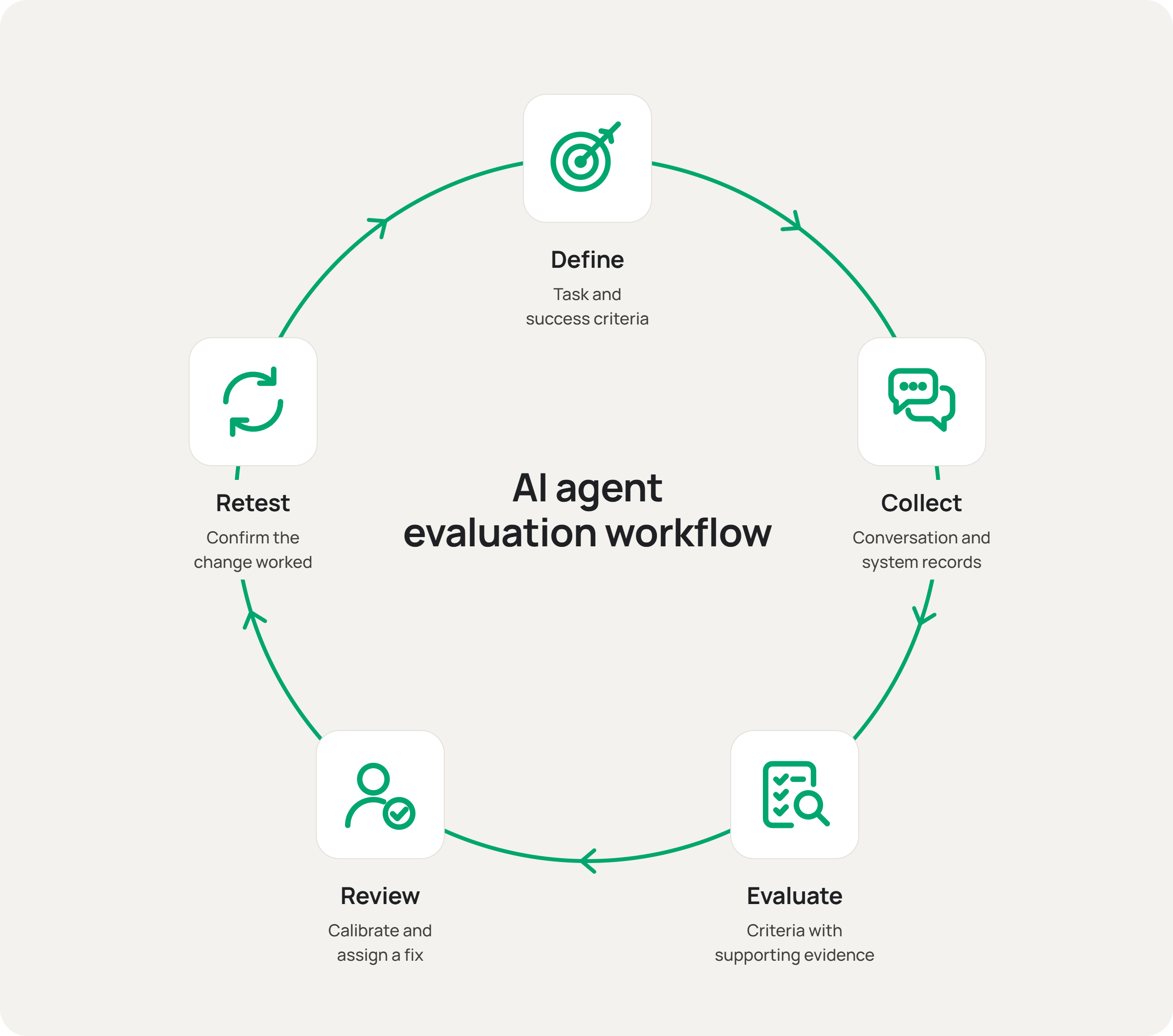
Name the customer task, successful outcome, current policy, and conditions that require human escalation. Set serious-failure rules before reviewing results.
Connect the conversation to available tool results and system records. Keep missing evidence visible so an evaluator can mark an outcome unverified.
Use the six criteria below, with quotes, timestamps, and relevant records supporting each decision. Separate a correct explanation from successful execution.
Calibrate against qualified human review. Investigate disagreements and give each confirmed issue an owner responsible for the instruction, workflow, or policy change.
Repeat relevant tests after the change. Include edge cases and check for new failures before extending the deployment.
Use six checks before expanding the deployment. These tests make each criterion reviewable.
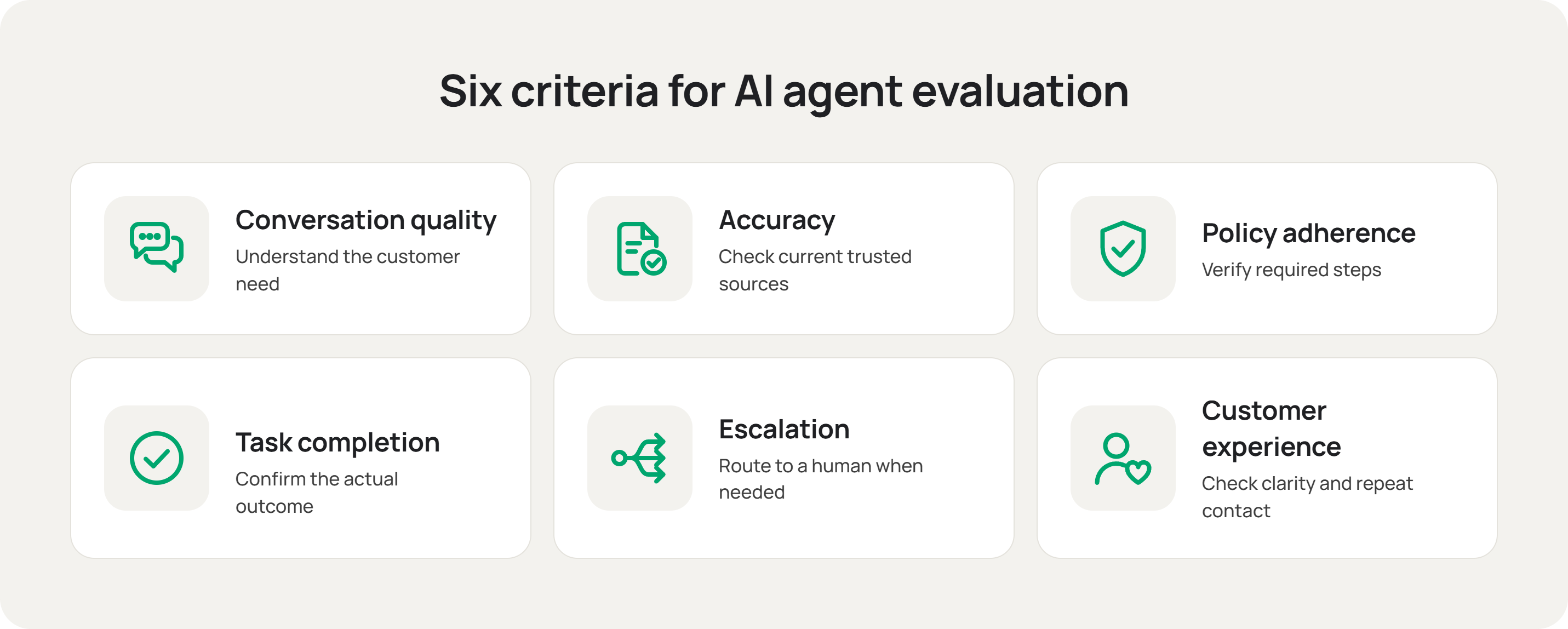
| Criterion | Practical test |
|---|---|
| Conversation quality | Did the agent clarify the need and retain the customer’s corrections? |
| Accuracy | Did the answer match the current approved knowledge or policy? |
| Policy adherence | Did required checks occur before restricted actions? |
| Task completion | Did the relevant action succeed in the system record? |
| Escalation | Was an appropriate escalation option offered, with enough context for a human? |
| Customer experience | Were the customer’s needs addressed and next steps confirmed? |
Illustrative example: An AI agent says a duplicate charge was refunded, but the transaction log shows failure. The customer’s “thank you” does not establish successful completion. If the transaction record is unavailable, mark the outcome unverified rather than assuming success.
Build a representative AI agent testing set, calibrate the evaluator against human-reviewed examples, assign fixes to responsible owners, and rerun affected scenarios after changes. NIST’s Generative AI Profile supports reference-data checks and varied evaluation methods, including human oversight.
Adapt the tests to the customer’s actual task.
| Setting | Example evaluation focus |
|---|---|
| Retail and service operations | Correct cancellation, booking, or refund, with an accurate explanation of what happened. |
| B2B SaaS support | Accurate troubleshooting and a complete handoff when the issue needs specialist access. |
| Financial services and insurance | Approved information, required verification, and escalation for restricted decisions. Requirements depend on the workflow. |
Give each reviewer a clear operational responsibility.
| Role | What they should own |
|---|---|
| Frontline management | Review handoffs, coach human follow-through, and flag recurring failures with supporting conversations. |
| Operations and QA leaders | Own criteria, calibration, review queues, and operational process fixes. |
| AI product and engineering teams | Instructions, tool behavior, reproducible tests, and retesting. |
| Compliance and risk teams | Applicable requirements, serious-failure rules, and sensitive findings. |
| CX and Customer Success leaders | Unresolved needs, repeat contact, and the quality of human handoffs. |
Every organization adding AI agents to customer conversations should be able to answer one question: are our AI agents being evaluated with the same rigor, the same criteria, and the same coverage as our human team?
If the answer is no, the follow-up question writes itself: what are we missing, and at what scale?
When choosing an evaluation workflow, ask to see one case from source evidence through reviewer judgment to an assigned fix. Our best conversation intelligence tools guide provides a broader selection context.
Compass documents evaluation of human and AI conversations with supporting evidence. Bring a representative use case and ask how the available sources, review workflow, and supporting system records fit your requirements.


