

Turn evidence from customer conversations into decisions a specific team can act on.
Customer conversations contain evidence about what people need, where they encounter difficulties, and how well a team responds. Conversation insights help turn that evidence into decisions about customer follow-up, coaching, and service improvements.
A conversation insight is an evidence-based explanation of a customer need, interaction outcome, or business issue, developed by interpreting what customers and agents say in context. It connects an observation to its significance: what happened, why it matters, and what the team should investigate or do next.
Chordia's term page for conversation-derived insight describes findings grounded in conversation content and context. An insight can come from one consequential interaction or a pattern across several. Its wording should make that scope clear.
A customer asking how to reset a password is an observation. Similar questions appearing across calls and support tickets suggest a pattern. Reviewing those conversations alongside the reset process may reveal that customers cannot use the link they receive. That checked explanation gives operations something specific to investigate.
For the broader process behind this work, see what conversation intelligence is and how it works.
Each contributes a different part of the explanation.
| Output | What it tells a team | Example |
|---|---|---|
| Summary | What happened in an interaction | A customer requested help signing in and received reset instructions. |
| Customer signal | A specific cue or event worth examining | The customer says the reset link has already failed. |
| Pattern | Similar observations across a defined set | Several reviewed contacts describe the same reset-link problem. |
| Insight or finding | What the checked evidence helps explain | The reset flow may be a shared source of customer effort and needs investigation. |
These outputs support one another. A summary preserves the interaction's main events, a signal identifies something worth examining, and an insight explains its significance. An automated label or plausible summary needs checking before it becomes a business conclusion.
The same set of customer conversations contains signals relevant to every customer-facing function. The difference is which signals matter to whom.
Findings intelligence adds the operating process around that learning: bringing related evidence together, prioritizing an issue, and assigning follow-through. This guide focuses on recognizing and checking the insight that feeds that process.
Collecting conversation insights gives teams a clearer basis for choosing what to improve and who should act. The benefits come from connecting the customer's actual experience to a specific decision, rather than collecting more labels or reports.
An insight helps a team distinguish an isolated question from a recurring need. The following are illustrative situations. Counts are hypothetical, not measured customer results.
A renewal objection appears on 25 accounts. Each account executive handles it differently. No one sees the pattern.
The same pricing question asked by 45 customers across three channels in two weeks, with each channel team treating it as a one-off. A product feature generating confusion after a recent update. A friction point in the onboarding flow that shows up in conversations but never in surveys. These findings need to reach CX and product teams who can address the root cause, not the symptom.
Reviewing the actual request and desired outcome helps explain the underlying customer need.
Conversation insights can connect symptoms that different teams are investigating separately. The following situations are illustrative rather than reports about a named customer.
Support tickets spike after a product update. Two teams troubleshoot independently, but the root cause stays unfixed.
The most valuable findings often span multiple teams. A pricing objection showing up on discovery calls is a sales problem. The same objection showing up on renewal calls is a retention problem. The fact that it started appearing after a pricing change three months ago is a product and packaging problem. No single team sees the full picture because the conversations live in different systems reviewed by different people.
The timing suggests an investigation. It does not by itself establish that the pricing change caused the objection.
Account teams can use conversation evidence to decide which objection needs a response. Possible findings include the following examples.
A competitor gaining ground in mid-market discovery calls. A pricing objection appearing with increasing frequency. A specific objection-handling approach that correlates with higher win rates. These are revenue-relevant findings that need to reach sales leadership with evidence, not anecdote.
A correlation can guide further review without proving that one sales behavior caused the outcome. Explicit churn intent can justify follow-up without predicting that the customer will leave.
The benefit is a precise review task for the person who can change the behavior or process. For example:
A specific agent behavior declining across a team. A process step being shortened under time pressure. A queue where handle times are rising because agents lack knowledge base coverage for a new call type. These are operational findings that need to reach the people managing day-to-day performance.
Check whether the cause belongs to coaching, knowledge content, or a blocked workflow before assigning training.
Conversation insights can give specialists a specific question with evidence. These are examples of issues requiring review.
A disclosure being skipped on outbound calls in one region. A verification step being abbreviated on a specific call type. A required statement delivered after the commitment instead of before it. These findings carry regulatory exposure and need to reach compliance officers with enough evidence to assess severity and respond.
Whether a possible compliance gap establishes a violation depends on the applicable requirement and context. Chordia's voice of customer guide also explains how wording and outcomes inform interpretation.
Organizations generate thousands of customer conversations every month. When those conversations are analyzed at scale, patterns emerge: recurring objections, shifting customer concerns, compliance drift, product confusion, competitive mentions, escalation triggers, coaching gaps.
Teams need to deliver these patterns to the people who can act on them.
Teams collect conversation evidence to answer a practical question: where are customers getting stuck, which needs remain unmet, or what should change? Analysis connects related observations, checks their meaning, and turns a supported explanation into a decision with an owner.
Connect the evidence to a specific decision.
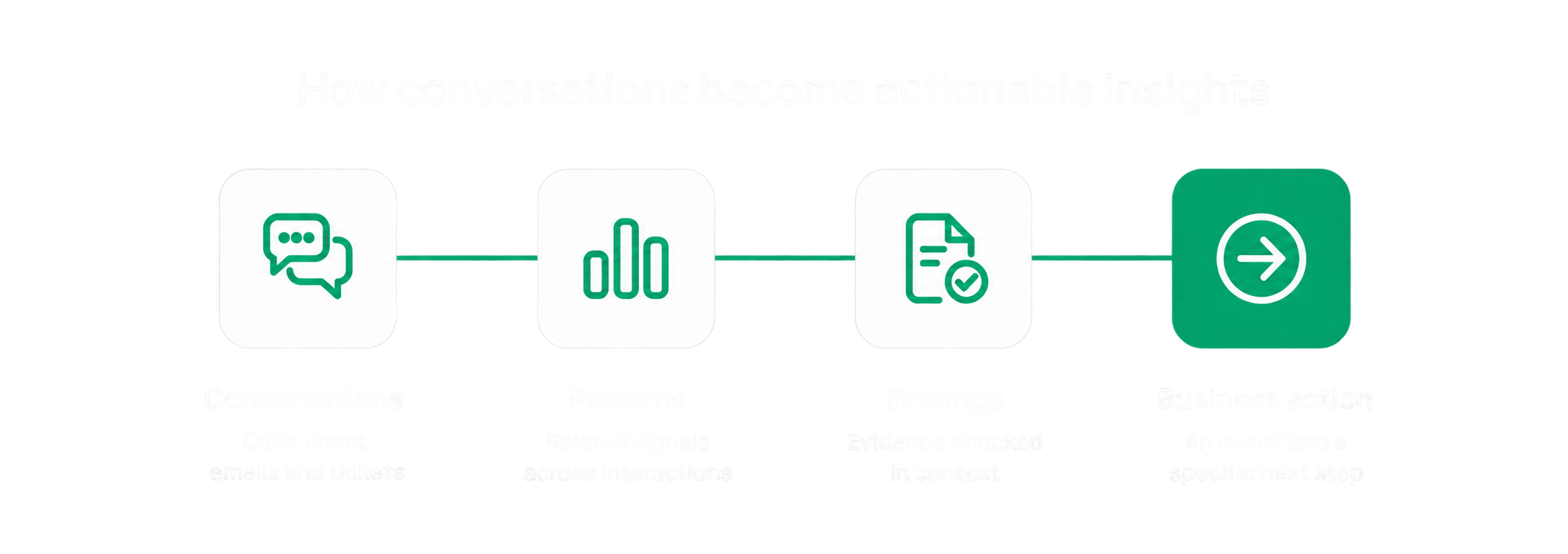
Define the question, channels, period, and customer group in scope. Retain the original recordings or messages where access permits, including speaker information and the surrounding exchange. Note missing channels or incomplete records so the limits of the analysis remain clear.
Findings intelligence routes each finding to the person who can act on it, with enough evidence and context to choose the next step.
Group related observations across calls, chats, emails and tickets. Connect contacts reliably and avoid counting one continuing issue as multiple customers.
Use the following evidence standard for findings selected for operational review.
Every finding comes with the specific conversations, moments, and quotes that support it. A coach or a VP doesn't need to go searching for examples. The evidence is right there: which reps, which calls, which moments, what was said. The finding is defensible because anyone can go to the source and verify it. This traceability is what separates an actionable finding from a directional data point.
Traceability supports review. It does not guarantee the interpretation is correct.
The next step and owner are clear.
A finding without an owner is a finding that doesn't get resolved. Effective findings intelligence assigns each finding to the team or individual responsible for acting on it, with a recommended action and a status that tracks whether the pattern changes in subsequent conversations. A finding stays open until the pattern shifts in the data, not until someone marks it complete in a project management tool.
Treat this as a workflow principle, not a guarantee that software or ownership alone will fix the issue. Chordia's CX action guide connects interpretation to routing.
Choose a recurring customer question and connect its supporting conversations to an accountable owner. Explore Findings Intelligence and read how teams turn CX data into coordinated action.
Illustrative scenario: Customers describe repeated sign-in failures across calls, chats, and tickets. A reviewer compares the original quotes, the sequence of contacts, and available reset-flow records. Similar reports suggest a reset-link problem, but the team still needs to establish which part of the experience failed.
Route the finding according to the evidence.

If a customer remains blocked and has an open commitment or renewal discussion, send the account owner an alert with the unresolved need and promised follow-up. Sales or customer success can coordinate a response without asking the customer to reconstruct the history.
If the reset flow works but agents repeatedly skip an available instruction, give the frontline manager an evidence-based coaching task. Use the relevant transcript moment and approved guidance in a short review session. Avoid assigning training merely because an interaction was difficult.
If customers and agents encounter a reproducible blocker, send operations a process investigation with the affected step and supporting records. A system defect may require engineering involvement; an unclear instruction may belong to the content or process owner. Conversation evidence narrows the investigation without proving a technical root cause on its own.
These routes can run together when the evidence supports them. Immediate customer follow-up may be needed while a process investigation continues. Chordia's guidance on separating process failures from agent performance explains why those responsibilities should be considered separately.
After a change, inspect later conversations for the same obstacle and check any available outcome records. Keep the issue open if customers remain blocked or the evidence is incomplete.
Open the source recording or message, including the turns before and after the quoted passage. A statement such as "that did not work" needs a clear referent. Transcription, speaker attribution, and generated summaries can introduce errors, so consequential decisions need a review path back to the source.
State the reviewed population and missing channels. The source illustrates another reporting risk below; its percentages are hypothetical, not measured results.
Weekly or monthly reports aggregate findings into topic summaries, trend lines, and averages. These are useful for general awareness but poor at driving action. A report that lists twenty trends doesn't tell a VP of Sales which one is costing pipeline this quarter. A compliance summary that shows 94% adherence doesn't flag the specific team where adherence dropped from 98% to 87% in three weeks. Without prioritization by business impact, reports inform without compelling action.
Compare similar cases and check alternative causes. This source example describes prioritization; its percentage is illustrative, and estimates of impact or risk require evidence and explicit assumptions.
Not every pattern matters equally. A compliance step being shortened on 3% of calls in one queue is different from a pricing objection reshaping win rates across an entire segment. Findings intelligence prioritizes by business impact, revenue at risk, compliance exposure, customer churn probability, so the organization focuses on what matters most, not what happened most recently.
This describes a desired review process, not a verified capability of every platform.
Compare detections with qualified human review across the languages, channels, and situations where they will be used. Include missed signals as well as false alarms. NIST's AI Risk Management Framework 1.0, published in January 2023, supports representative testing and continuing checks of AI reliability. Its guidance does not certify a particular system or guarantee an insight is correct.
Use human review to resolve uncertainty before an automated interpretation becomes a consequential decision. Share evidence through approved access controls and redact unnecessary personal information from broader circulation.
The customer task determines the useful insight.
| Industry | Illustrative pattern to investigate | Practical action |
|---|---|---|
| E-commerce and retail | Customers ask again about a return after receiving instructions. | Operations checks the return steps and handoff; support follows up on open cases. |
| Financial services | Customers repeatedly misunderstand a fee explanation. | The policy owner reviews clarity and applicable requirements; managers coach the approved explanation. |
| Healthcare administration | Patients report difficulty completing appointment preparation. | Administrative teams inspect scheduling instructions and access barriers, routing clinical questions to qualified staff. |
| Professional services | Clients describe deliverables differently from the agreed scope. | Account and delivery owners review commitments and clarify expectations with the client. |
These examples describe possible review tasks, not measured customer results. The same interaction may contain an individual issue needing immediate follow-up and a wider process question that requires more evidence.
Give the finding to someone with authority.
| Persona | Decision supported by conversation insights |
|---|---|
| Frontline managers and operations leaders | Decide whether to coach a behavior, clarify guidance, or investigate a process blocker. |
| Customer experience and customer success leaders | Coordinate unresolved needs, account commitments, and recurring customer effort across teams. |
| Revenue and sales leaders | Review objections, follow-through, and account concerns using the buyer's actual context. |
| Risk and compliance teams | Review possible policy gaps against the applicable requirement and supporting evidence. |
| Product and service owners | Investigate recurring problems with representative conversations and relevant system records. |
The key insight is that none of these findings require separate analytics programs for each team. They all come from the same conversations. What changes is routing: which finding goes to which team, with what priority, and with what evidence attached.
Accountability has a record. A finding that stays open until the pattern changes in actual conversations creates a different kind of accountability than a task that gets marked complete.
Choose a question that leads to a decision: where are customers getting stuck, which commitments remain open, or which explanations keep failing? Agree what evidence would support an answer and who will act on it. Preserve the original context so another reviewer can challenge the interpretation.
When selecting software, ask vendors to demonstrate that workflow on an appropriate, approved example. Use the best conversation intelligence tools guide to connect those requirements to a wider evaluation. An insight becomes useful when a team can explain the evidence, choose a proportionate action, and check what happened afterward.
Compass connects conversation evidence with findings and recommended next steps. Explore Compass or discuss how it could support your team's review and follow-through.


