

Evaluate interactions against defined standards, with evidence, reviewer calibration and a clear next step.
Conversation quality analysis is the evaluation of customer interactions against defined standards to understand how well a customer’s needs were handled. It examines observable behavior, the information given, the steps taken and the outcome supported by the conversation. A useful assessment shows the evidence behind its conclusion and gives the responsible person a clear next step.
The interaction might be a support call, a sales meeting, a chat or an email exchange. Quality means something different in each setting. A return inquiry may need an accurate explanation and an agreed action; a discovery meeting may need clear questions and a shared understanding of the buyer’s problem. The standard should reflect that purpose.
Call quality monitoring applies this review to voice interactions. Automated quality assurance uses software to perform evaluation tasks across accessible interactions. Conversation quality analysis describes the assessment itself, whether people, software or both carry it out.
It also has a narrower focus than conversation intelligence as a whole. Quality asks how well the interaction was handled. Broader conversation analysis can also reveal recurring customer needs, emerging objections or product issues. Those findings may explain a quality problem without making it an individual employee’s fault.
A transcript preserves the exchange, a summary condenses it, and a quality evaluation judges specific criteria against the available record. A polite ending, a short call or a positive sentiment estimate does not establish that the customer received the right answer.
“Improve your communication” gives an employee little to practice. A review can instead identify the unanswered question, show where the explanation became unclear and agree on a better way to confirm understanding. Effective behaviors deserve the same attention, so teams can explain what worked and repeat it.
A shared QA scorecard makes the expected behaviors explicit. Reviewers still need to compare their interpretations using the same interactions. Consistency depends on clear criteria and calibration; using the same form or AI model does not guarantee agreement.
A delayed answer may reflect missing knowledge, an approval bottleneck or an unavailable system. Checking the surrounding evidence helps managers decide whether to coach a behavior, correct guidance or ask an operations owner to fix a process. Chordia’s guide to distinguishing process failures from agent performance develops this diagnosis.
Repeated explanations, unfulfilled commitments and unresolved questions can appear across channels. Reviewing related interactions helps teams see whether an apparent resolution lasted. Wider analysis can reveal patterns, but disconnected channels and incomplete records still limit the picture.
Use observable criteria suited to the interaction.
| Dimension | Evidence to examine | Interpretation to avoid |
|---|---|---|
| Understanding | Questions, restatement and acknowledgement of each stated need | A greeting proves active listening |
| Accuracy and clarity | The explanation compared with current approved information | A confident answer must be correct |
| Resolution | What changed, what remains open and what the customer confirmed | A closed ticket proves resolution |
| Next steps | The action, responsible person and timing communicated | A promise proves completion |
| Applicable requirements | Required events and their order in the relevant context | A detected phrase proves the whole requirement was met |
Some criteria may not apply to all interactions. A general product inquiry may not require the same verification steps as an account change. Preserve that distinction rather than forcing every interaction into a universal checklist.
The purpose is to produce a reviewable assessment that supports an appropriate response. The process connects an interaction’s purpose, a defined standard and supporting evidence before anyone acts on the result.
The workflow connects standards, evidence and action.
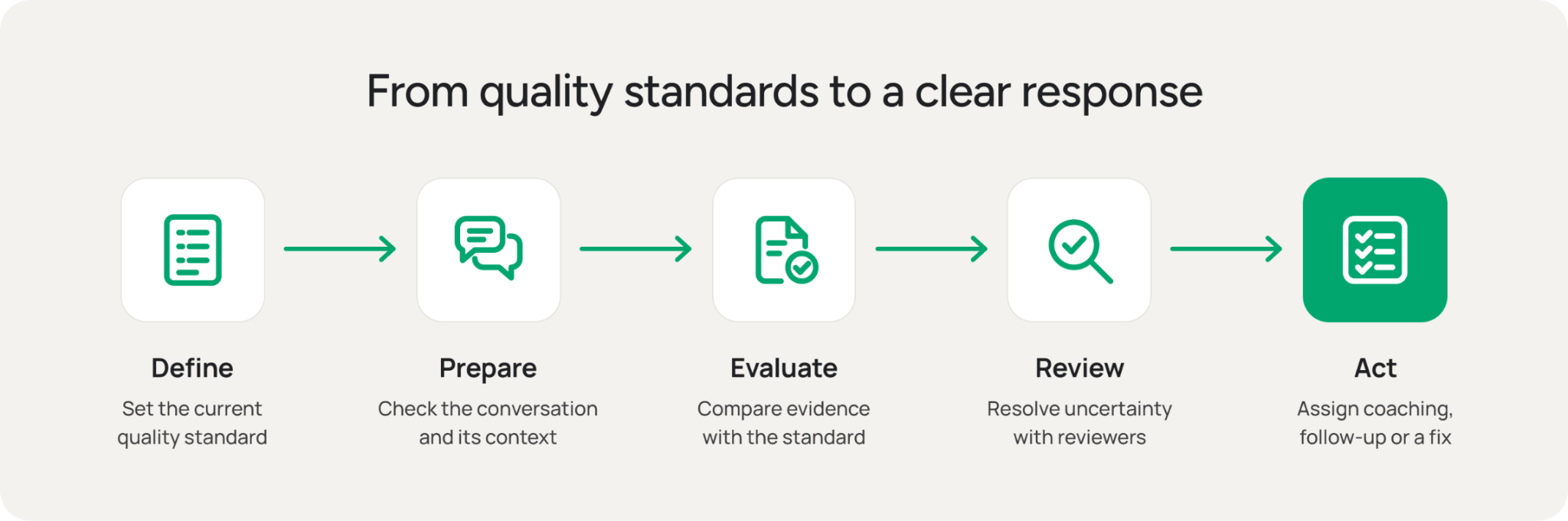
Choose one interaction type and describe the expected behaviors in plain language. For an order-status inquiry, these might include identifying the order, explaining its current state and agreeing on what happens next. Define what counts as met, partly met, not met, not applicable and insufficient evidence.
Record the relevant policy or knowledge version. An assessment of accuracy needs an authoritative reference; a plausible explanation in the transcript is not enough. Keep critical required steps visible rather than allowing a high average to conceal a serious miss.
For calls, check recording quality, transcription, speaker attribution and timestamps. For text, preserve message order and the surrounding thread. Connect earlier or later interactions where they affect the question being evaluated, and limit access to the people who need the record.
Define coverage precisely. If a team handles 10,000 interactions in one month and successfully analyzes 8,000, its coverage is 80% for that stated monthly population.
Identify the relevant moment and compare it with the standard. Keep the quotation or timestamp, the criterion, the rationale and any uncertainty together. Chordia’s explanation of AI conversation evaluation describes how transcription, event detection and rubric-based assessment fit together.
AI can help locate and evaluate candidate evidence, but a fluent rationale can still be wrong. If a recording is incomplete, “not observed” may mean insufficient evidence rather than a confirmed omission. The same care applies when interpreting tone, indirect answers or an ambiguous customer response.
Have informed reviewers evaluate the same examples and resolve differences in the criterion or evidence. Include straightforward and difficult interactions, relevant languages and channels, and cases where a signal should be absent. Review both incorrect flags and missed events before relying on the output for consequential decisions.
The NIST AI Risk Management Framework’s Measure guidance supports testing before deployment, ongoing evaluation and interpretation in context. It is voluntary AI risk guidance, not a contact-center scoring standard or certification. Apply its principles to the evaluator’s actual use and limits.
Give the finding to someone who can act. A supervisor may coach a closing behavior; an operations lead may remove a recurring approval delay. A customer follow-up may be needed alongside either action. Record what was agreed and inspect subsequent relevant interactions to see whether the intended change occurred.
Keep the original assessment and any reviewer correction traceable. When a score looks surprising, return to the interaction and its context before deciding what it says about performance.
Explore evidence-based quality evaluation and a practical guide to turning conversation findings into coaching and operational action.
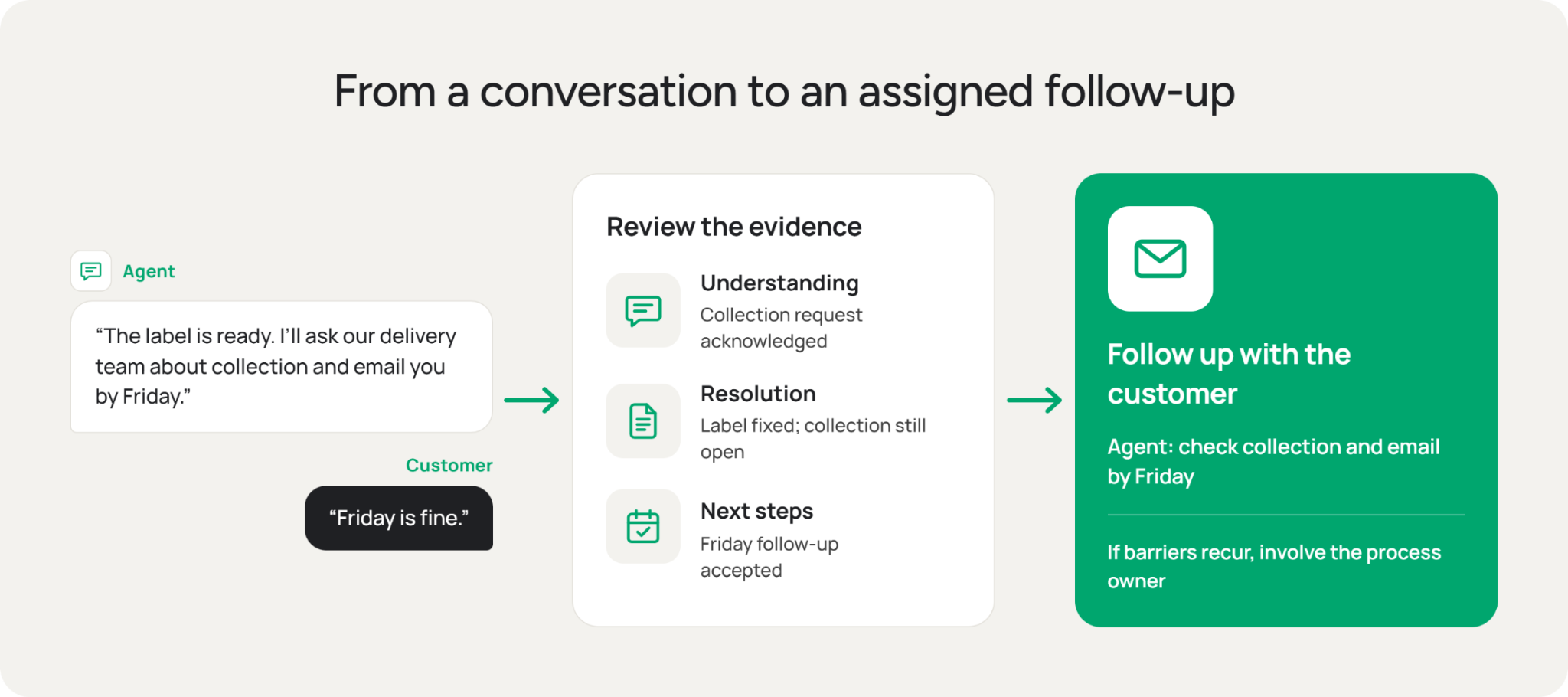
Consider this illustrative returns conversation:
Customer: “The return label works now. Will someone collect the parcel? I can’t get to a drop-off point.”
Agent: “The label is ready. I’ll ask our delivery team about collection and email you by Friday.”
Customer: “Friday is fine.”
The agent has given a follow-up owner and deadline, and the customer has accepted that timing. The collection request is still pending. This should remain visible even if the immediate label problem has been fixed.
Review each need against its supporting evidence.
| Review question | Evidence and assessment |
|---|---|
| Was the customer’s need understood? | The collection request was acknowledged through a proposed check with the delivery team. Review the full exchange if clarification is needed. |
| Was the issue resolved? | The label works; collection is unconfirmed. The overall need remains partly open. |
| Were next steps agreed? | The agent will check collection and email by Friday; the customer accepts. That supports an agreed next step, not completed collection. |
| What should happen next? | Track the promised response. If similar access problems recur, ask the process owner to examine collection options and guidance. |
The Confusion Unresolved signal illustrates a related check: whether expressed uncertainty received an adequate response. It should not be applied automatically here; an open operational request is not necessarily confusion. Likewise, the Signal Library distinguishes customer needs being addressed from next steps being confirmed. A review should preserve those separate judgments.
Different settings need different evidence and responses.
| Industry | Conversation quality question | Useful response |
|---|---|---|
| Retail and e-commerce | Were return options explained accurately and remaining commitments made clear? | Improve explanations or route recurring delivery constraints to operations. |
| Financial services | Did the customer receive a clear explanation of the relevant account or payment process? | Review unclear explanations and route applicable disclosure questions to qualified specialists. |
| Healthcare administration | Were appointment arrangements, preparation instructions and non-clinical next steps understood? | Correct scheduling guidance and route clinical questions to qualified staff. |
| Travel and hospitality | Were disruption options, unresolved requests and follow-up timing explained? | Clarify customer communication and review handoff delays. |
These are applications of conversation review. They do not establish legal compliance, clinical correctness or a guaranteed business result. The responsible specialists should define the requirements and reference information for their setting.
Each role needs evidence for a different decision.
| Role | Decision supported | Action |
|---|---|---|
| Frontline Management | Which observable behavior needs reinforcement or practice? | Coach a specific moment and review later examples. |
| Risk and Compliance | Does a flagged event need specialist investigation? | Check applicable requirements and preserve the supporting record. |
| Customer Experience | Where do customers repeatedly struggle? | Bring recurring friction to the owner of the journey or process. |
| Revenue and Sales | Were needs explored and commitments agreed clearly? | Coach discovery, explanations and follow-through. |
Quality, coaching, compliance and findings work can share the same conversation evidence. Their decisions remain distinct: assess the interaction, develop a behavior, investigate a requirement or coordinate a recurring issue. Sharing evidence helps prevent four teams from reconstructing the same exchange separately.
Begin with a question your team can answer and act on, such as whether customers leave returns conversations knowing the next step. Select the relevant interaction types and a small, explicit set of criteria before broadening the scope.
Compare reviewers’ judgments on the same records. Where they disagree, determine whether the problem is missing context, an unclear definition or an evaluation error. NIST’s AI RMF Playbook Measure guidance recommends testing in expected operating conditions and using human review for unexpected data and unreliable outputs. For a quality program, that means checking the evaluator against the conversations it will actually assess.
Consider call difficulty before comparing employees. A short, successful transaction and a complex complaint offer different opportunities and constraints. A relationship between a behavior and an outcome alone does not show that the behavior caused it.
Explain how people can inspect evidence and challenge a judgment. Define permissions, retention and handling of sensitive data with the responsible owners. Keep unavailable records and uncertain interpretations visible rather than presenting them as successful evaluations.
Finally, agree who receives each finding and who can change the practice. A useful review ends with a clear decision: reinforce an effective behavior, coach a specific gap, follow up with a customer or fix an operating constraint. Teams comparing approaches can use the published conversation intelligence tools guide to examine evidence, coverage and operating fit. For a focused comparison of quality analysis and automation platforms, see the top conversation quality analysis and automation software review.
Compass connects customer interactions to deliver Conversation Quality, Conversation Compliance, Conversation Coaching and Findings Intelligence.


