

Coverage describes reach. Evidence and review establish whether the result is useful.
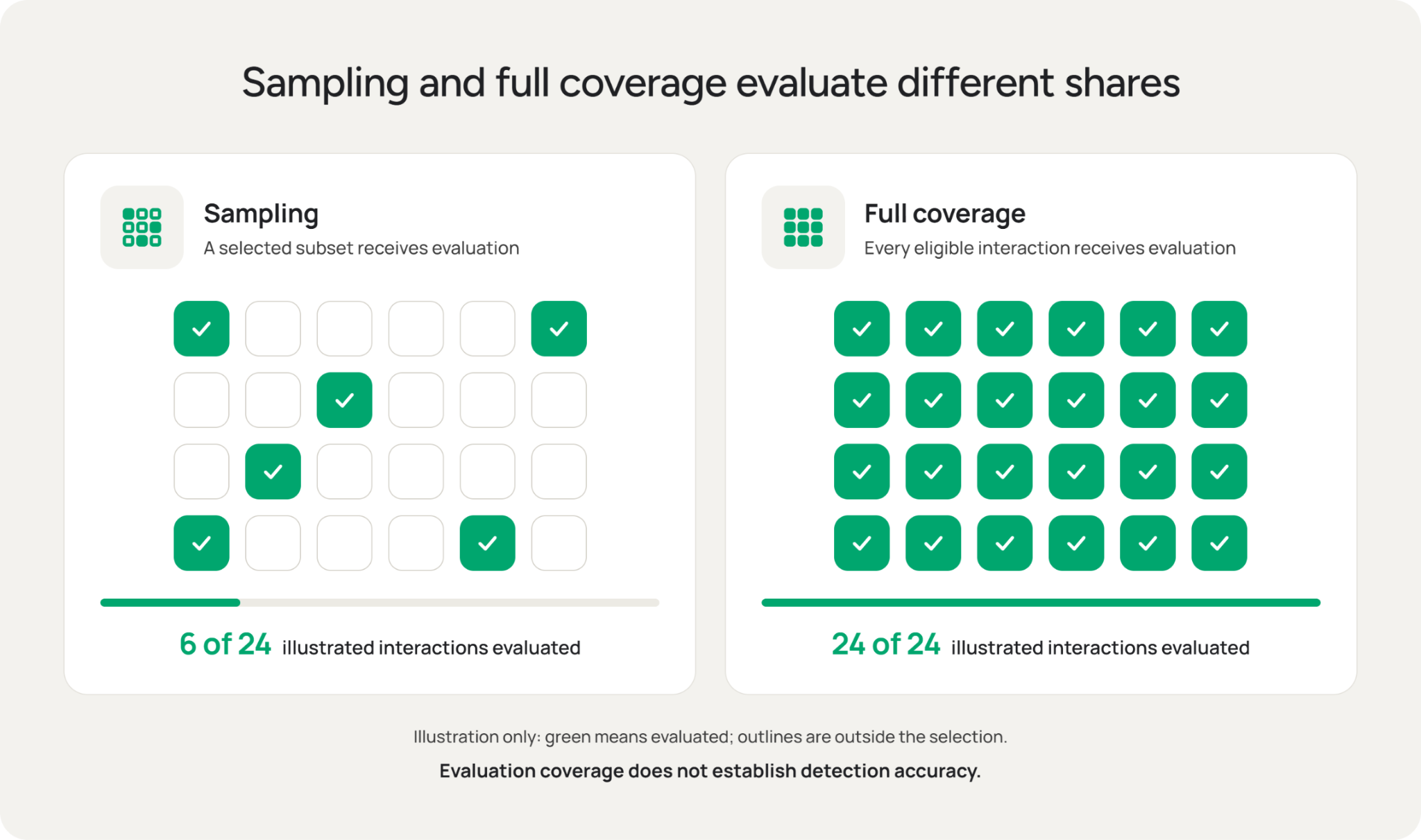
Sampling evaluates a selected subset of customer conversations. Full coverage aims to evaluate every eligible conversation in a defined population. The difference is how much of the work receives an assessment. It does not establish whether each assessment is correct.
For many teams, the practical approach combines broad automated evaluation with selective human review. Automation extends visibility, while people investigate exceptions, check apparently clean results and resolve ambiguous judgments. This guide explains how to compare the approaches and define what coverage means for your work.
In conversation intelligence, sampling means selecting interactions for analysis or review rather than examining the entire population. A team might select calls randomly, choose a set from each queue, or investigate complaints. Each selection serves a different purpose.
A random sample can support estimates about the population from which it was drawn. A targeted sample helps investigate a particular concern, but its results should not be presented as an overall performance rate. Reviewing only complaints, for example, tells you about those complaints rather than the overall customer experience.
Full coverage means attempting the defined evaluation across all eligible interactions in scope, usually through automated quality assurance. The scope might be recorded support calls during a week or supported calls, chats and emails. State the channels, time period, exclusions and completed processing so the result can be interpreted.
Automated coverage and human review are separate activities. A system may evaluate every eligible call while people listen to only a subset. Conversely, storing every recording does not mean every conversation was evaluated.
Compare reach, interpretation and the work each requires.
| Dimension | Sampling | Full coverage |
|---|---|---|
| Accuracy | Human or automated judgments can be wrong. Population estimates also depend on selection, sample size and variability. | Removes selection uncertainty within a genuinely complete population, but retains transcription, interpretation and scoring errors. |
| Risk detection | Useful for known concerns and detailed investigations; events outside the selection remain unexamined. | Gives eligible interactions an opportunity to be checked. A missed detection is still possible. |
| Coaching | Supports close listening and discussion, but a few calls may give a narrow picture of someone’s work. | Provides more examples across call types and time. |
| Bias | Selection may over-represent certain shifts, agents or call types. Random or stratified selection can reduce this problem. | Reduces selective-review gaps when inputs are complete. Missing channels, uneven transcripts and evaluation bias can remain. |
| Effort | Manageable at a chosen review volume; more manual reviews require more listening and administration. | Automated processing expands reach. Integration, criteria, exception handling and quality checks still require work. |
| Scalability | Fixed samples are feasible, but may become thinner as volume or diversity grows. | Can process larger volumes within system capacity; latency, cost and reviewer capacity must be checked. |
NIST’s guidance on selecting sample sizes ties sampling decisions to the intended estimate, variability, desired precision and practical constraints. A fixed percentage alone does not establish that a sample is adequate.
A small overall sample may contain very few interactions from a less common call type. A recurring misunderstanding in that group can look isolated or remain unseen. Broader evaluation can reveal a pattern, provided the relevant conversations are included and the criteria detect it reliably.
Compare like interactions before drawing conclusions. Twenty routine status calls and twenty difficult cancellations involve different conditions. More data makes the comparison possible; it does not make an unadjusted average fair.
When supervisors choose only memorable failures, coaching may overemphasize exceptions. Reviewing only easy calls can hide genuine gaps. Sampling bias in QA describes how an unrepresentative selection distorts the picture. See conversation coaching for how to turn observed moments into feasible practice.
Use a planned selection across relevant agents, shifts and interaction types when assessing routine performance. Keep targeted investigations identifiable. An escalation review is useful, but it should not silently become the representative sample for an entire team.
Automated evaluation can help reviewers find moments worth inspecting instead of searching through recordings. Reviewers can spend more time examining uncertain findings, discussing evidence and correcting definitions. Chordia’s guide to reviewing more calls without adding QA staff describes this shift in detail.
Capacity still matters. A system that produces thousands of flags without prioritization can create a new backlog. Agree who handles urgent findings, how disputes are resolved and which repeated issues belong with a process owner.
The purpose is to expand visibility while keeping assessments useful. Begin with a bounded population and a clear review question, then check the data and interpretation before widening the scope.
Name the channels, teams, languages, interaction types and dates included. Decide whether transferred calls count as one customer interaction or several call segments, and use that unit consistently. Document exclusions such as test records or recordings your organization cannot use.
Check connected sources against the work customers actually do. A complete voice feed will not show an unresolved email that follows the call. The guide to choosing conversation intelligence across existing systems explains why the connected workflow matters.
Separate records available at the source, eligible records and completed evaluations. Keep missing, failed and pending items visible. A low-confidence result also needs a clear status; a completed processing job is not necessarily a usable assessment of every criterion.
For an illustrative week, suppose there are 2,000 recorded interactions. Of these, 1,800 are eligible under a documented scope, and 1,710 receive the intended evaluation. That is 95% of eligible interactions and 85.5% of all recorded interactions. The 200 excluded records and 90 eligible records not evaluated remain visible in the reconciliation.
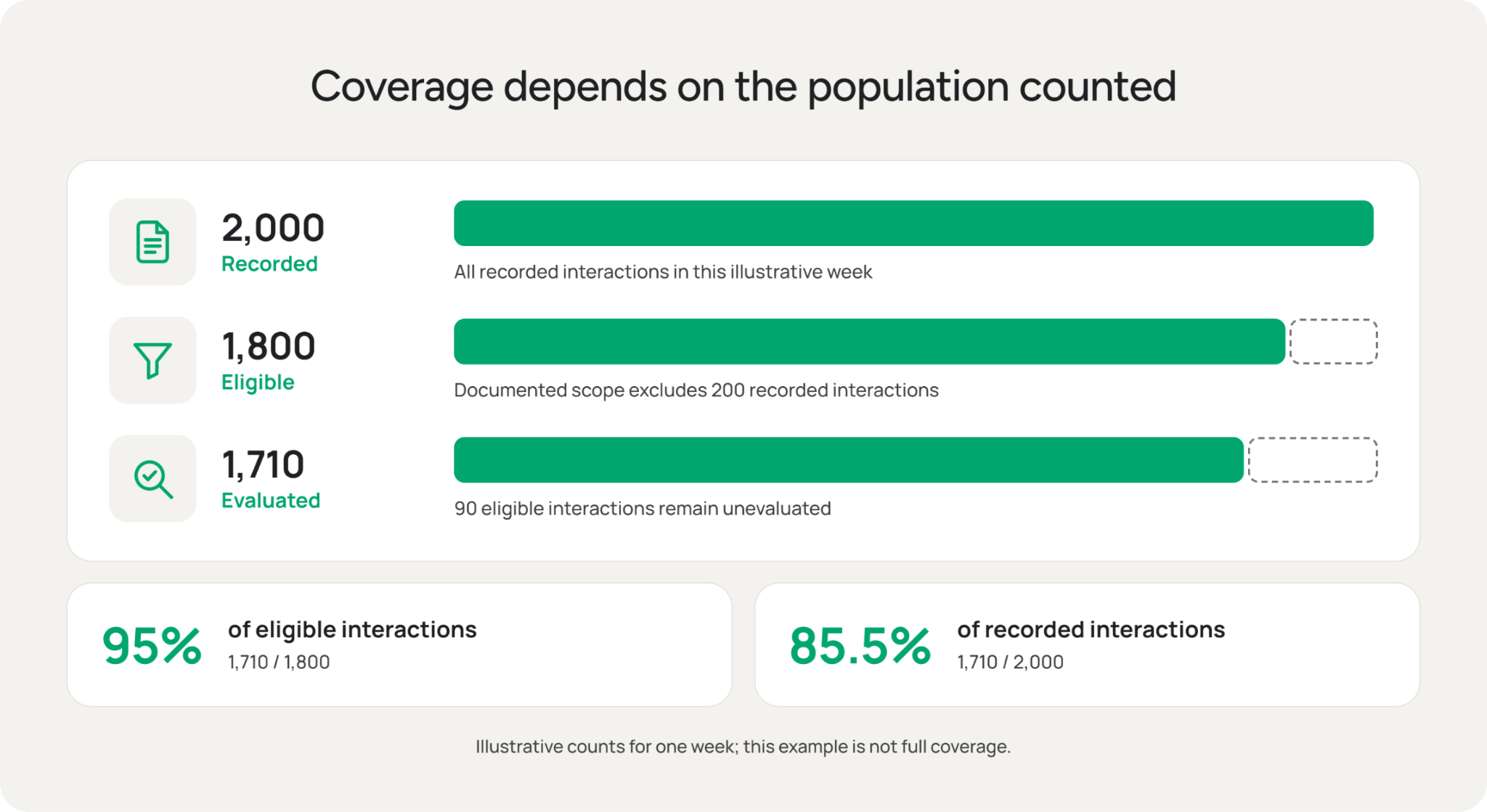
Do not describe that example as full coverage. State the actual rate and explain the gaps. Even when every eligible record is evaluated, a narrower eligibility rule can leave important customer interactions outside the claim.
Define observable behaviors in a QA scorecard. For each criterion, specify when it applies and what evidence supports a judgment. A disclosure check, for example, should distinguish an applicable missed step from a conversation where that requirement did not apply.
Compare automated results with informed human review across ordinary, difficult and ambiguous cases. Chordia’s guide to evaluating conversations at scale connects expanded coverage with consistent definitions and traceable evidence.
If AI agents handle some interactions, include scenarios where their answers sound plausible but fail to address the request. Use the same evidence standard while recognizing different failure patterns, as described in evaluating AI agents with conversation intelligence.
Explore Chordia’s Conversation Quality approach and use the buyer guide to examine coverage, evidence and the human review workflow your team needs.
Review high-impact, uncertain and disputed findings. Also select apparently clean interactions independently of the system’s flags. Reviewing only flagged records helps assess false alarms, but cannot reveal how often the system missed an issue in unflagged conversations.
A false positive flags an event that did not occur. A false negative misses an event that did occur. Both matter: one wastes attention or creates unfair feedback; the other leaves a problem unseen. Use human-in-the-loop review where a judgment needs confirmation before action.
Give confirmed findings an owner and a specific next step. A behavior gap may call for coaching; a recurring obstacle across many people may need a workflow or policy change. Findings Intelligence explains how related evidence can support a coordinated response.
Recheck after changes to scripts, products, customer mix or evaluation logic. Retain representative review alongside targeted investigations so the team can notice new failure patterns. Expand only as quickly as the ingestion, evaluation and review workflow can support.
Sampling is valuable when the question requires detailed interpretation, when a team is validating an evaluator, or when only a bounded investigation is justified. It also helps verify automated outputs after broader coverage is operating.
Choose the selection method for the question. Random selection supports a less selective view of the accessible population. Stratified selection ensures specified groups receive attention; overall estimates must account for how those groups were sampled. Targeted selection concentrates on known risk, but its findings describe that focus rather than the full population.
For example, a team can investigate every flagged verification issue while independently reviewing unflagged calls from the same period. The two groups answer different questions. Keep them separate in reporting rather than combining them into an apparent overall failure rate.
Match the scope to the operating question.
| Setting | Useful coverage question | Human review focus |
|---|---|---|
| Financial services and insurance | Are applicable required steps evaluated across the selected call types? | Sequence, applicability, supporting evidence and specialist interpretation |
| Healthcare administration | Are scheduling, intake and billing conversations included where permitted? | Unclear instructions, missing context and appropriate handling of sensitive information |
| Retail and service businesses | Do findings cover channels, locations and shifts with different customer needs? | Repeated explanation gaps and the difference between coaching and process issues |
| BPO and multi-client operations | Are client populations, criteria and exclusions kept distinct? | Correct client standards, permissions and fair comparisons |
These are operational applications. Broader conversation analysis does not by itself establish legal compliance or permission to process every record.
Give each role a clear review responsibility.
| Role | Decision to support | Practical responsibility |
|---|---|---|
| Frontline Management | Which behavior needs coaching? | Inspect evidence across relevant call types and discuss confirmed examples |
| Risk and Compliance | Which applicable gap needs investigation? | Set escalation rules and confirm consequential interpretations |
| Customer Experience | Where is friction recurring? | Compare channels and route shared obstacles to their process owners |
| QA and analytics leaders | Can the results support the intended conclusion? | Define populations, reconcile processing and maintain independent checks |
Use sampling when it answers a bounded question or provides a sound basis for validation. Use broader automated evaluation when the aim is visibility across the eligible population. Keep human review focused on consequential findings, uncertainty and independent checks of results the system considered clean.
Before accepting a full-coverage claim, establish what population it covers, how many records were evaluated and how interpretation is checked. More conversations create an opportunity for a better view. Evidence, appropriate selection and responsible follow-through determine whether that view supports the decision at hand.
Compass connects customer interactions across voice, chat and email sources and supports evidence-based quality review, coaching, compliance review and findings. Bring a defined population of conversations and test the coverage, evidence and next steps your team needs.


