

Turn a verified moment into feasible practice and later evidence of the behavior.
Conversation coaching uses evidence from customer interactions to help a person improve or reinforce a specific behavior. A manager and employee examine what happened, agree on what to practice and review later conversations to see whether that behavior changed.
The useful result is an action the person understands and can carry out. A quality score or automated recommendation can help identify where to look, but coaching requires interpretation, discussion and follow-through. This guide explains that workflow and how to apply it across customer-facing teams.
Conversation coaching connects an observed interaction with a learning task. The evidence might be a discovery question that clarified the customer's needs, an explanation that caused confusion or a follow-up commitment that remained vague. Good examples can be reinforced as well as gaps corrected.
A coaching opportunity is an observable moment worth developing or repeating. The coach checks the surrounding exchange, the applicable standard and the options available to the employee before deciding what the moment means.
Conversation intelligence can help find related examples across supported calls, messages and other records. It makes those examples easier to locate; it does not turn every signal into a correct diagnosis or a mandatory coaching task.
A QA scorecard evaluates interactions against defined criteria. Coaching uses relevant evidence to help someone perform a behavior more effectively. General training teaches a skill or standard to a wider group; an individual coaching conversation applies it to a person's work.
The activities can support each other. A scorecard may flag weak confirmation of next steps, training may demonstrate a useful closing structure, and coaching may help one employee apply that structure to difficult conversations. Completing a review form alone does not show that learning occurred.
Advice such as "take more ownership" leaves the employee to infer what should change. A coach can instead examine the moment when a customer asked about timing, then practice agreeing a clear next step. The behavior is visible and the task is concrete.
The CIPD's performance feedback evidence review supports specific, task-related feedback and two-way discussion. Its review concerns feedback from managers or supervisors; it is not evidence that an automated coaching product improves performance.
A strong example makes effective behavior easier to discuss. A manager can show how someone restated a complicated request, checked understanding and chose an appropriate next step. The team can learn from the sequence while adapting it to different customer needs.
Avoid treating a high score or successful outcome as sufficient proof of a transferable technique. Examine what the person did, the situation they faced and whether the same approach is suitable elsewhere.
Coaching is useful when the person has a meaningful behavior to change. A stalled approval, inaccessible knowledge article or contradictory policy may require a process owner as well. Chordia's guide to distinguishing process failures from agent performance provides a useful diagnosis question: what constrained the person's choices?
Both causes can coexist. An employee may need to explain a delay more clearly while operations fixes the delay itself. Related findings can be coordinated through the approach described in Findings Intelligence.
The purpose is to turn a verified observation into practice and later review. Establish a shared standard, select relevant evidence and make the employee part of deciding how to improve.
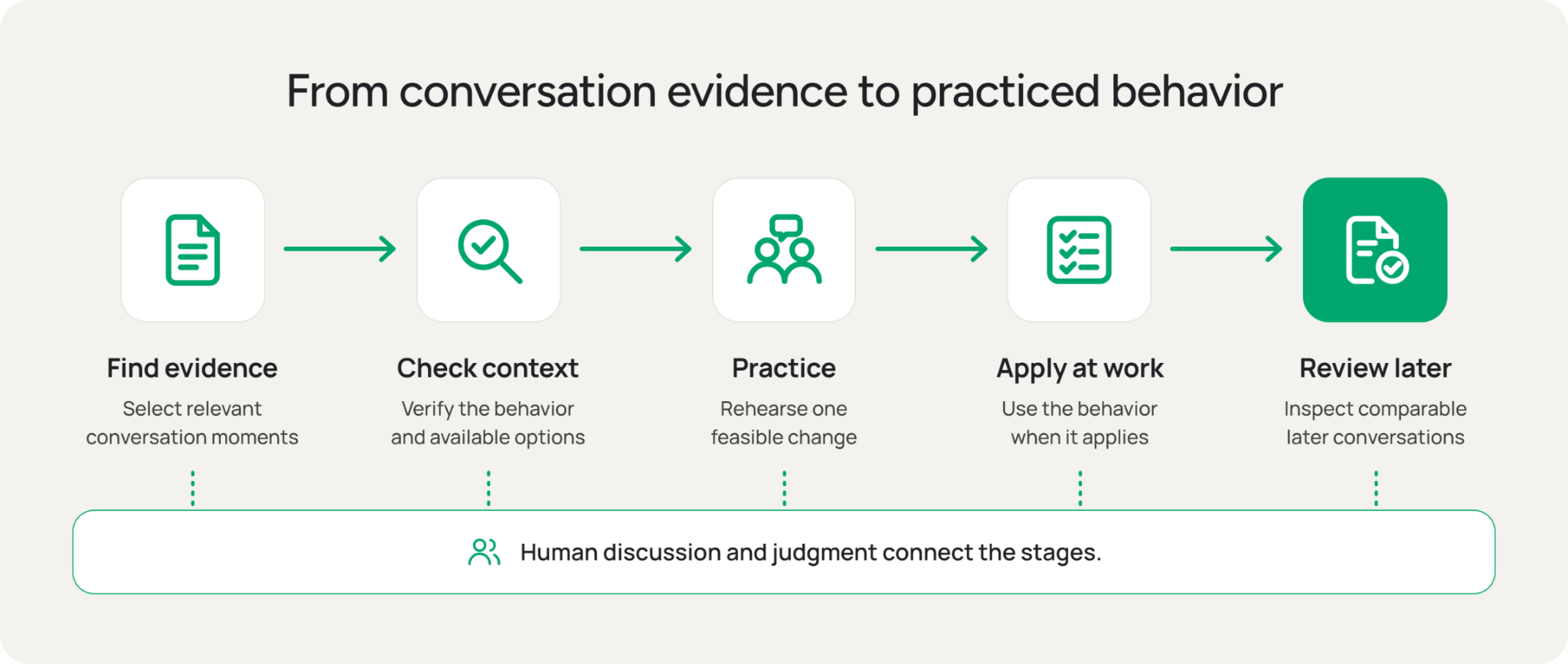
Start with an observable behavior, such as clarifying the request before proposing a solution or confirming the owner and timing of a follow-up. State when the behavior applies so that an exception is not treated as a routine failure.
Use examples from comparable interaction types, including strengths and uncertain cases. A simple inquiry and a complicated escalation provide different opportunities to demonstrate the same skill. Chordia's discussion of agent performance analytics explains why case context matters when interpreting patterns.
Open the relevant recording or transcript and check the surrounding turns. Confirm speaker attribution, the customer's actual request and any later clarification. Give the employee a chance to explain constraints or correct a mistaken interpretation.
Look for what was available at the time: the relevant policy, tool response, permission and information. If evidence is incomplete, record the uncertainty and seek more context. A plausible explanation from an AI system is not a substitute for checking the interaction.
A confirmed high-impact error may need prompt correction and the appropriate escalation. A lower-impact habit may be better addressed after several comparable examples. The timing should reflect the likely consequence, the evidence and the person's opportunity to learn.
Chordia's coaching timing guidance separates urgent issues from patterns to discuss later. A possible serious issue still needs timely investigation; "wait for a pattern" should not delay protective action. There is no universal number of calls or fixed weekly schedule that suits every coaching question.
Explore Chordia's Conversation Coaching approach and read the timing tips to plan feedback around evidence, the stakes and a practical next step.
Ask the employee what they were trying to achieve and what they notice in the example. Connect the observed behavior with the agreed standard, then work through a realistic alternative. Keep the discussion focused enough that the person can practise the change.
For a vague follow-up, practice might involve naming the responsible person, confirming a feasible channel and time, and checking the customer's understanding. Rehearse a similar scenario and discuss what to do when the timing is genuinely uncertain. Avoid asking employees to make commitments they cannot keep.
Agree who will review the follow-up, which comparable interactions matter and when the conversation will resume. Look for the practiced behavior in later evidence, including examples selected independently of automated flags. Recognize a sustained strength as well as an improvement.
If the behavior does not change, check whether the practice was clear and whether the person had the tools and opportunity to use it. Adjust the support or investigate a wider constraint. A better customer outcome can be encouraging, but it does not by itself prove that coaching caused the change.
Suppose a service conversation ends with an employee promising to send information. The customer asks when to expect it, but review of the full interaction confirms that no timing or follow-up agreement was established. The following is an illustrative coaching scenario, not a customer result.
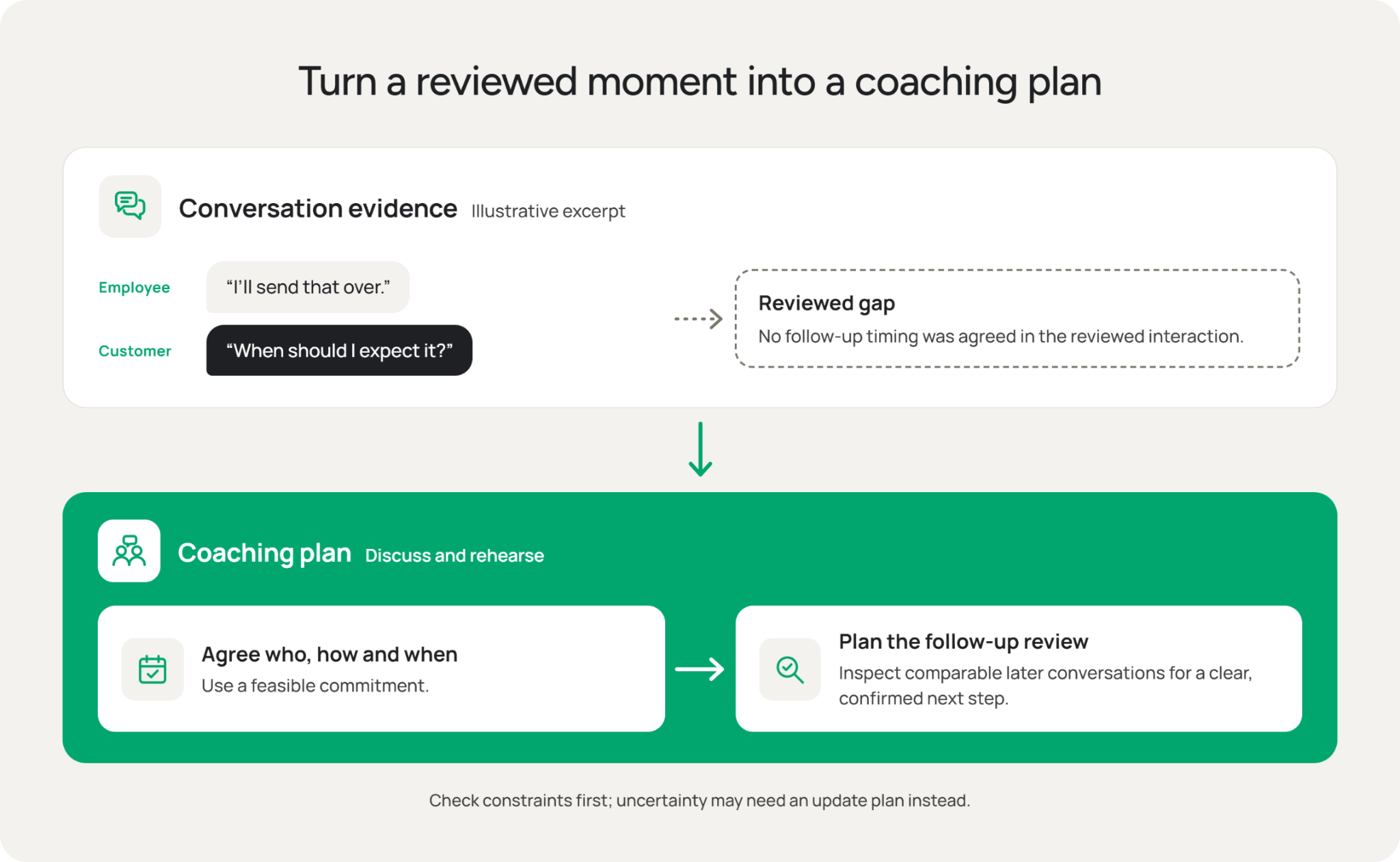
The coach should first ask whether a known delivery limit or unclear process prevented a precise commitment. If the employee had an available, reliable next step, the practice can focus on explaining and confirming it. If the timing was not knowable, practice communicating that uncertainty and agreeing who will provide an update.
Keep a short record of the agreed work.
| Coaching record | Illustrative entry |
|---|---|
| Evidence | Customer asked about timing; the reviewed interaction contained no agreed follow-up time |
| Behavior to practice | Confirm the responsible person, channel and feasible timing before closing |
| Practice | Rehearse a follow-up explanation and an alternative when timing is uncertain |
| Owner and review | Employee practices; supervisor reviews comparable follow-up conversations at the agreed check-in |
| What to inspect later | Whether the next step was clear and confirmed, with supporting conversation evidence |
This record supports a discussion. It should not become a checklist that overlooks the customer's actual question or the employee's circumstances.
Signals identify moments to inspect before choosing a response. Examples from Chordia's signal library include Active Listening Demonstrated, Customer Needs Restated, Customer Needs Fully Addressed and Evaluation Confidence Low.
Check the context behind each signal.
| Observed signal or pattern | Coaching question | Additional check |
|---|---|---|
| Customer needs were restated | Did the restatement capture the actual request? | Compare the customer's response and any correction |
| Some stated needs remained unanswered | Which question was left open? | Check whether another channel or later action addressed it |
| Strong active listening | Which behavior could the employee repeat? | Identify the specific turn and why it helped here |
| Low evaluation confidence | Is there enough evidence to form a view? | Resolve missing context or poor transcription before feedback |
Use a relevant set of conversations when looking for repetition. If all examples come from complaints or difficult escalations, that selection may not describe the person's usual work. State what was reviewed rather than inferring consistency from a handful of convenient records.
When an AI agent handles the conversation, the corrective task may involve its instructions, knowledge, tools or escalation logic. That work belongs in the AI-agent evaluation workflow, with retesting of relevant scenarios. A human coaching session and an AI configuration change need different owners and checks.
Choose a behavior that fits the work.
| Setting | Useful coaching focus | Context to retain |
|---|---|---|
| Retail and multi-location services | Clarify needs and explain the next step | Location practices, available services and customer constraints |
| Software sales and customer success | Discovery, expectation-setting and follow-through | Deal stage, account history and promises made by other teams |
| Healthcare administration | Explain scheduling, intake or billing steps clearly | Available information, permissions and sensitive-data handling |
| Financial services and insurance | Explain applicable steps accurately and confirm understanding | Current approved guidance and specialist escalation where needed |
These are possible applications, not claims of certified suitability or guaranteed results. Topic-specific requirements should be interpreted by the relevant specialists.
Give each role a clear contribution.
| Role | Contribution to coaching | Decision they support |
|---|---|---|
| Frontline Management | Discuss evidence, rehearse a behavior and check later examples | What should this employee practice next? |
| QA and enablement leaders | Calibrate criteria and prepare relevant learning examples | Are managers applying a shared, usable standard? |
| Customer Experience | Identify recurring confusion across interactions | Does the issue need individual coaching or a wider change? |
| Risk and Compliance | Review consequential interpretations and escalation needs | What needs prompt specialist attention? |
Begin with one behavior and a clear standard. Use evidence the employee can inspect, listen to their explanation and agree on a feasible practice. Keep coaching proportionate to the issue and route shared process barriers to someone who can address them.
For teams introducing supporting software, check whether it can connect the records the coach needs and preserve the evidence behind a recommendation. The guide to choosing conversation intelligence across existing systems sets out relevant integration questions. For a focused vendor shortlist, see our comparison of the best conversation coaching tools. The value of the workflow depends on what people learn and do with those records.
Compass connects interactions across supported sources and supports evidence-based coaching, quality review and findings intelligence. Bring representative conversations and test how your team can inspect a recommendation, agree on a response and review later evidence.


