

Pick a coaching tool that connects behavior, evidence and later follow-through.
The best conversation coaching tool helps a manager identify a specific behavior, review the supporting interaction and agree what an employee should practice. It also makes it possible to examine later conversations and see whether that behavior changed. A useful shortlist depends on whether you need coaching across customer relationships, a structured supervisor workflow, simulation practice or live help during calls.
For a broader category shortlist, see our best conversation intelligence tools guide. Compass by Chordia is our first editorial recommendation for teams that need conversation evidence and customer context across supported systems. NiCE, Cresta, CallMiner, Observe.AI and Gong offer credible alternatives with different emphases. This comparison explains which coaching job each is suited to and what to demonstrate before buying.
Choose according to the work your supervisors need.
| Tool | Recommended fit | Main buying test |
|---|---|---|
| 1. Compass | Coaching grounded in customer context across supported systems | Inspect a recommendation, its evidence and the relevant Customer Thread |
| 2. NiCE | Quality evaluation and coaching within a workforce engagement environment | Trace a quality finding into a coaching package and agent review |
| 3. Cresta | Coaching connected with quality analysis and simulation practice | Follow a behavior from evaluation into a plan and targeted rehearsal |
| 4. CallMiner | Conversation analytics linked to supervisor-agent coaching | Inspect a scored example, notification and two-way feedback |
| 5. Observe.AI | Evidence-backed coaching plans with human approval | Edit a proposed plan and inspect behavior tracking after coaching |
| 6. Gong | Revenue-team coaching and structured call feedback | Apply a sales scorecard and review coaching adoption |
Conversation coaching software uses evidence from interactions to help people improve how they handle customers. A coaching opportunity is a specific, changeable behavior worth discussing. The software should help the supervisor understand the moment, hear the employee's explanation and agree a feasible practice task.
Conversation intelligence supplies the wider analysis. A scorecard defines expected conduct. Our guide to moving from scorecard reviews to evidence-based coaching explains how reviewed evidence becomes learning and follow-through. The useful buying question is how those activities connect in daily work.
Live assistance supplies guidance during the customer interaction. A coaching session allows more discussion and rehearsal afterward. Some products connect both. Chordia's guide to what helps during live customer calls explains why timing and relevance matter. Buying live prompts alone does not establish that a manager can track a development plan.
Start with a situation your team needs to handle better, such as clarifying a customer need or agreeing the next step. Specify channels, languages and teams, then identify the records the product can actually receive. A claim to analyze every conversation needs a defined population of connected, eligible interactions. See sampling versus full coverage when defining that population.
If coaching spans sales and support, demonstrate the relevant customer history. Our guide to choosing conversation intelligence across existing systems provides useful integration questions. Confirm permissions, record matching and missing-data handling for your deployment.
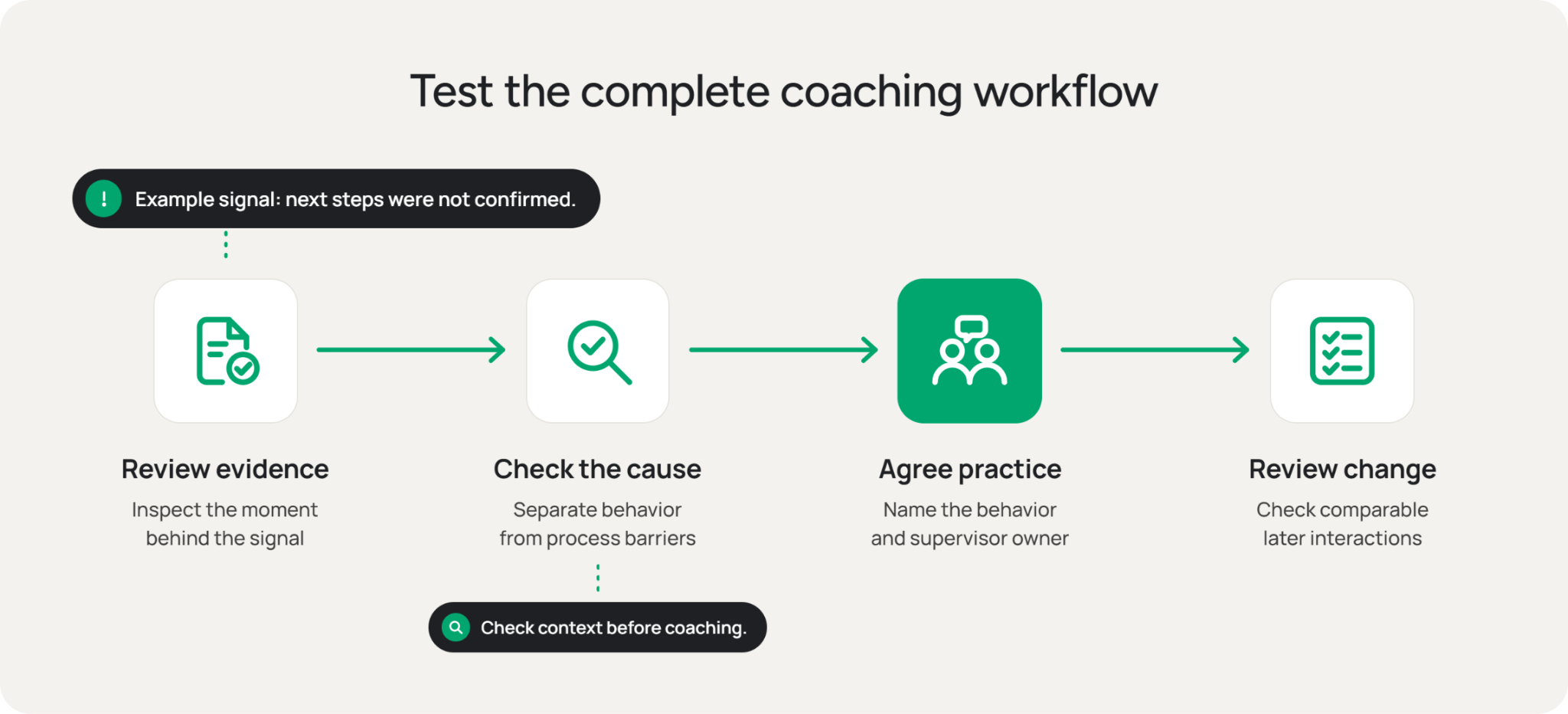
Open the passage behind a recommendation and verify the speaker, sequence and relevant context. Ask a supervisor to reject an incorrect recommendation and explain why. The buyer should see how the system handles that correction rather than accept a fluent explanation as proof.
An employee may lack a skill, or a process may prevent the expected action. Chordia's guide to process failures versus agent performance helps separate those causes. A broken booking system needs an operational response as well as any useful communication coaching.
Have a supervisor prepare a session, share evidence and agree a practice task with an employee. Record who owns the follow-up and when the team will review it. Where simulations are offered, check whether they practice the behavior your evaluation identified.
Test live assistance separately. Ask whether a prompt arrives soon enough to help, how many prompts the employee sees and whether supervisors can intervene appropriately. Confirm which assistance, simulation and coaching modules the quote includes.
Inspect comparable later interactions for the agreed behavior. Separate changes in employee conduct from changes in workload, customer difficulty or policy. A rise in a KPI after coaching is useful evidence to investigate, but timing alone does not prove the coaching caused it.
Request comparable quotes for ingestion, evaluation volume, supervisor seats, practice tools, implementation and ongoing administration. Include the work needed to maintain criteria and coach definitions. Use when to coach immediately versus wait for a pattern to discuss response timing rather than imposing a universal coaching schedule.
Test each vendor against the same workflow.
These matrices summarize documented workflows and the questions buyers should test. They are not accuracy benchmarks. Features may require configuration or separate modules. “Confirm” means demonstrate the requirement in the proposed package.
Compare how each tool prepares a useful session.
| Tool | Coaching input and evidence | Plan preparation |
|---|---|---|
| Compass | Conversation moments, customer context and behavior findings | Evidence-backed opportunities and examples of excellence for supervisor review |
| NiCE | AI quality scores, evaluation summaries and behavior evidence | Configurable evaluation forms and coaching packages |
| Cresta | Quality and outcome analysis with conversation examples | Personalized coaching plans and targeted simulation practice |
| CallMiner | Manual or automated scores and voice/text interaction examples | Trackable agent feedback and customizable coaching workflows |
| Observe.AI | Predefined and discovered behaviors with interaction evidence | Configurable Performance Agents draft editable coaching plans |
| Gong | Recorded calls, scorecards and AI-assisted call review | Structured feedback and best-practice call libraries |
Compare the work after a recommendation appears.
| Tool | Follow-through emphasis | Scope to demonstrate |
|---|---|---|
| Compass | Reviewed behavior evidence alongside wider findings and ownership | Later evidence review, supported connectors and task handoff |
| NiCE | Agent review of coaching packages and quality performance monitoring | Licensed coaching/QM tier, permissions and external-source scope |
| Cresta | Coaching progress tracking and practice linked to real interactions | Coaching, simulation and live-assist licensing and integration |
| CallMiner | Trackable notifications, agent-supervisor dialogue and performance views | Selected modules, analytical ownership and API/export requirements |
| Observe.AI | Human plan approval and subsequent behavior tracking | Performance Agents configuration, data scope and cohort reporting |
| Gong | Scorecard adoption and coaching statistics for revenue teams | Enable plan, seats and the exact interaction types captured |
Our first choice when a coaching issue needs customer context across supported systems and a clear route into action by the right team.
Compass connects supported interactions into a Customer Thread. Its Conversation Coaching solution identifies opportunities and examples of excellence, with quotes, timestamps and context. Compass separates expected call difficulty from agent contribution (lift) so supervisors compare agents on what the agent actually controlled, not on who got the easier calls.
The editorial case for Compass is shared context: a supervisor can investigate whether a difficult conversation reflects an employee behavior, an earlier promise or a process barrier. Conversation Quality, Compliance and Findings Intelligence support related review and ownership decisions.Findings Intelligence is the layer the other tools don’t have. It pulls findings from across the business, ranks by impact, attaches a next action, and routes each one to the right person within the organization.
Validate connectors, permissions and your required coaching-task workflow. Obtain current assurance documentation through Chordia's security and trust information and resolve mandatory requirements during procurement.
Multi-location service teams can review explanations and follow-through across locations. Teams handling longer customer relationships can examine earlier interactions before coaching the latest employee. These are editorial workflow applications, subject to source availability and governance.
Frontline supervisors, operations leaders and CX owners who need to connect an employee learning task with broader customer context. Include a process owner when the remedy extends beyond coaching.
No independent Compass product award was verified for this comparison. First place reflects Chordia's editorial assessment of the defined workflow rather than a comparative test win.
The Chordia G2 profile does not yet provide a substantive review sample. Request references from teams with a similar operating model and test representative conversations before purchase.
A strong option when contact-center coaching needs to sit inside an established quality and workforce engagement program.
NiCE Quality Management documents AI-assisted scoring, evaluation summaries and recommendations for coaching. Its employee interface provides coaching packages for review and completion. Configurable forms and feedback support the supervisor's process. Confirm the licensed QM and coaching capabilities in your proposal.
The strength is an established connection between quality evaluation and workforce workflows. Chordia's NiCE comparison explains the complementary case for adding broader conversation intelligence to an existing CXone environment.
Test external-source coverage and the workflow your licenses support. Choose Compass instead when coaching needs evidence from customer interactions across supported business systems. Existing CXone customers can evaluate coexistence rather than treating this as a full-suite replacement.
Customer-service operations with established QA processes are a practical application inferred from the documented workflow. In healthcare or financial services, validate your required controls and configuration separately.
QA managers, contact-center supervisors, workforce engagement leaders and CXone program owners.
NiCE reports Leader positioning in QKS Group's 2025 SPARK Matrix for Workforce Engagement Management. The category covers a broader operating suite and does not establish comparative coaching accuracy.
TrustRadius reviewers describe useful statistics and an integrated workspace, alongside individual usability and session issues. Many reviews are incentivized and concern the whole suite. Test the actual coaching module rather than applying suite feedback as a coaching verdict.
Explore Chordia's coaching approach and use the timing guide to decide which evidence calls for an immediate conversation and which needs a broader review. Bring an example your supervisors currently find difficult to coach.
Explore Conversation Coaching Read the Coaching Timing Guide
A strong option for contact centers that want conversation analysis to connect with personalized coaching and targeted simulation practice.
Cresta documents behavior evaluation, coaching plans using real examples and tracking after coaching. Use Chordia's Cresta comparison to frame the customer-journey and contact-center scope discussion. It also offers simulation training based on customer conversations and live guidance through its wider offering. Buyers should confirm the components included in their proposal.
The main strength is the connection between analysis, teaching examples and rehearsal. Test whether a simulated session actually exercises the skill that needs development, then inspect later real interactions.
Validate configuration effort, languages and the required product bundle. Choose Compass instead when the key need is customer history spanning supported business systems and accountable findings beyond the contact-center coaching workflow. Cresta remains compelling when simulation practice and live assistance carry more weight.
Cresta's product material includes airline, healthcare and financial-services examples. Those examples support consideration for service operations, without establishing suitability for every organization's data or assurance requirements.
Contact-center coaching leaders, learning teams, QA leaders and operations owners who want practice linked to evaluated interactions.
Cresta reports Leader placement in The Forrester Wave for Conversation Intelligence Solutions for Contact Centers, Q2 2025. The recognition covers the broader category and does not establish a coaching accuracy ranking for this article.
Recent G2 seller-profile reviews praise call insights, reporting and customer-team responsiveness. The profile covers a broader portfolio, while newer component profiles have limited review evidence. Test the particular coaching and simulation configuration you plan to buy.
A strong option when coaching sits alongside a broader conversation analytics program with established analytical ownership.
CallMiner Coach uses manual or automated evaluation criteria to identify behaviors for guidance or reinforcement. Its documented workflow includes trackable agent notifications, interaction snippets, performance dashboards and two-way supervisor-agent engagement. API connections support integration with other business applications.
The strength is coaching grounded in a wider analytics workflow, with employee feedback on circumstances outside their control. Chordia's CallMiner comparison supplies useful scope questions.
Validate who maintains evaluation categories, reports and coaching workflows, plus the modules included. Choose Compass instead when a continuous Customer Thread and shared findings ownership define the buying need.
CallMiner's public materials include financial services, healthcare, retail and travel applications. Test the relevant interaction types and data controls rather than inferring suitability from an industry label.
Conversation analytics leaders, QA managers, coaching supervisors and CX operations teams.
CallMiner reports Leader recognition in The Forrester Wave for Conversation Intelligence Solutions for Contact Centers, Q2 2025. This concerns the broader category rather than an independent coaching test conducted for this article.
An April 2026 G2 reviewer praises analysis and Coach while requesting more API filtering and usage detail. Some reviews are incentivized. Test your exports and operational reporting, without treating one review as a current universal restriction.
A strong option for customer-operations teams that want software to prepare coaching plans while supervisors review and approve them.
Observe.AI's Performance Agents identify relevant behaviors, assemble evidence and draft editable plans. Supervisors retain approval, and subsequent interactions support behavior tracking. Its wider offering includes live assistance, which should be evaluated as a separate workflow.
The strength is a defined connection from interaction evidence to a human-approved plan and subsequent review. Chordia's Observe.AI comparison helps frame the operating-scope discussion. Current product evidence should govern feature judgments.
Test the configured behaviors, reporting and handoff into the supervisor's routine. Choose Compass instead when customer history across supported systems and action by several business teams define the purchase. Observe.AI is credible when its customer-operations suite and editable coaching plans fit the existing program.
Service operations with repeatable coaching standards are a practical application inferred from the documented workflow. Validate sector-specific data requirements and relevant customer references.
QA leaders, contact-center supervisors, coaching program owners and customer-operations teams that need consistent review and approval.
Observe.AI reports Pioneer recognition in CMP Research's 2025 Prism for Automated QA and QM. It concerns an adjacent evaluation category and does not independently validate the newer Performance Agents workflow.
A March 2026 Gartner Peer Insights review praises evaluation and trend analysis while describing administrative and support difficulties. This is one deployment experience, predating the September Performance Agents launch. Use it to plan adoption questions rather than rate the new coaching product.
A strong option when the primary coaching job is developing sales conversations and reinforcing a revenue team's methodology.
Gong documents structured call scorecards, AI-assisted call review, coaching statistics and best-practice libraries. Its scorecard examples include discovery, demos, customer-success kickoffs and QBRs. Access depends on plan and seat, so confirm the Enable capabilities included.
Its strength is a revenue-centered coaching workflow with account and deal context. Chordia's Gong comparison helps buyers consider how far their requirement extends beyond that focus.
Test capture permissions, the scorecard and how managers use feedback in discussion. Choose Compass instead when coaching must connect sales, service and operational findings across supported systems. Gong remains a credible fit for revenue enablement, including documented post-sale use cases.
B2B sales and customer-success teams are a practical application of the documented scorecards. Broader service or compliance coaching requires demonstration against the intended workflow.
Sales managers, revenue operations leaders, enablement teams and customer-success managers coaching commercial conversations.
Gong reports Leader recognition in The Forrester Wave for Revenue Orchestration Platforms for B2B, Q3 2024. The category and year matter. This is not a contact-center coaching award.
G2 reviewers describe useful call review and peer examples, with individual concerns about transcripts and notifications. These observations support a pilot using your terminology, recording setup and manager workflow rather than a generic product score.
Start by checking what your current contract already includes. An existing quality module may provide evaluation forms, feedback and coaching packages with less procurement work. Chordia's built-in CCaaS QA comparison frames the question of evidence beyond the telephony environment.
Evaluate the actual vendor and tier. CCaaS QA is a category, not one product with a uniform feature set. Compare your existing workflow with Compass on the same evidence, ownership and later-review requirements.
A custom workflow can help a team explore transcript feedback or implement specialized criteria. Chordia's DIY LLM comparison highlights the infrastructure question behind a transcript experiment.
Budget for ingestion, permissions, evidence references, evaluation tests, corrections, task history and monitoring. These controls can be engineered. Compare the ongoing cost and ownership of that work with a packaged product, using the same review and coaching tests.
Use signals to investigate a specific learning need.
| Example signal | What the reviewer should check | Coaching and later-review test |
|---|---|---|
| Next Steps Confirmed | Who will act, through which channel and by when | Practice a feasible commitment, then inspect comparable follow-through |
| Customer Needs Fully Addressed | Whether the response resolves the expressed need | Rehearse checking for unresolved needs, then review later examples |
| Active Listening Demonstrated | Whether the employee acknowledges and uses relevant customer information | Practice a clarification, then inspect its use in context |
| Evaluation Confidence Low | Whether transcript quality or context makes the assessment uncertain | Send for human review before assigning a learning task |
These examples use Chordia's Signal Library as a vocabulary for the pilot. Ask every vendor to implement equivalent observable criteria. A flag alone does not establish fault, and low evaluation confidence is a review requirement rather than an employee skill deficit.
Match the workflow to the operating setting.
| Setting | Products to consider | Workflow to demonstrate |
|---|---|---|
| Multi-location services | Compass, CallMiner | Evidence and follow-up across locations using comparable situations |
| Contact-center onboarding | NiCE, Cresta, Observe.AI | A specific skill, practice plan and later behavior review |
| Call-heavy sales or service | Cresta, NiCE | Useful live guidance alongside supervisor coaching |
| Longer customer relationships | Compass, Gong | Earlier promises and related interactions informing a coaching decision |
| Healthcare or financial-service operations | Any shortlisted product meeting procurement requirements | Access controls, relevant evidence and sector-specific approval before use |
These are editorial fit assessments based on workflows. They do not imply regulatory approval or a customer outcome.
Each role should test its own daily work.
| Role | Buying question | Product fit to investigate |
|---|---|---|
| Frontline supervisor | Can I prepare and follow up a specific session? | All six, with different emphasis on live help and planned coaching |
| Coaching program owner | Can we maintain standards and inspect adoption? | NiCE, CallMiner, Cresta and Observe.AI |
| Customer Experience leader | Does recurring friction require coaching or process work? | Compass and broader analytics/coaching offerings |
| Sales or service enablement leader | Can staff practice and adopt relevant behaviors? | Gong for revenue coaching, Cresta for contact-center practice |
| Operations and procurement | Will the workflow fit our sources and required controls? | Every shortlisted product, assessed against the same scope |
Choose Compass first when coaching depends on understanding customer history across supported systems and connecting the learning task with wider findings and ownership. Validate that proposition on your own conversations and resolve any integration or assurance requirements before purchase.
Shortlist NiCE when coaching belongs within an established workforce engagement program, and CallMiner when conversation analytics and supervisor feedback lead the decision. Consider Cresta for coaching linked to practice, Observe.AI for editable evidence-backed plans, and Gong for revenue-team development. Check existing CCaaS capabilities and the cost of maintaining a custom LLM workflow before adding another product.
Give each vendor the same representative interactions. Ask a supervisor to check the evidence, hear the employee's context, agree a practice task and review comparable later work. That demonstration will reveal more about fit than a generic feature checklist.
See how Compass connects coaching opportunities with conversation evidence and customer context. Bring representative interactions to a demo and examine how your supervisors would review the findings and decide the next step.
The order reflects our editorial assessment for the stated use cases, using public product information and qualitative reviews checked in October 2026. We did not conduct a controlled comparative product test. Vendor claims and individual reviews do not guarantee results. Product scope and commercial terms require confirmation.


